When most of us think of salmon and pinnipeds and Seattle, one of the first characters to come to mind is Herschel. Herschel was a California sea lion who famously camped out at the Hiram M. Chittenden Locks in the early 1980s. With a few of his conspecifics, he spent several years enthusiastically catching salmon when they tried to swim past the locks to spawn. State and federal officials watched Herschel and his cohort with growing alarm as dozens of steelhead disappeared down their gullets. To dissuade the sea lions, officials detonated seal bombs, they piped unpleasant sounds through underwater speakers, they piloted a fiberglass orca named Fake Willy, among other interventions. Nothing worked.
Herschel’s comings and goings eventually attracted national attention; he was even profiled in the Los Angeles Times. And California sea lions continue to bedevil officials all along the west coast, as they struggle to prevent the animals, at times lethally, from consuming dwindling salmon stocks. But in recent years another pinniped has started to attract the attention, if not quite the ire (yet) of state salmon officials: the considerably more humble harbor seal.
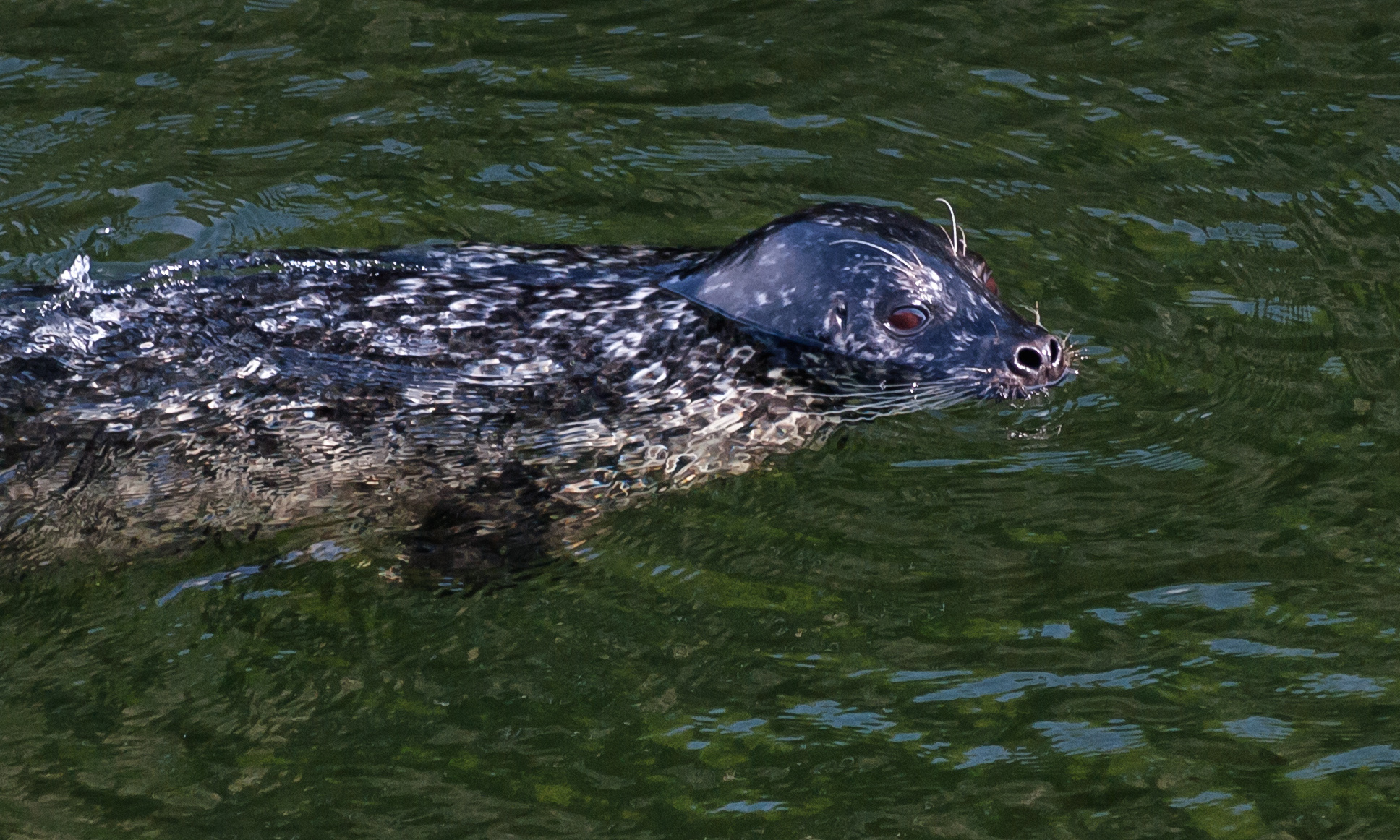
Harbor seals are a common if at times subtle inhabitant of the Salish Sea. At their largest they grow to be more than five feet long and weigh close to 250 pounds. (For his part, Herschel tipped the scales at more than 800 pounds.) Stare at Puget Sound long enough these days, and before long you are likely to see a pair of large, black, globular eyes staring back at you, as a harbor seal floats with just the tip of its head above the water.
This wasn’t always the case. “In a way, harbor seals are a conservation success story,” says Casey Clark, a biologist with the Washington Department of Fish and Wildlife (WDFW) who spoke of them at the Salish Sea Ecosystem Conference last April. Their population has rebounded after historic lows, when they were killed in droves of the west coast of North America. WDFW now divides the state’s seals into four stocks: a coastal stock, which went from 6,000 animals in 1980 to about 17,000 now; a northern inland stock in Puget Sound, which currently has about 16,000 animals; and two smaller stocks in southern Puget Sound (about 2,500 animals) and Hood Canal (about 3,000 animals). WDFW biologists consider these stocks to be relatively stable; some have been so for nearly thirty years. “There’s a perception that seal populations have grown out of control, and they continue to grow,” Clark says, “but that isn’t true.”
But many salmon stocks, especially in Puget Sound, continue to not do terribly well. Seals are generalist predators and eat a wide variety of prey, and they are known to catch salmon when they can. In south Puget Sound, for instance, they might eat up to one-third of steelhead smolts migrating out of the Nisqually River each year, according to data from the National Oceanographic and Atmospheric Administration (NOAA).
There is growing pressure on the state, then, to “Do Something About This,” as Clark puts it. (When he says the phrase, his intonation makes it clear each word is capitalized.) The challenge, though, is that biologists are still trying to determine seals’ true impact on salmon. Seals eat salmon, yes, but do they do so all the time? And how much does their consumption vary from year to year? On top of that, problems with seals, Clark says, tend to be highly localized, at places like the Ballard Locks, or certain estuaries. These local challenges, in turn, drive a perception of larger problems that might not be wholly accurate.