

Species: Contia tenuis
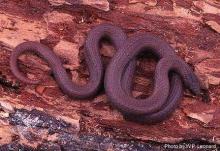
Common Sharp-tailed Snake
Species
Encyclopedia of Puget Sound

Articles:
This article was originally published by the Washington Department of Fish and Wildlife as part of its annual report Threatened and Endangered Wildlife in Washington.
Classification
Kingdom
Animalia
Phylum
Craniata
Class
Reptilia
Order
Squamata
Family
Colubridae
Genus
Contia
NatureServe

Classification
Informal Taxonomy
Animals, Vertebrates - Reptiles - Snakes
Formal Taxonomy
Animalia - Craniata - Reptilia - Squamata - Colubridae - Contia - , with a smaller range extending from west-central Oregon to the Monterey Bay region of central California.
Ecology and Life History
Habitat Type Description
Terrestrial
Migration
true - false - false
Non-migrant
true
Locally Migrant
false
Food Comments
Diet apparently is restricted primarily to slugs.
Reproduction Comments
Reproductive females deposit a clutch of up to 9 egg probably in June or July.
Conservation Status
NatureServe Global Status Rank
G5
Global Status Last Reviewed
2010-08-23
Global Status Last Changed
2010-08-23
Distribution
Conservation Status Map
<img src="http://www.natureserve.org/explorer/servlet/GetMapGif?CA.BC=S1&US.CA=S5&US.OR=S4&US.WA=S3" alt="Conservation Status Map" style="width: 475px; height: auto;" />
Global Range
The range extends from northern and central California (along the Coast Ranges south to San Luis Obispo County and the Sierra Nevada south to Tulare County) northward to the Willamette Valley, Oregon, and also includes the Puget Lowland southwest of Tacoma (at least formerly) and scattered locations on the east side of the Cascades in Washington and north-central Oregon, as well as the southern end of Vancouver Island and the nearby Gulf Islands of British Columbia, at elevations from sea level to around 2,010 meters (6,600 feet) (Nussbaum et al. 1983, Brown et al. 1995, Leonard and Ovaska 1998, St. John 2002, Stebbins 2003, Feldman and Hoyer 2010). A record from near McGillivray Lake in south-central British Columbia needs confirmation (Stebbins 2003).