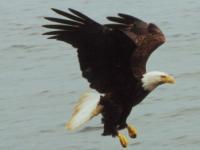
Species: Haliaeetus leucocephalus

Bald Eagle
Species
    Haliaeetus leucocephalus

    Adults have a white head, white tail, and a large bright yellow bill; elsewhere the plumage is dark. Immatures are dark with variable amounts of light splotching on the body, underwing coverts, flight feathers, and tail base; averages 79-94 cm long, 178-229 cm wingspan (NGS 1983).

    Science Review:

    Articles:

    Predator–prey dynamics of bald eagles and glaucous‐winged gulls

    An unintended consequence of the recovery of bald eagles (Haliaeetus leucocephalus) has been the impact on seabirds. The authors of a 2019 paper published in Ecology and Evolution suggest that the effects of bald eagle activity on a large glaucous-winged gull (Larus glaucescens) colony on Protection Island in the Strait of Juan de Fuca include the possibility of coexistence but also the possibility of gull colony extinction.

    Glaucous-winged gulls in flight at Protection Island National Wildlife Refuge. Photo: Peter Davis/U.S. Fish and Wildlife Service
    Declines in marine birds trouble scientists

    Why did all the grebes leave? Where did they go? And what does their disappearance say about the health of the Salish Sea? Seasonal declines among some regional bird species could hold important clues to the overall health of the ecosystem.

    Western grebe. Public Pier, Blaine, WA. Photo: Andrew Reding https://www.flickr.com/photos/seaotter/10298390254
    Bald Eagle (Haliaeetus leucocephalus)

    This article was originally published by the Washington Department of Fish and Wildlife as part of its annual report Threatened and Endangered Wildlife in Washington.
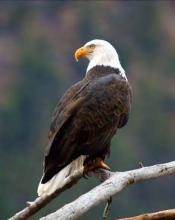
    Bald eagle at Blue Lake, Sinlahekin WLA (photo by Justin Haug).
    Bald eagles

    The Puget Sound region has the highest densities of bald eagles in Washington. Breeding pairs initiate nesting activities in January or February. 
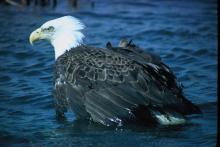
    Bald eagle (Haliaetus leucocephalus). Image courtesy U.S. Fish and Wildlife Service.
    Kingdom
    Animalia
    Phylum
    Craniata
    Class

    Aves

    Order

    Falconiformes

    Family

    Accipitridae

    Genus

    Haliaeetus

    Classification
    Other Global Common Names
    pygargue à tête blanche - Águila Cabeza Blanca
    Informal Taxonomy
    <p>Animals, Vertebrates - Birds - Raptors</p>
    Formal Taxonomy
    Animalia - Craniata - Aves - Falconiformes - Accipitridae - Haliaeetus - (AOU 1998).

    Adults have a white head, white tail, and a large bright yellow bill; elsewhere the plumage is dark. Immatures are dark with variable amounts of light splotching on the body, underwing coverts, flight feathers, and tail base; averages 79-94 cm long, 178-229 cm wingspan (NGS 1983).

    Short General Description
    Bald eagle. Mature adults have a white head and tail.
    Migration
    <p>true - true - true - 55,000 square kilometers (Grubb et al. 1994). Maximum distance between feeding area and night roost site was less than 16 km in winter in Missouri (Griffin et al. 1982). In north-central Arizona, February-April home range of immatures averaged 400 square kilometers; birds moved frequently and roosted singly or in small groups (Grubb et al. 1989).</p>
    Non-migrant
    true
    Locally Migrant
    true
    Food Comments
    Feeds opportunistically on fishes, injured waterfowl and seabirds, various mammals, and carrion (Terres 1980). See Haywood and Ohmart (1986), Kralovec et al. (1992), Brown (1993), and Grubb (1995) for diet of inland breeding populations in Arizona, Colorado, and Wyoming. Hunts live prey, scavenges, and pirates food from other birds (e.g., osprey) and, in Alaska, sea otter (Watt et al. 1995, Condor 97:588-590). See Palmer (1988) for further information on hunting methods. In the Columbia River estuary, tidal flats and water less than 4 m deep were important foraging habitats (Watson et al. 1991). See Caton et al. (1992) for information on foraging perches used in Montana. Sheep carcasses were significant food sources in winter in Oregon (Marr et al. 1995, Wilson Bulletin 107:251-257).
    Reproduction Comments
    Clutch size is 1-3 (usually 2). Incubation lasts about 5 weeks, by both sexes. Second hatched young often dies. Young first fly at 10-12.5 weeks, cared for by adults and may remain around nest for several weeks after fledging. Generally first breeds at about 5-6 years. Adults may not lay every year.
    Ecology Comments
    Commonly roosts communally, especially in winter. See Curnutt (1992) for information on the dynamics of a year-round communal roost in southern Florida. <br><br>In Montana, the introduction of shrimp (MYSIS RELICTA) had a cascading effect through the food chain, ultimately causing displacement of bald eagles (Spencer et al. 1991).
    Length
    94
    Weight
    5244
    NatureServe Global Status Rank
    G5
    Global Status Last Reviewed
    2005-03-11
    Global Status Last Changed
    2005-03-11
    Conservation Status Map
    <img src="http://www.natureserve.org/explorer/servlet/GetMapGif?CA.AB=S4&CA.BC=S5&CA.LB=S4&CA.MB=S4&CA.NB=S3&CA.NF=S4&CA.NT=S4&CA.NS=S4&CA.NU=__&CA.ON=S4&CA.PE=S4&CA.QC=S3&CA.SK=S5&CA.YT=S4&US.AL=S3&US.AK=S5&US.AZ=S2&US.AR=S2&US.CA=S2&US.CO=S1&US.CT=S1&US.DE=S2&US.DC=SX&US.FL=S3&US.GA=S2&US.ID=S3&US.IL=S2&US.IN=S2&US.IA=S3&US.KS=S2&US.KY=S2&US.LA=S3&US.ME=S4&US.MD=S2&US.MA=S2&US.MI=S4&US.MN=S3&US.MS=S2&US.MO=S3&US.MT=S3&US.NN=__&US.NE=S3&US.NV=S1&US.NH=S2&US.NJ=S1&US.NM=S1&US.NY=S2&US.NC=S3&US.ND=S1&US.OH=S2&US.OK=S2&US.OR=S4&US.PA=S2&US.RI=S1&US.SC=S2&US.SD=S1&US.TN=S3&US.TX=S3&US.UT=S1&US.VT=S1&US.VA=S2&US.WA=S4&US.WV=S2&US.WI=S4&US.WY=S3" alt="Conservation Status Map" style="width: 475px; height: auto;" />
    Global Range
    H - >2,500,000 square km (greater than 1,000,000 square miles) - H - Breeding range extends from central Alaska, northern Yukon, northwestern and southern Mackenzie, northern Saskatchewan, northern Manitoba, central Ontario, central Quebec, Labrador, and Newfoundland south locally to the Commander and Aleutian Islands, southern Alaska, Baja California (both coasts), Sonora (Brown et al. 1988), New Mexico, Arizona, Texas Gulf Coast, and Florida (including the Keys); breeding is very localized in the Great Basin and prairie and plains regions in interior North America, where the the breeding range recently has expanded to include Nebraska and Kansas. In Arizona, nesting occurs primarily along the Salt and Verde rivers in the central part of the state; only a few pairs nest in the western part of the state (http://www.swbemc.org/nest_sites.html). In Nevada, the few nesting pairs are primarily in the west-central part of the state, with another nesting area in extreme southern Elko County (GBBO 2010). <br><br>In the nonbreeding season, bald eagles occur generally throughout the breeding range except in the far north (AOU 1983, Sibley and Monroe 1990), most commonly from southern Alaska and southern Canada southward. The Chilkat Bald Eagle Preserve, Alaska, supports the largest wintering population anywhere (Ehrlich et al. 1992). Winter concentrations occur in British Columbia-northwestern Washington, along the Missouri and Mississippi rivers, and in northern Arkansas. One of the largest fall (mid-October to mid-December) migrant concentrations (200-300 birds at any one time, close to a thousand individuals through the season) occurs at Hauser Lake near Helena, Montana.
    Global Range Code
    H
    Global Range Description
    >2,500,000 square km (greater than 1,000,000 square miles)
    ELEMENT_GLOBAL.2.104470