

Species: Melanitta perspicillata
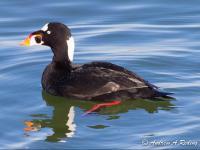
Surf Scoter
Species
Show on Lists
Encyclopedia of Puget Sound
Science Review:
Articles:
A December 2013 report identifies marine and terrestrial bird species for use as indicators within the Puget Sound Partnership's "Vital Signs" for ecosystem health.

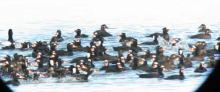
This paper examines the importance of prey size to shifting scoter populations in two bays in north Puget Sound.
More than 70 bird species regularly utilize Puget Sound during some or all stages of their life histories, but only a portion of these are actively being investigated.

Classification
Kingdom
Animalia
Phylum
Craniata
Class
Aves
Order
Anseriformes
Family
Anatidae
Genus
Melanitta
NatureServe

Classification
Other Global Common Names
Negreta Nuca Blanca - macreuse à front blanc
Informal Taxonomy
<p>Animals, Vertebrates - Birds - Waterfowl</p>
Formal Taxonomy
Animalia - Craniata - Aves - Anseriformes - Anatidae - Melanitta
Ecology and Life History
Migration
<p>false - false - true - Migrates northward in flocks along coast with peak in April-May. Migrates southward from breeding grounds late August-October. In Beaufort Sea area, westward migration of males to molting areas occurs in late spring-early summer.</p>
Non-migrant
false
Locally Migrant
false
Food Comments
Eats mainly invertebrates; mollusks (especially blue mussel and other bivalves), crustaceans and aquatic insects. In summer also some plant food (pondweeds, wild celery, muskgrass and seeds of sedges and bulrushes). May dive to depths of 2-9 m and stay under water 19-32 seconds (Terres 1980).
Reproduction Comments
Breeding begins generally around mid-June. In northern Quebec, egg laying began in the first week of June; hatching occurred in the second and third weeks of July (Savard and Lamothe, 1991, Can. Field-Nat. 105:488-496). Clutch size is 5-8. Incubation is done by female (male departs). Precocial young are tended by female.
Length
51
Weight
1000
Conservation Status
NatureServe Global Status Rank
G5
Global Status Last Reviewed
1996-11-21
Global Status Last Changed
1996-11-21
Other Status
<p>LC - Least concern</p>
Distribution
Conservation Status Map
<img src="http://www.natureserve.org/explorer/servlet/GetMapGif?CA.AB=__&CA.BC=S3&CA.LB=S5&CA.MB=S4&CA.NB=__&CA.NF=__&CA.NT=S3&CA.NS=__&CA.ON=S4&CA.PE=__&CA.QC=S4&CA.SK=S4&CA.YT=S3&US.AL=__&US.AK=S4&US.AZ=__&US.AR=__&US.CA=__&US.CO=__&US.CT=__&US.DE=__&US.FL=__&US.GA=S4&US.ID=__&US.IL=__&US.IN=__&US.IA=__&US.KS=__&US.KY=__&US.LA=__&US.ME=__&US.MD=__&US.MA=__&US.MI=__&US.MN=__&US.MS=__&US.MO=__&US.NH=__&US.NJ=__&US.NY=__&US.NC=__&US.ND=__&US.OH=__&US.OR=__&US.PA=__&US.RI=__&US.SC=__&US.SD=__&US.TN=__&US.TX=__&US.UT=__&US.VT=__&US.VA=__&US.WA=__&US.WV=__&US.WI=__" alt="Conservation Status Map" style="width: 475px; height: auto;" />
Global Range
H - >2,500,000 square km (greater than 1,000,000 square miles) - H - BREEDS: western Alaska (scattered nesting in northern Alaska?), Mackenzie Delta, northern Prairie Provinces, to James Bay and Newfoundland; central Labrador; possibly northeastern Siberia. WINTERS: primarily coastal from Aleutian Islands to Baja California and Gulf of California (mainly coast of southeastern Alaska and British Columbia, also the coast near San Diego); Nova Scotia to Florida, Gulf Coast (rarely); Great Lakes; casual in other areas; accidental in Hawaii (Oahu). In the early 1990s, USFWS Winter Sea Duck Survey in eastern North America found the highest densities of scoters (all species) in Virginia, New York, Maine, and Massachusetts (descending order of abundance, Kehoe 1994).
Global Range Code
H
Global Range Description
>2,500,000 square km (greater than 1,000,000 square miles)