Species: Pseudacris regilla

Northern Pacific Chorus Frog
Species

    Dorsal color highly variable: usually green or brown, but also gray, tan, bronze, blackish, or reddish, often with irregular dark spots or blotches ; toe tips expanded; dark stripe from snout to shoulder; snout-vent length up to about 5 cm. Mature male: dark throat; breeding call is a loud repeated kreck-ek. Larvae: brown or olive, often with spotting or mottling; eyes wide apart, at margin of head when viewed from above; to about 44 mm long. Egg masses: soft loose clumps of around 10-80 eggs, attached to objects in shallow water; each eggs surrounded by two jelly envelopes (requires magnification).

    Articles:

    Reports: Sauk-Suiattle amphibian surveys

    The Sauk-Suiattle Indian Tribe conducts annual surveys of amphibian egg masses in the Reservation Slough wetland near the Sauk River.
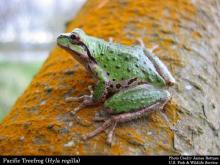
    Pacific Treefrog; photo by James Bettaso, U.S. Fish and Wildlife Service
    Kingdom
    Animalia
    Phylum
    Craniata
    Class

    Amphibia

    Order

    Anura

    Family

    Hylidae

    Genus

    Pseudacris

    Classification
    Informal Taxonomy
    Animals, Vertebrates - Amphibians - Frogs and Toads
    Formal Taxonomy
    Animalia - Craniata - Amphibia - Anura - Hylidae - Pseudacris - .

    Dorsal color highly variable: usually green or brown, but also gray, tan, bronze, blackish, or reddish, often with irregular dark spots or blotches ; toe tips expanded; dark stripe from snout to shoulder; snout-vent length up to about 5 cm. Mature male: dark throat; breeding call is a loud repeated kreck-ek. Larvae: brown or olive, often with spotting or mottling; eyes wide apart, at margin of head when viewed from above; to about 44 mm long. Egg masses: soft loose clumps of around 10-80 eggs, attached to objects in shallow water; each eggs surrounded by two jelly envelopes (requires magnification).

    Migration
    false - false - false - Individuals migrate up to several hundred meters between breeding sites and nonbreeding upland habitats.
    Non-migrant
    false
    Locally Migrant
    false
    Food Comments
    Known to eat beetles, flies, spiders, ants, and ispopods, etc. Larvae scape periphyton off rocks, eat filamentous algae and epiphytic diatoms in floating mats, bottom feed on benthic detritus, and surface feed on films of diatoms and pollen (Kupferberg et al., Copeia 1994:446-457).
    Reproduction Comments
    >
    Ecology Comments
    Larvae are preyed upon by carnivorous aquatic insects, bullfrogs, garter snakes, and many birds and mammals. Important predators on adults include garter snakes.
    Length
    5
    NatureServe Global Status Rank
    G5
    Global Status Last Reviewed
    2008-11-03
    Global Status Last Changed
    2001-11-13
    Other Status

    LC - Least concern

    Conservation Status Map
    <img src="http://www.natureserve.org/explorer/servlet/GetMapGif?CA.BC=S5&US.AK=SNR&US.CA=SNR&US.MT=S4&US.OR=S5&US.WA=S5" alt="Conservation Status Map" style="width: 475px; height: auto;" />
    Global Range
    G - 200,000-2,500,000 square km (about 80,000-1,000,000 square miles) - G - >
    Global Range Code
    G
    Global Range Description
    200,000-2,500,000 square km (about 80,000-1,000,000 square miles)
    ELEMENT_GLOBAL.2.857719