This article was originally published by the Washington Department of Fish and Wildlife as part of its annual report Threatened and Endangered Wildlife in Washington.
By Washington Department of Fish and Wildlife. Species accounts were compiled by Derek Stinson, Gary Wiles, Gerald Hayes, Jeff Lewis, Lisa Hallock, Steve Desimone, and Joe Buchanan.
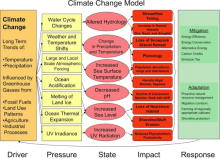
[Editor's note: Updated information related to this chapter is available in the 2015 report State of Knowledge: Climate Change in Puget Sound.]We all experience the weather with its day to day changes, and we are all familiar with the regular seasonal changes in climate where our weather transitions between spring, summer, winter and fall. Human caused climate change refers to sustain...
Pink salmon now comprise nearly 80 percent of all adult salmon in the North Pacific. This record abundance is coming at a cost to other salmon species such as threatened Chinook, which compete with pinks for spawning territory. A new study shows that the ecological toll may extend all the way to endangered southern resident killer whales.
Recently the PSP listed several contaminants of concern for Puget Sound organized into four general categories including toxics, nutrients, pathogens, and other (i.e. deviations in physical/chemical state of a water body; Puget Sound Partnership 2008b). Specific issues related to these categories, including discussions on several chemicals of concern, have been detailed therein and ...
Background
Puget Sound river hydrology could be affected by climate change. Precipitation in the region occurs predominately in the winter months. The accumulation of snow in the mountains is a primary storage mechanism, particularly for the snowmelt-dominated and transitional river systems. It has been estimated that more than 70% of total stream discharge in the Western Unit...
A recent summary includes information compiled in Winter 2013 by the modeling workgroup of the Puget Sound Ecosystem Monitoring Program (PSEMP). It describes several ecosystem modeling efforts in the region.
By Puget Sound Ecosystem Monitoring Program (PSEMP)
Adult northern fur seals spend more than 300 days per year (about 80 percent of their time) at sea. During the summer and autumn they intermittently fast while on land and feed at sea. During the winter and spring they are pelagic, occupying the North Pacific Ocean as well as the Bering and Okhotsk Seas. Northern fur seals are considered rare in the Salish Sea, and there have been 93 confirmed sightings of stranded animals in the state of Washington since 1982.
By National Oceanic and Atmospheric Administration
Alberti, M., D. Booth, K. Hill, B. Coburn, C. Avolio, S. Coe, and D. Spirandelli. 2007. The impact of urban patterns on aquatic ecosystems: An empirical analysis in Puget lowland sub-basins. Landscape and Urban Planning 80:345-361.
Allendorf, F.W., et al. 2008. Genetic effects of harvest on wild animal populations. Trends in Ecology & Evolution 23(6):327-337.
Arukwe, A. 2008. Ster...
This article was originally published by the Washington Department of Fish and Wildlife as part of its annual report Threatened and Endangered Wildlife in Washington.
By Washington Department of Fish and Wildlife. Species accounts were compiled by Derek Stinson, Gary Wiles, Gerald Hayes, Jeff Lewis, Lisa Hallock, Steve Desimone, and Joe Buchanan.
There are over seventy USGS gauging stations on unregulated rivers and streams in Puget Sound, which are continuously collecting streamflow data. There are over 170 specific metrics that can be used to evaluate different aspects of streamflow. In order to determine which of these is most suitable for Puget Sound, we performed a review of the literature to determine salient managemen...