The Port Gamble S’Klallam reservation covers 1,340 acres. Over half of the nearly 2,000 enrolled tribal members live on the reservation. Port Gamble Bay, the tribe’s ancestral home, has proven to be more resilient than other nearby water bodies, but it still carries a load of toxins from the Pope & Talbot sawmill, which operated on the bank for over 150 years.Port Gamble S'Klallam...
Wade out into the shallows of Puget Sound on a warm, sunny day and put your ear close to the water. You might catch the faint, champagne-like bubbling of eelgrass.
The symposium was held on September 12–14, 2012, at the University of Washington, Friday Harbor Laboratories campus. Sixty scientists, graduate students, and fisheries policy experts convened; showcasing ongoing research, conservation, and management efforts targeting forage fish from regional and national perspectives.
By Theresa Liedtke, Caroline Gibson, Dayv Lowry and Duane Fagergren (Eds.)
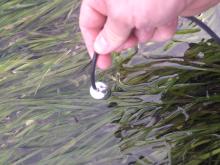
Puget Sound herring reproduction is not limited by the amount of suitable spawning vegetation, according to a November 2014 paper in the journal Marine Ecology. The article points to terrestrial or marine variables as likely determinants of egg loss.
By Shelton A. O., Francis T. B., Williams G. D., Feist B., Stick K., & Levin P. S.
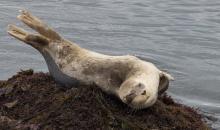
A 2017 paper in the journal Aquatic Mammals reports that harbor seals in the Salish Sea are less concerned about predators when they become habituated to humans.
By Jennifer K. Olson and Alejandro Acevedo-Gutiérrez
A 2025 article in the journal Environmental Management analyzes the use of structured decision making (SDM) with four different watershed groups to understand the governance factors that facilitated the use of SDM as a decision support tool.
Here we provide a limited synthesis of stream gauge data to examine trends in freshwater flows with respect to annual and daily flows, timing of flow, low flows and flows relative to instream flow guidelines. This is intended to supplement a review of published information, but we caution that a full analysis of these data and appropriate vetting of methods and interpretations is ne...
This article originally appeared in the State of Washington Bat Conservation Plan. Further information is available from the Washington Department of Fish and Wildlife.