

False killer whales in the Salish Sea

Overview
The false killer whale is a tropical to warm temperate species of dolphin that is not normally found in the Salish Sea. However, the species does occasionally appear in small numbers in Pacific Northwest waters of Washington and British Columbia, and even sometimes as far north as Alaska. They are highly social animals that typically feed on large pelagic fish, such as tuna and mahi mahi.
Status, trends & events
False killer whales are considered naturally rare, and there are no global estimates of abundance, but they generally occur in low densities across their extensive range (Zaeschmar and Baird 2025). Based on the areas where abundance has been estimated, the global population of the species, however, probably numbers no more than 50 to 100 thousand individuals. There is a very large population of false killer whales in the eastern tropical Pacific, which was estimated to contain about 40,000 individuals (CV=0.64) in 1993 (Wade and Gerrodette 1993). Although widely distributed, many false killer whale populations are nonetheless at risk, and the species is listed as Near Threatened on the IUCN Red List (Baird 2025a).
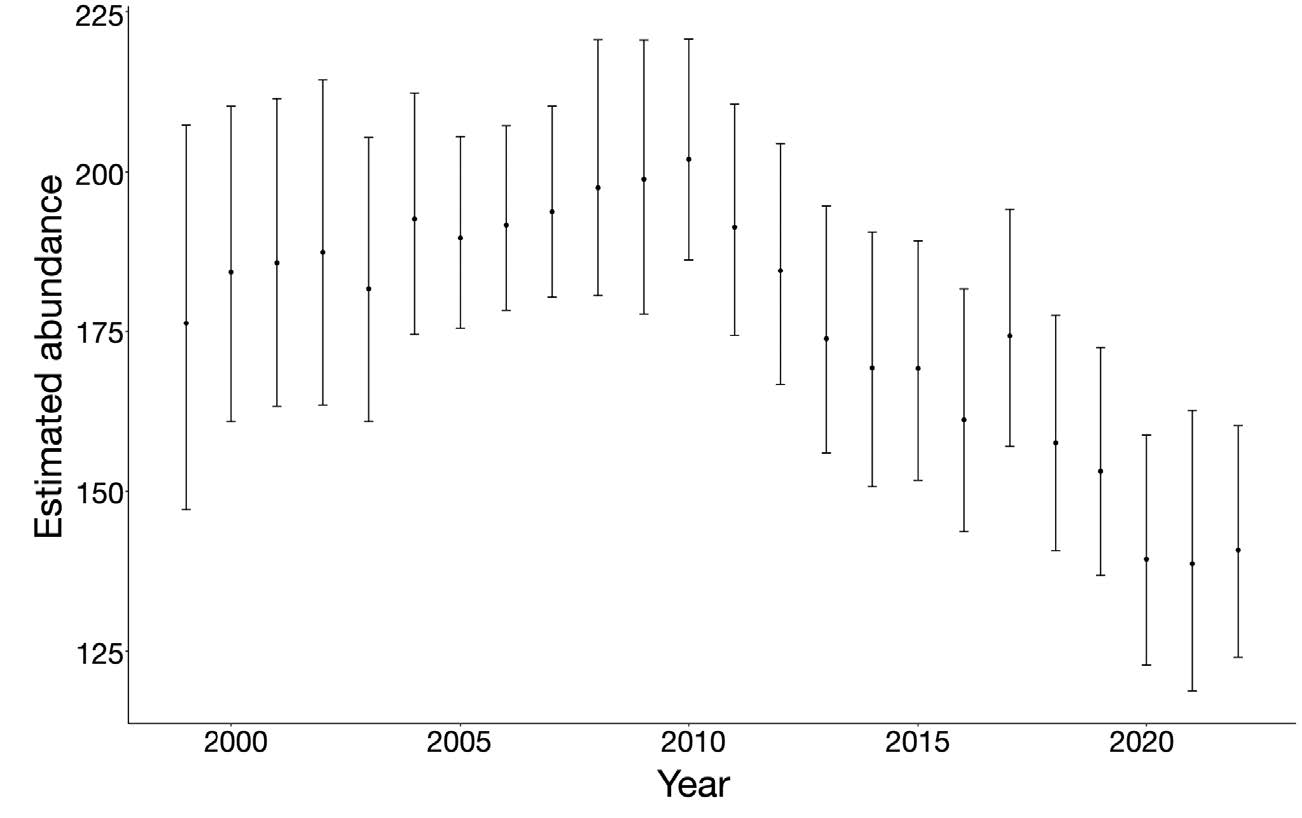
The only year-round populations in US waters of the Pacific Ocean are in Hawai‘i, though in the Atlantic, they also occur in the Gulf of Mexico and along the southeastern US. NOAA recognizes three stocks of false killer whales in Hawaiian waters (Carretta et al. 2023). The Hawaiian Pelagic Stock is the largest, estimated at 5,528 individuals (CV= 0.35), but its status and the trend in population numbers are unknown. It is not listed as Endangered or Threatened. The Main Hawaiian Insular stock is the smallest, numbering only about 139 animals in 2022 (CRI = 114, 162; Badger et al. 2025). It has been declining in recent years, and it is listed as Endangered under the US Endangered Species Act. The Northwestern Hawaiian Islands stock is intermediate in size, with the most recent estimate of about 477 individuals, but the estimate is very statistically imprecise and therefore only approximate (CV=1.71). Its trend and status are unknown (Carretta et al. 2023).
Natural history
The scientific name of the false killer whale is Pseudorca crassidens. The genus name, Pseudorca, comes from the similarity of its skull to that of the killer whale (Orcinus orca). The type specimen’s skull was mistakenly thought by British biologist Richard Owen to be from an extinct species. Crassidens means “thick-toothed,” which is certainly fitting. False killer whales are actually large dolphins, one of the largest in the family Delphinidae. They can reach lengths up to 5 m (females) or 6 m (males), and weights of up to 2,000 kg. Newborns are 1.5-2.1 m long. The body is shaped somewhat like a cigar, with a blunt head showing little or no beak, a bulging melon that may strongly overhang the lower jaw (particularly in adult males), a tall falcate dorsal fin in the middle of the back, and flippers with a diagnostic bulge on the leading edge (giving them an S-shape). The color pattern is simple, largely uniform dark gray, but with a faint dorsal cape (it may be hard to see in poor lighting), and a light patch of variable shape on the belly (Jefferson et al. 2015).
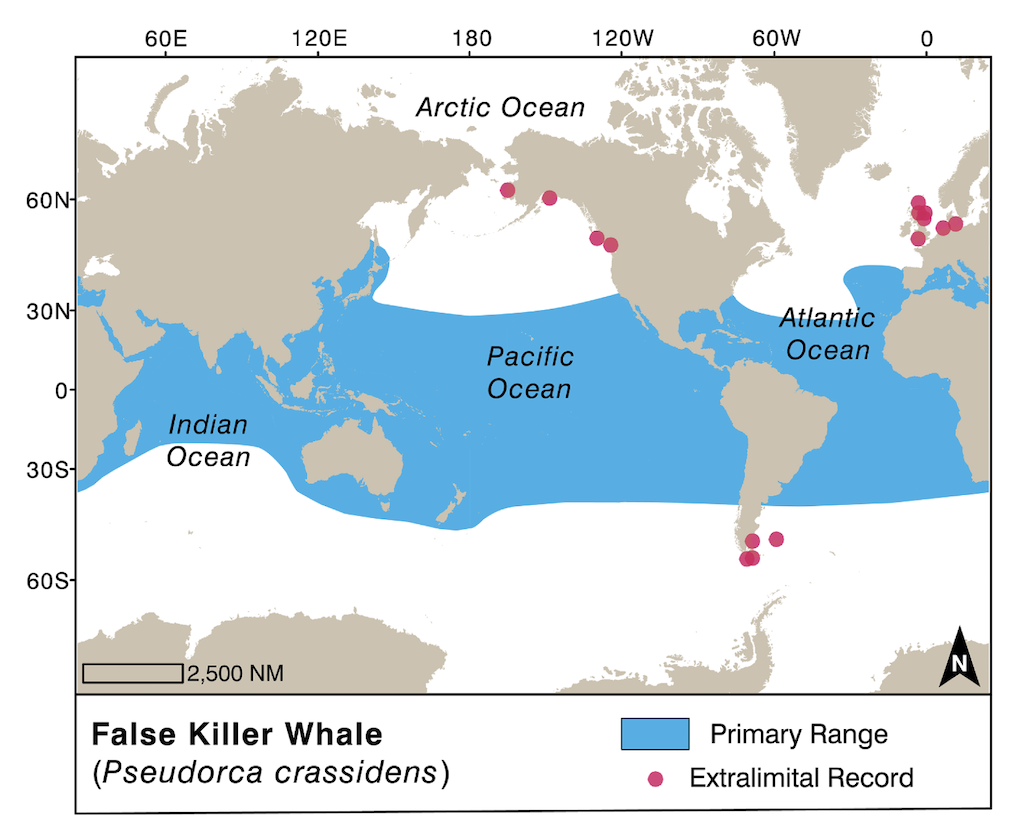
False killer whales use a wide range of habitats, but they occur at highest densities in tropical regions within about 15° of the equator. Although some populations (esp. those in Southern Hemisphere waters) regularly use continental shelf waters, the species mostly is observed in waters of the continental slope or oceanic regions of deep water. Within Hawai‘i, they occur in a wide range of water depths, extending from <50 m to nearly 5,000 m (Zaeschmar and Baird, 2025).
The Salish Sea is not part of the normal range of the false killer whale. Until 1987, the only record there was of an individual shot and killed by locals in Puget Sound in May 1937 (Scheffer and Slipp 1948). On 3 May 1987, a group of at least 12 false killer whales showed up in Puget Sound, with one individual stranding on Denman Island, BC (Strait of Georgia). Over the next 2 months, repeated sightings of what are thought to be all or part of the same group were made in southern BC and Puget Sound waters (Osborne et al. 1988; Stacey and Baird 1991; Ford 2014). There are 115 records of false killer whales in BC waters (though not all in the Salish Sea), but many of these are of single individuals and are probably related to the visit of that original group in 1987 (Ford 2014). False killer whales from more southern areas along the Pacific coast of North America occasionally make incursions along the U.S. west coast (Douglas et al. 2023), and are likely the ones seen in the Salish Sea.
Although false killer whales are not known as a migratory species, seasonal movements do occur in many parts of the range. These are usually erratic movements into more temperate (cooler) waters, mostly in summer months. Examples are movements into Scotland in the North Atlantic; Washington, British Columbia, and even Alaska in the North Pacific; the Falkland Islands in the South Atlantic; and sometimes into the Southern Ocean. The furthest north record in the Pacific is a specimen found stranded on 22 November 2014 at Scammon Bay, in the Bering Sea (Baird 2025b). Well-studied populations show varying degrees of site fidelity, with some having extensive movements of thousands of kilometers, and others showing very limited ranges. For instance, individuals of the Hawaiian insular population do not range more than about 450 km (Zaeschmar and Baird 2025).
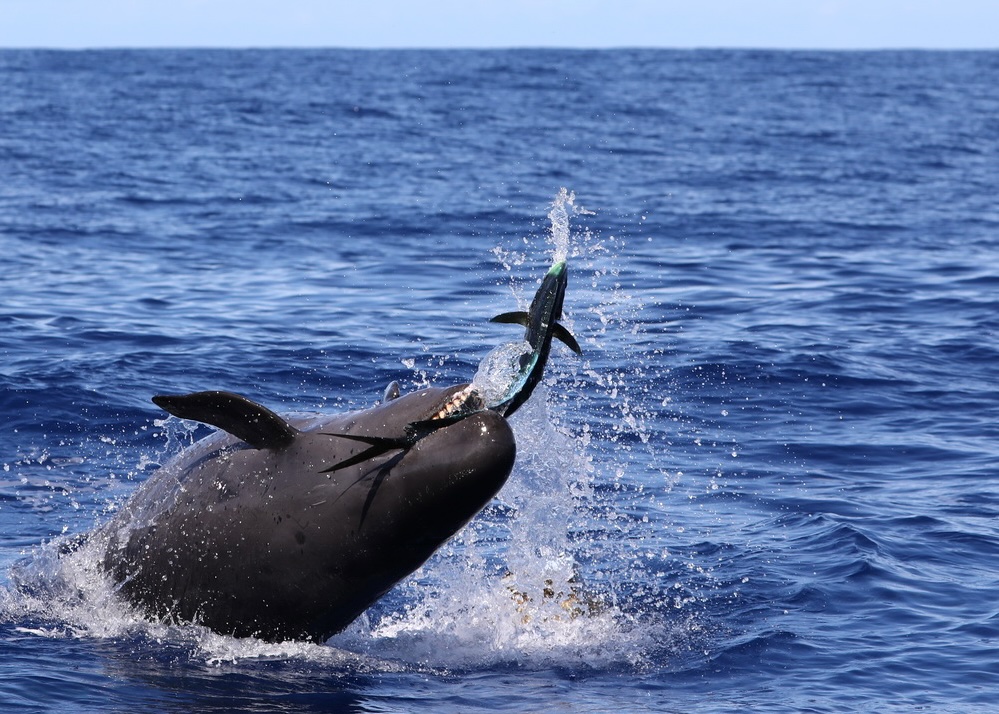
These are somewhat opportunistic feeders, mainly dining on squid and tropical fishes. Zaeschmar and Baird (2025) listed no less than 22 species of cephalopods and 40 species of fish that have been documented in their diet. They appear especially adapted to feed on large pelagic fish species, such as tunas, mahi mahi, wahoo, various billfish, and even barracuda. There are reports of them harassing other marine mammal species, including dolphins, but reports of them actually feeding on marine mammals are unconfirmed (Baird 2025c). False killer whales do depredate fish from longlines in a number of areas, including Hawai‘i, thereby earning the ire of longline fishermen. They have no major natural predators, but large sharks and occasionally killer whales do attack this species.
The acoustic behavior of false killer whales has not been as well studied as that of their larger cousin, the killer whale, but recordings have been made in multiple locations around the world. A wide variety of whistles, clicks, and burst-pulse sounds have been identified, as in most other dolphin species. The clicks are used primarily for echolocation, and the whistles are likely communicative; possible signature whistles have even been identified. False killer whale whistles have lower frequencies than those of many other dolphins, but their vocalizations are consistent with those of other delphinids that feed on large prey (Zaeschmar and Baird 2025).
There has never been a directed fishery that focused on false killer whales as the main target species, but the animals have been killed in culls in Japanese and Taiwanese waters. Due to their frequent depredation of longlines, they are also sometimes shot as competitors by the fishermen. For some smaller populations, such as those in Hawai‘i, this can be a significant conservation issue. They also get caught in some other fisheries using lines, gillnets, trawls, and seines, and although documentation of population impacts are rare, in some cases, the catch can be substantial. Environmental contaminants in the tissues of this top predator can reach high levels, and there is concern about the impacts this may be having on survival and reproduction. Climate change impacts are also a concern, though not well studied at this point (Zaeschmar and Baird 2025). Outside of Hawai‘i and a few other small areas, there is no reliable information on population trends for the species. Serious conservation problems on a global scale are not known, so there is no threat of immediate extinction of the species.
Because they occur there only rarely, there have been no detailed, long-term ecological studies on the species in the Salish Sea. Most of what is known about them in our part of the world comes from detailed studies in the Hawaiian islands.
Data sources & gaps
Most status information in this report comes from Carretta et al. (2023). While some monitoring and information gaps for this species exist, there is generally adequate information to determine the status and trends of this species in Hawai‘i, but information specific to the Salish Sea or Puget Sound is largely lacking.
Methods & statistics
Methods of determining the population status of the Hawaiian stocks of the false killer whale mostly come from mark-recapture studies using photo-identification data, vessel-based line-transect analysis, and habitat-based species distribution modeling (see Carretta et al., 2023).
References
Badger, J. J., Baird, R. W., Johnson, D. S., Bradford, A. L., Mahaffy, S. D., Kratofil, M. A., . . . Oleson, E. M. (2025). Accounting for spatiotemporal sampling bias in a long-term dataset establishes a decline in abundance of endangered false killer whales Pseudorca crassidens in the main Hawaiian Islands. Endangered Species Research. doi:10.3354/esr01423
Baird, R. W. (2025a). Out of sight, out of mind: False killer whale populations are at risk. Whalewatcher, 45, 76-82.
Baird, R. W. (Ed.) (2025b). False Killer Whales - The Pseudorca Issue. Whalewatcher (ACS Journal), 45, 86 pp.
Baird, R. W. (2025c). False killer whales are dolphin predators? Not so fast…. Whalewatcher, 45, 63-65.
Bradford, A. L., Becker, E. A., Oleson, E. M., Forney, K. A., & Barlow., J. E. M. A. J. (2020). Abundance estimates of false killer whales in Hawaiian waters and the broader Central Pacific. NOAA Technical Memorandum NMFS-PIFSC-104. viii + 70pp..
Carretta, J. V., Oleson, E. M., Forney, K. A., Weller, D. W., Lang, A. R., Baker, J., . . . Brownell Jr., R. L. (2023). U.S. Pacific marine mammal stock assessments: 2022. NOAA Technical Memorandum NMFS-SWFSC, 684, 404 pp.
Douglas, A. B., Garita Alpízar, F., Acevedo-Gutiérrez, A., Mahaffy, S. D., Rasmussen, K., Quintana-Rizzo, E., . . . Baird, R. W. (2023). False killer whales (Pseudorca crassidens Cetacea: Delphinidae) along the Pacific coast of Central America and Mexico: Long-term movements, association patterns and assessment of fishery interactions. Revista de Biologia Tropical, 71(S4). doi:10.15517/rev.biol.trop..v71iS4.57189
Ford, J. K. B. (2014). Marine mammals of British Columbia. Royal British Columbia Museum, Victoria, British Columbia, Canada. 460pp. ISBN 978-0-7726-6734-2.
Jefferson, T. A., Webber, M. A., & Pitman, R. L. (2015). Marine Mammals of the World: A Comprehensive Guide to Their Identification, Second Edition: Academic Press/Elsevier.
Osborne, R., Calambokidis, J., & Dorsey, E. (1988). A Guide to Marine Mammals of Greater Puget Sound: Island Publishers.
Scheffer, V. B., & Slipp, J. W. (1948). The whales and dolphins of Washington State, with a key to the cetaceans of the west coast of North America. American Midland Naturalist, 39, 257-337.
Stacey, P. J., & Baird, R. W. (1991). Status of the false killer whale, Pseudorca crassidens, in Canada. Canadian Field-Naturalist, 105, 189-197.
Wade, P. R., & Gerrodette, T. (1993). Estimates of cetacean abundance and distribution in the eastern tropical Pacific. Reports of the International Whaling Commission, 43, 477-493.
Zaeschmar, J., & Baird, R. W. (2025). False killer whale Pseudorca crassidens (Owen, 1846). In T. A. Jefferson (Ed.), Ridgway and Harrison’s Handbook of Marine Mammals, Vol. 2: Oceanic Dolphins (pp. 537-588): Academic Press.
Related
Baird, R.W. 2009. False killer whale (Pseudorca crassidens). Pages 405-406 in Encyclopedia of Marine Mammals. Edited by W.F. Perrin, B. Wursig and J.G.M. Thewissen. Academic Press, San Diego, CA.
False killer whales in Hawai'i are vanishing right before our eyes, Cascadia Research Instagram
A pod of a dozen or more false killer whales roams Puget Sound, UPI Archive May 1987
Acknowledgements
The author thanks to Robin Baird for comments on an earlier draft, the University of Washington Puget Sound Institute for funding, and also the Puget Sound Ecosystem Monitoring Program's Marine Mammals Working Group for helping to facilitate the production of this chapter.