

Northern right whale dolphins in the Salish Sea
Overview
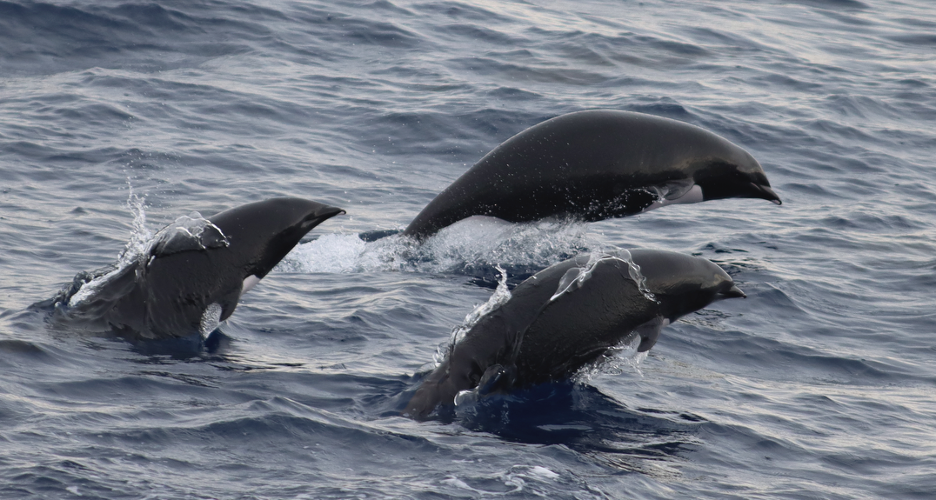
The northern right whale dolphin (Lissodelphis borealis) is one of the most unusual marine mammals of the North Pacific Ocean. It is the only dolphin species in the Northern Hemisphere with no hint of a dorsal fin, and it is very slender and streamlined, making it appear almost eel-like. Northern right whale dolphins are found only in cool temperate waters of the North Pacific and are moderately common in offshore waters. However, they are uncommon in nearshore regions and rarely enter inshore bays or channels. While they have been sighted here, their occurrence in Puget Sound and the Salish Sea is considered to be outside their normal habitat.
Status, trends & events
There is little evidence for separate populations of northern right whale dolphins, though this issue has not received much study. Currently a single stock (the California/Oregon/Washington stock) is recognized by NOAA for management in US waters. Although these animals likely range into Canadian waters, and occasionally into Mexican waters, no other management stocks are currently established for the species.
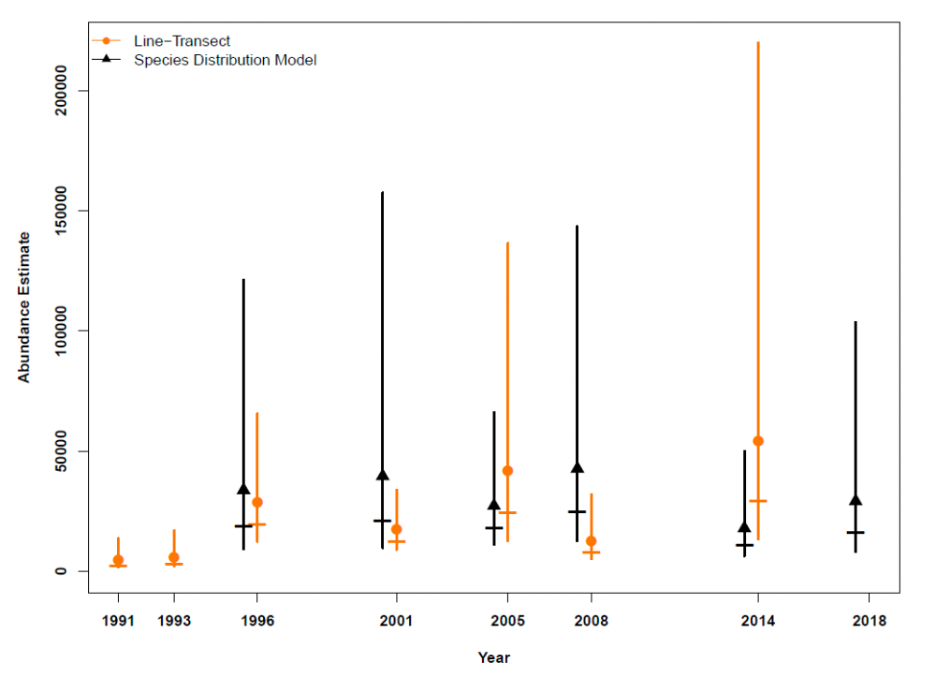
The northern right whale dolphin is not listed as Threatened or Endangered under the US Endangered Species Act. By-catch does occur in some fisheries in both the US and Canada, but there are currently no known conservation concerns for this species off the North American west coast. They have never been hunted commercially in this area either. The current best estimate of the number of northern right whale dolphins along the US west coast is 29,285 (CV = 72%), but this estimate (from 2018) may be outdated and is very imprecise, so it must be taken with a bit of caution.
Natural history
As a species endemic to the offshore North Pacific Ocean, northern right whale dolphins have not been intensively studied. They occur mainly over the continental slope and outer continental shelf, but also in deep oceanic waters (Ferrero and Walker 1993). They are rarely encountered in inshore waters. Their preferred habitat is cold water with surface temperatures of 8-19°C (Jefferson and Van Waerebeek 2025), and water temperature appears to be the main factor in determining their movements. There are occasional southward movements into the southern part of their range off southern California and even northern Baja California, Mexico, during periods of cold water.
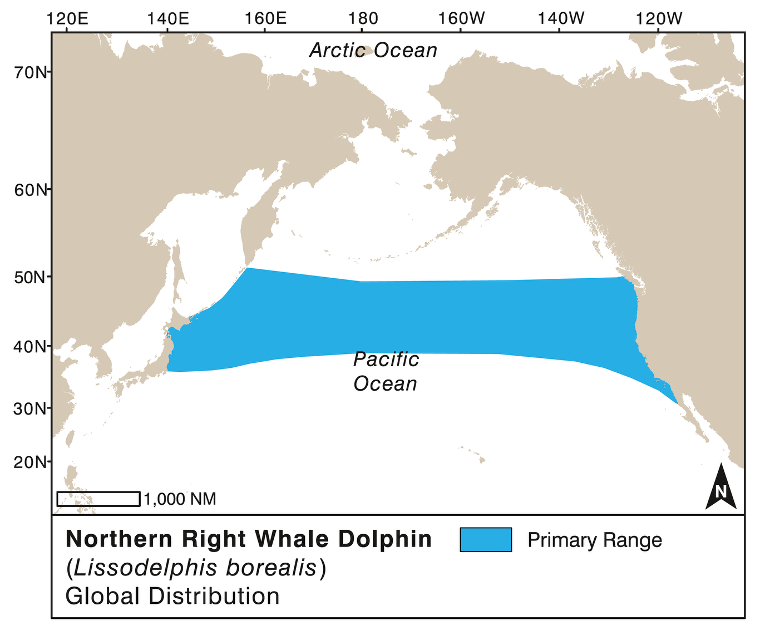
Northern right whale dolphins are very rare in Puget Sound and the Salish Sea, though unconfirmed reports in this area exist (Everitt et al 1979; Angell and Balcomb 1982; Calambokidis and Baird 1994). Only a single sighting was reported for Canadian inshore waters in Ford’s (2014) review of records. They were never sighted in 35,102 km of aerial surveys for marine mammals, covering all of Puget Sounds in all four seasons from 2013-2016 (Smultea et al. 2017, 2022). Osborne et al. (1988) reported an unconfirmed sighting of this species in Puget Sound in 1977, and the near absence of records for Puget Sound indicates that any occurrences of the species here should be considered extralimital.
These dolphins feed mostly on squid and small fish. Feeding habits have not been particularly well studied, but Jefferson and Van Waerebeek (2025) cited at least 14 genera of cephalopods and 32 genera of fishes as among their known prey. Many of their fish prey are meso- to bathypelagic species, such as lanternfish (myctophids). It is likely that they make use of the deep scattering layer (DSL), which brings some of their deepwater prey species toward the surface, reaching near-surface waters at night.
Biology
Northern right whale dolphins are very slender, with small flippers and flukes, and the total absence of a dorsal fin, or even of a dorsal ridge – the back is completely smooth (Leatherwood and Walker 1979). They have a short beak, that is demarcated from the melon by a shallow groove. They reach lengths of up to 3.1 m, though most are much shorter (Ferrero and Walker 1993). Males attain somewhat longer lengths than females, and at birth they are about 1 m in length (Ferrero and Walker 1993; Jefferson and Van Waerebeek 2025). The color pattern is a uniform charcoal gray to black, with a sharply demarcated white patch on the belly that stretches between the flippers and then narrows as a thin stripe to the flukes. There is a small white patch just behind the tip of the lower jaw, and the flukes are white underneath, with lighter gray trailing edge frosting on the upper surface (Jefferson and Van Waerebeek 2025). There is an anomalous color pattern (termed “swirled”), with more extensive white, which occurs on some animals. Most large schools will often have one or more individuals with this unusual color pattern. The coloration of calves is somewhat muted, with dark and light gray replacing black and white (Jefferson et al. 2015).
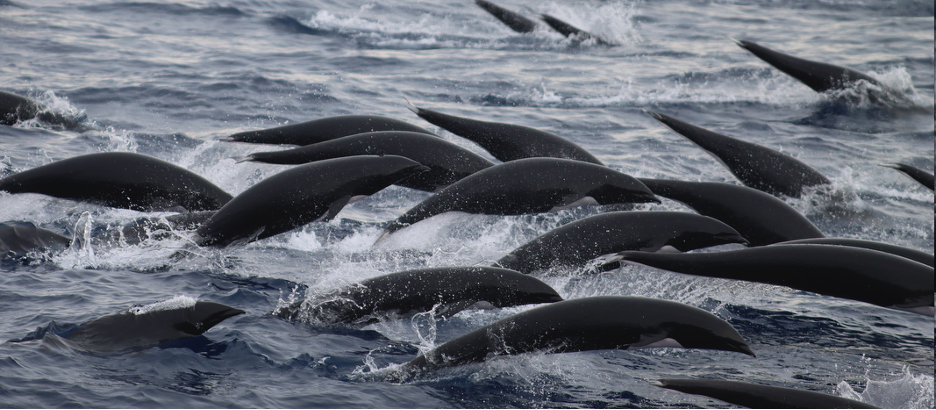
These animals are very lively and energetic swimmers, with reported swimming speeds of up to 34 km/hr, often porpoising out of the water in closely spaced ranks with low-angle leaps. From a distance these can be easily mistaken for groups of porpoising California sea lions (Zalophus californianus). Northern right whale dolphins form medium to large schools, with average school sizes of about 100 in the eastern North Pacific and over 200 in the western North Pacific (Jefferson and Van Waerebeek 2025). Smaller groups of a few dozen may be more common in some areas, like the Southern California Bight. Mixed schools with other species of small cetaceans, sometimes in the hundreds or even exceeding 1,000, are common. They can be seen with Risso’s dolphins (Grampus griseus), but more commonly with Pacific white-sided dolphins (Aethalodelphis obliquidens). Right whale dolphins are normally rather shy and skittish but appear to be more willing to ride bow waves of ships when they are accompanied by Pacific white-sided dolphins.
Their acoustic behavior is not well studied, but Rankin et al. (2007, 2008) have described the sounds produced by this species off North America, whichconsist of mainly clicks (likely used for echolocation) and burst-pulse sounds (likely used for communication). No whistles were recorded, which is surprising, but perhaps the stereotyped burst-pulse sounds replace the whistles used by many other species of dolphins. Peak frequencies recorded were 37-41 kHz, but presumably these dolphins can make much higher-frequency sounds.
While there are no known reports of predation on northern right whale dolphins, they certainly face this risk. Bigg’s killer whale (Orcinus orca rectipinnus) would be their most likely predator. Sharks are probably not important predators.
Northern right whale dolphins do not appear to be suffering greatly at the hands of humans at present. There is no commercial fishery for the species, and although they have been caught in and killed in fisheries targeting other species, this does not appear to be common. In US west coast waters a few are killed in the thresher shark/swordfish driftnet fishery and the domestic groundfish trawl fishery (Carretta et al. 2024). In the 1980s, an experimental driftnet fishery for flying squid (Todarodes pacificus) killed several right whale dolphins in offshore Canadian waters (Jamiesen and Heritage 1987, 1988). The only known large-scale kill of this species occurred in the 1980s and1990s in the central Pacific Asian squid driftnet fishery, but that fishery no longer operates in that area and would not likely have affected animals along our coast (see Ferrero and Walker 1993; Mangel 1993). Climate change may be affecting the distribution of these animals, with their southern limits moving north as waters warm, but there is no evidence that this is a serious threat.
Due to the fact that the species is very rare in these waters, no dedicated studies of northern right whale dolphins have been conducted in Puget Sound or the Salish Sea. However, with increasing human activities and therefore more eyes searching the water of this region, it is possible that reports of northern right whale dolphins in inshore Washington and BC waters will increase. If you see one of these dolphins in the Salish Sea, please contact NOAA in the US, or Department of Fisheries and Oceans in Canada.
Data sources & gaps
Most status information in this report comes from Carretta et al. (2024). While some monitoring and information gaps for this species exist, there is generally adequate information to determine the status and approximate trends of this species along the West Coast. Information specific to the Salish Sea or Puget Sound, however, is largely lacking.
Methods & statistics
Methods of determining the population status of the California/Oregon/Washington stock of northern right whale dolphins mostly comes from vessel-based line-transect analysis, and habitat-based species distribution modeling (see Carretta et al., 2024).
References
Angell, T., & Balcomb, K. C. (1982). Marine Birds and Mammals of Puget Sound. Puget Sound Books.
Calambokidis, J., & Baird, R. W. (1994). Status of marine mammals in the Strait of Georgia, Puget Sound and the Juan de Fuca Strait and potential human impacts. In R. C. H. Wilson, R. J. Beamish, F. Aitkens, & J. Bell (Eds.), Review of the marine environment and biota of Strait of Georgia, Puget Sound and Juan de Fuca Strait (Vol. 1948, pp. 282-303). Canadian Technical Report of Fisheries and Aquatic Sciences.
Carretta, J. V., Oleson, E. M., Forney, K. A., Bradford, A. L., Yano, K., Weller, D. W., Lang, A. R., Baker, J., Orr, A. J., Hanson, B., Moore, J. E., Wallen, M., & Brownell Jr., R. L. (2024). U.S. Pacific marine mammal stock assessments: 2023. NOAA Technical Memorandum NMFS-SWFSC, 704, 420 pp.
Everitt, R. D., Fiscus, C. H., & DeLong, R. L. (1979). Marine mammals of northern Puget Sound and the Straits of Juan de Fuca. NOAA Technical Memorandum ERL-MESA, 41, 141 pp.
Ferrero, R. C., & Walker, W. A. (1993). Growth and reproduction of the northern right whale dolphin, Lissodelphis borealis, in the offshore waters of the North Pacific Ocean. Canadian Journal of Zoology, 71, 2335-2344.
Ford, J. K. B. (2014). Marine mammals of British Columbia. Royal British Columbia Museum, Victoria, British Columbia, Canada. 460pp. ISBN 978-0-7726-6734-2. 2014.
Jamieson, G. S., & Heritage, G. D. (1987). Experimental flying squid fishing off British Columbia, 1985 and 1986. Canadian Industry Report of Fisheries and Aquatic Sciences, 179, 103 pp.
Jamieson, G. S., & Heritage, G. D. (1988). Experimental flying squid fishery off British Columbia, 1987. Canadian Industry Report of Fisheries and Aquatic Sciences, 186, 79 pp.
Jefferson, T. A., Webber, M. A., & Pitman, R. L. (2015). Marine Mammals of the World: A Comprehensive Guide to Their Identification, Second Edition. Academic Press/Elsevier.
Jefferson, T. A., & Van Waerebeek, K. (2025). Right whale dolphins Lissodelphis borealis (Peale, 1849) and Lissodelphis peronii (Lacepede, 1804). In T. A. Jefferson (Ed.), Ridgway and Harrison’s Handbook of Marine Mammals, Vol. 2: Oceanic Dolphins (pp. 261-286). Academic Press.
Leatherwood, S., & Walker, W. A. (1979). The northern right whale dolphin Lissodelphis borealis Peale in the eastern North Pacific. In H. E. Winn & B. L. Olla (Eds.), Behavior of Marine Animals, Volume 3: Cetaceans (pp. 85-141). Plenum Press.
Mangel, M. (1993). Effects of high-seas driftnet fisheries on the northern right whale dolphin Lissodelphis borealis. Ecological Applications, 3, 221-229.
Osborne, R., Calambokidis, J., & Dorsey, E. (1988). A Guide to Marine Mammals of Greater Puget Sound. Island Publishers.
Rankin, S., Oswald, J. N., Barlow, J., & Lammers, M. O. (2007). Patterned burst-pulse vocalizations of the northern right whale dolphin, Lissodelphis borealis. Journal of the Acoustical Society of America, 121, 1213-1218.
Rankin, S., Oswald, J. N., & Barlow, J. (2008). Acoustic behavior of dolphins in the Pacific Ocean: Implications for using passive acoustic methods for population studies. Canadian Acoustics, 36, 88-92.
Smultea, M. A., K. Lomac‐MacNair, G. C., S. S. Courbis, & Jefferson, T. A. (2017). Aerial survey of marine mammals conducted in the inland Puget Sound waters of Washington, summer 2013–winter 2016. Final Report. Final report to the US Navy.
Smultea, M. A., Jefferson, T. A., & Lane, R. S. (2022). Marine mammal occurrence, distribution, and behavior in the inland waters of Washington from aerial surveys, 2013-2016. Northwestern Naturalist, 103(2) : 118-135."
Acknowledgements
The author thanks Joe Gaydos for comments on an original draft, the University of Washington Puget Sound Institute for funding, and also the Puget Sound Ecosystem Monitoring Program's Marine Mammals Working Group for helping to facilitate the production of this chapter.
Licensing & attribution
Data and products from the PSEMP Marine Mammal Work Group are governed by a Creative Commons BY-NC-SA license. Attribution should be to: “PSEMP Marine Mammal Work Group” with a link back to https://psemp.net/mmwg.