

Short-finned pilot whales in the Salish Sea
Overview
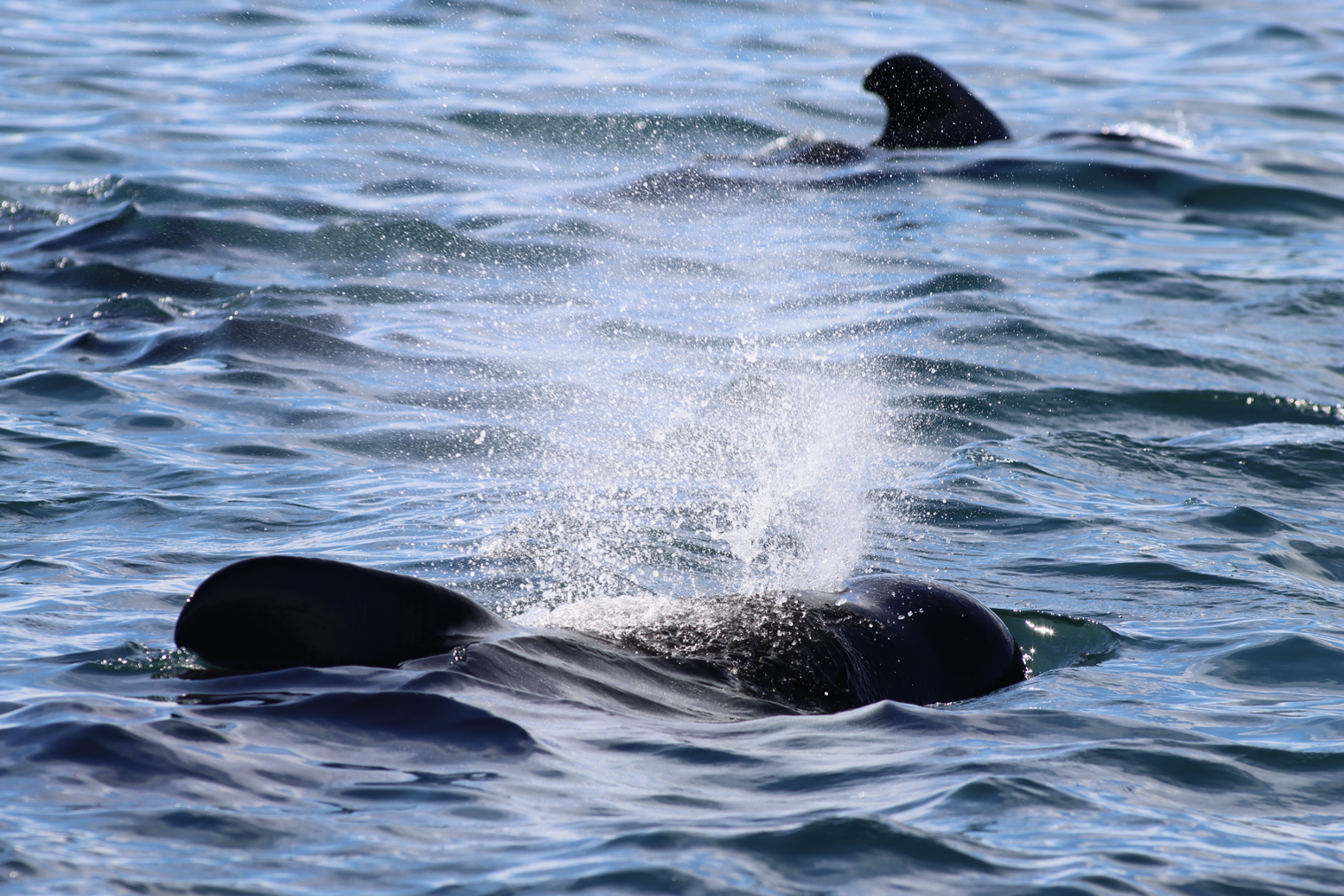
Pilot whales (Globicephala spp.) are well known to many people in the world, and the two species (short-finned and long-finned) are similar in appearance, although the short-finned species is mostly restricted to tropical and warm temperate waters, with long-fins more common in colder waters at higher latitudes. They are among the most common of cetacean species worldwide, but they tend to occur in offshore waters so records of the occurrence of short-finned pilot whales in the Salish Sea are few and far between.
Status, trends & events
Short-finned pilot whales (Globicephala macrorhynchus) occur around the world as distinct populations, some of which are associated with islands, such as the Hawaiian Islands. For management, NOAA Fisheries currently recognizes two stocks in US waters, including the California/Oregon/Washington stock, which apparently may be continuous with the eastern tropical Pacific (ETP) animals to the south (Van Cise et al. 2016), but it likely also ranges north occasionally into Canadian and Alaskan waters. Short-finned pilot whales are known from as far north as Southeast Alaska (Home 1980) and the Alaska Peninsula (Orr 1951), but these records are old and are considered extralimital and probably were associated with periods of unseasonably warm water. These animals are of the larger shiho-type geographic form. There is also a Hawai’i stock, which is managed separately, being part of a different geographic form (naisa-type) that may represent a different subspecies (Betty et al. 2025).
The west coast (California/Oregon/Washington) pilot whale stock is currently thought to number about 836 individuals (CV = 0.79) and is not considered ‘Depleted’ nor a ‘Strategic Stock’ under the US Marine Mammal Protection Act (Carretta et al. 2024). Its numerical trend is not known with any certainty, although a dramatic reduction in abundance in southern California was documented in the 1980s (Shane 1995a, 1995b; Jefferson and Schulman-Janiger 2018). Until the early 1980s, pilot whales were very common in the waters of the southern California Bight, especially around Santa Catalina Island, where a seasonally resident population of several hundred was thought to exist. Within a few short years from 1980-1985, these animals virtually disappeared from the area. It has traditionally been thought that this was probably due to a failure of market squid spawning from the strong 1982-1983 El Niño event, but recent work provides convincing evidence that the main cause of this decline may have been anthropogenic. Pilot whales likely had been suffering from heavy mortality caused by fisheries bycatches, shooting by fishermen, and live-captures for oceanaria (and possibly navy sonar acoustic impacts as well), and the 1982/83 El Niño may simply have been the “straw that broke the camel’s back”. Whatever the cause, this tragedy can be seen as a failure of NOAA’s Marine Mammal Protection Act, which was implemented to prevent exactly this kind of disaster. Now, although pilot whale groups come through southern California now and then, there has been no recovery of the stock (and little effort by NOAA to understand what happened and how to prevent it from happening again).
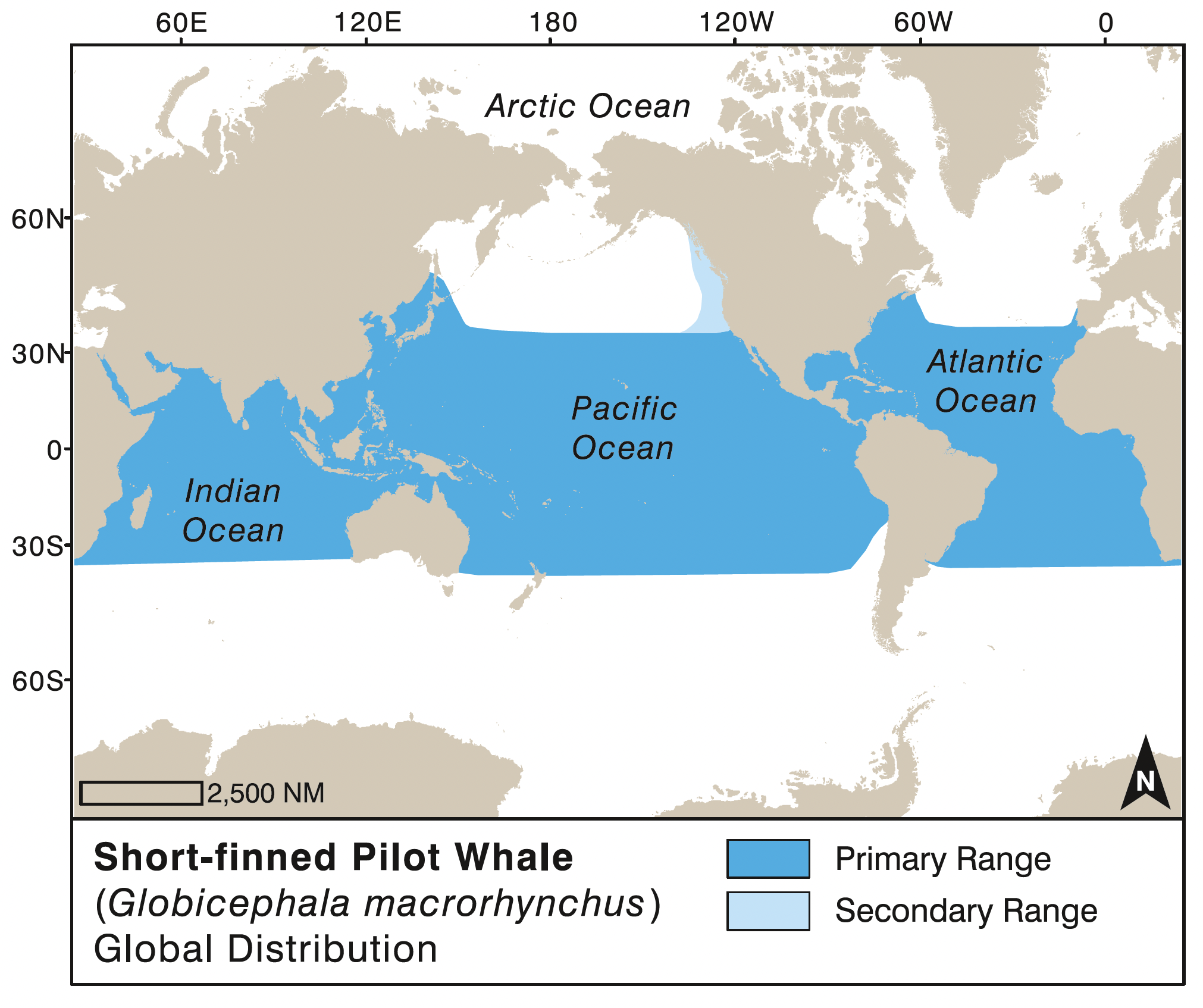
Short-finned pilot whales are the only species that currently occurs in the North Pacific Ocean, although a population of long-finned pilot whales was found in Japanese waters in previous times, but was likely extirpated there by hunting pressure. Globally, the species is found in all three major oceans (Pacific, Atlantic, and Indian) in a circumglobal fashion. They occur to about 40-45° latitude in both hemispheres, though they sometimes reach further poleward along continental margins. These are deep-diving squid specialists, and thus they are found mostly in offshore waters past the edge of the continental shelf (Jefferson et al. 2015; Betty et al. 2025).
Pilot whales were apparently known to the Quillayute natives of the Olympic Peninsula, who called the animals “mole whales” (Scheffer and Slipp 1948; Osborne et al. 1988). They may have been more common in this area in the past, but in recent decades pilot whales have been considered rare in the inshore waters of Washington and British Columbia (Everitt et al. 1979, 1980; Calambokidis and Baird 1994; Ford 2014). They are said to sometimes “wander” into the Strait of Juan de Fuca in summer and fall (Osborne et al. 1988), and there are three reports of them near the south end of Vancouver Island (Baird and Stacy 1993). Angell and Balcomb (1982) reported them as ‘common’ at the entrance to the Strait of Juan de Fuca, but without supporting details. However, confusion with killer whales (Orcinus orca) and false killer whales (Pseudorca crassidens) makes the identifications of many of the older and second-hand records somewhat questionable. Salish Sea records that can be confirmed with photos or specimens are very few but include one specimen (a 3.05 m male) captured for the Seattle Aquarium in Hood Canal on 24 March 1968, which died a few days later in captivity (Everitt et al. 1979, 1980), and a stranding (a 4.52 m female) at Metchosin (near Victoria, BC) on 23 November 1977 (Ford 2014). Norman et al. (2004) reported six stranding events of pilot whales in Washington State, but it is not known if any of these were in inshore waters.
Fish remains have been found in pilot whale stomachs, but the species is largely adapted to feeding on squid and other cephalopods in deep waters. They show the reduction in tooth number and size that is common among other cetacean squid feeders, such as Risso’s dolphins (Grampus griseus), beaked whales, and sperm whales (Physeter macrocephalus). Along the US west coast, one of their main prey items is the market squid (Doryteuthis opalescens, which used to be known as Loligo opalescens), but they are known to consume at least seven different species of cephalopods in the eastern North Pacific (Betty et al. 2025). The deepest and longest known dives for the species were 1,175 m and 28 minutes (Betty et al. 2025).
Biology
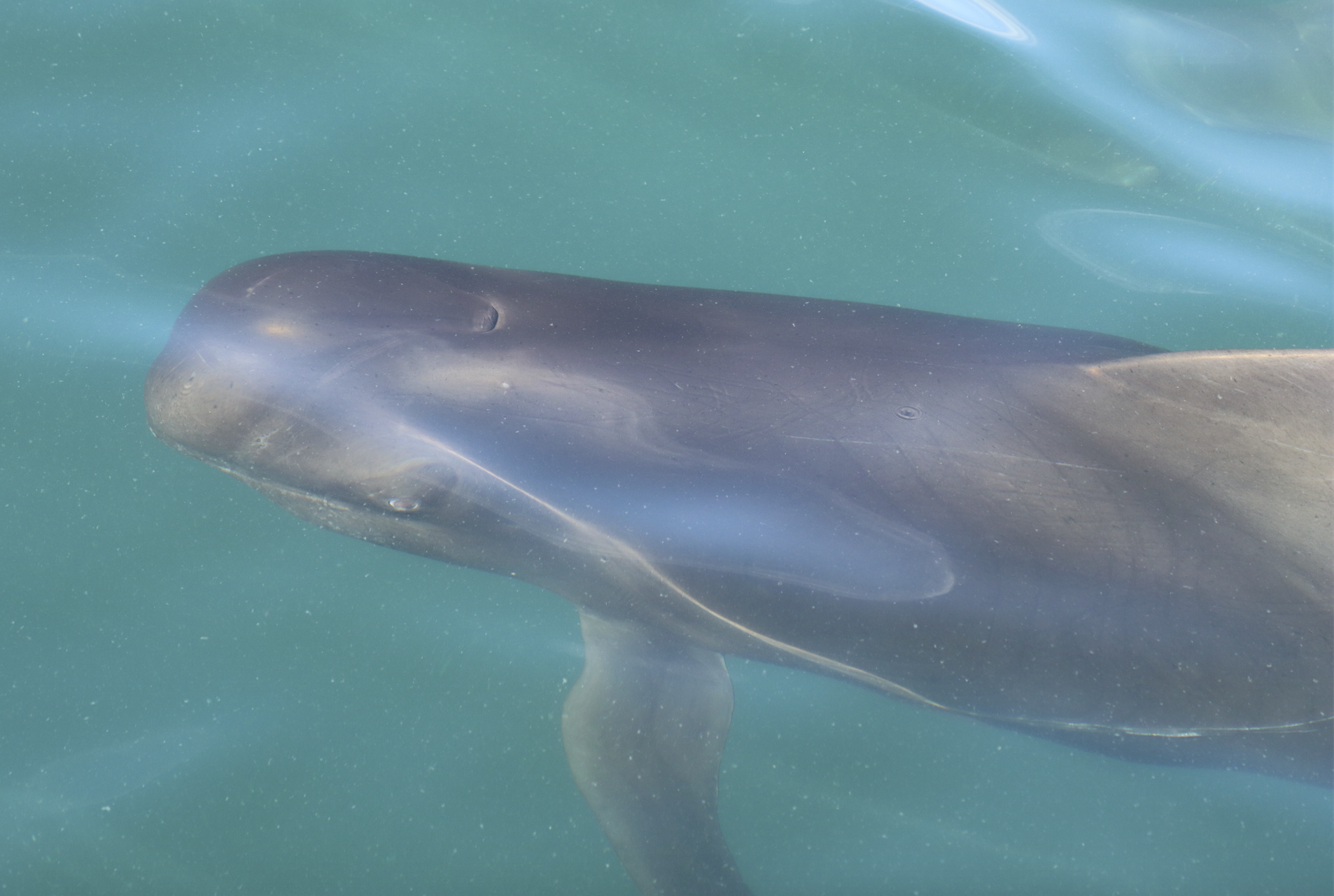
As a member of the group of cetaceans informally known as “blackfish”, pilot whales are mostly dark gray to black in color, but they usually have a light grayish post-dorsal fin saddle (similar to that of killer whales), light streaks extending back from the eyes defining a “cape”, and a light anchor-shaped patch on the belly. Pilot whales are easily identified, based mostly on their robust bodies, blunt (even bulbous) heads, short wide-based dorsal fins that are set only about 1/3 the way from the beak tip along the back (well ahead of the middle of the back), and gracefully curved flippers. Males grow much larger than females, with males reaching about 7.2 m in length, but females rarely exceeding 5.5 m. A large bull can possibly weigh up to 3,600 kg. There are usually 7-9 short, pointed teeth in each tooth row, which may be worn down in older specimens (Jefferson et al. 2015; Betty et al. 2025).
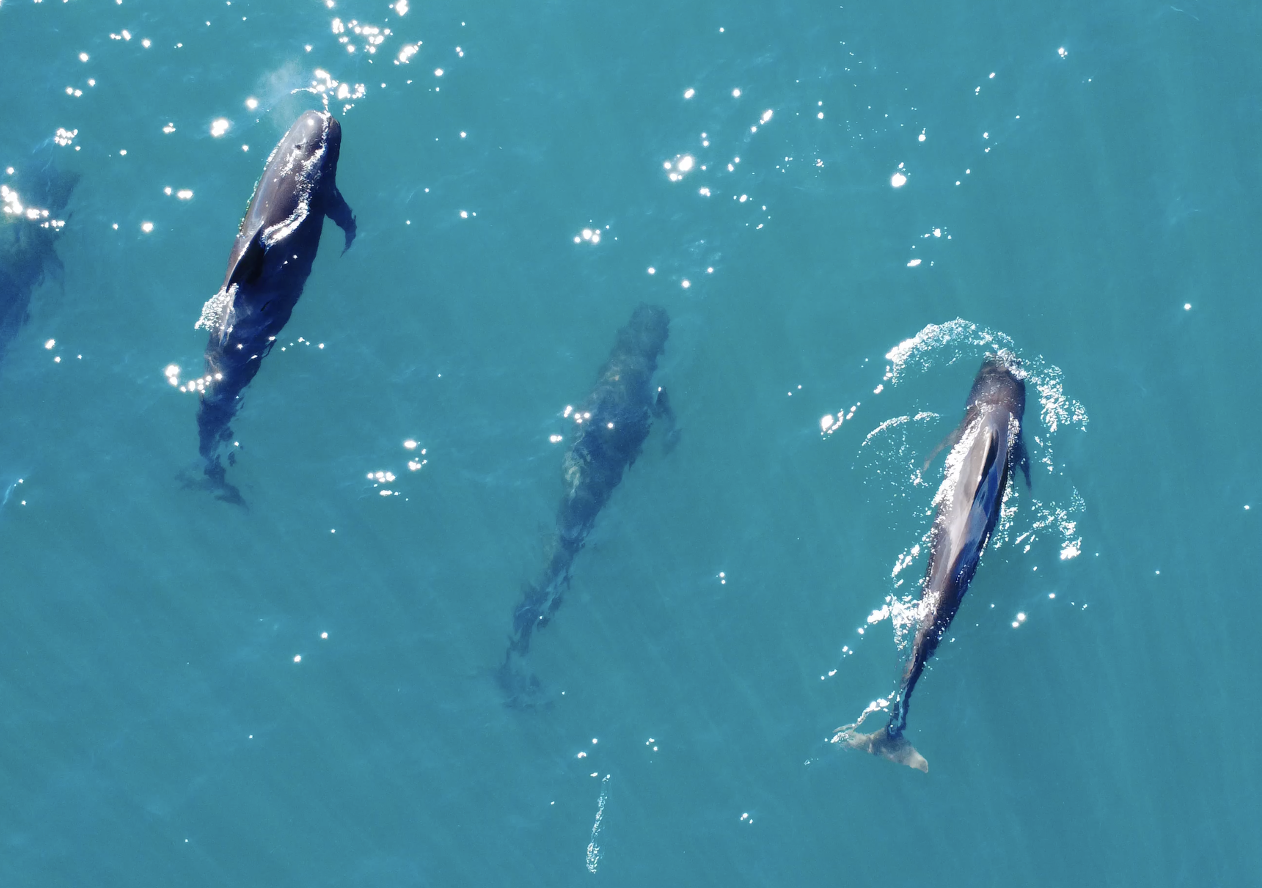
Pilot whales are highly social, with some of the strongest bonds known among cetaceans, and this aspect of their biology unfortunately makes them vulnerable to both mass strandings, and to drive fisheries (a method of using boats to herd and then hunt the whales) in which entire schools are killed. Group sizes tend to be large with dozens typical, and schools of many hundreds not at all uncommon. These consist of aggregations of what appear to be relatively stable maternal subgroups. These schools are often accompanied by other cetaceans (e.g., bottlenose, common, and Pacific white-sided dolphins; Risso’s dolphins; and gray whales - Betty et al. 2025) as well as occasionally California sea lions, perhaps because of superior squid-finding capabilities of the pilot whales.
Pilot whales are very vocal animals, and the acoustic sense is thought to be very important to these highly social animals; there may be group-specific information in their calls (Betty et al. 2025). Though not nearly as well studied in our waters as those of killer whales, the vocalizations of short-finned pilot whales are known to consist of both pure-tone whistles and various pulsed sounds (some used for echolocation and others apparently for social communication).&
The only major predator of short-finned pilot whales is probably our own species. The very large schools of the species may make them less vulnerable to shark attack (though some are known to occur), and although killer whales are certainly capable of attacking and eating pilot whales, there is significant evidence that suggests that killer whales may in fact often avoid pilot whales and even be threatened by them. The reasons for this are unknown, but pilot whale groups are generally much larger than those of killer whales, and so they may receive some level of safety from the large numbers. Their responses to mammal-eating killer whales resemble the ‘mobbing’ anti-predator behavior of some birds and land mammals (Betty et al. 2025).
Short-finned pilot whales face many threats in their extensive range, and although they are not as heavily hunted as their long-finned cousins, short-finned whales are taken in significant numbers, mostly in Japanese waters. Both drive fisheries, in which entire herds are driven ashore and slaughtered, and harpoon/crossbow fisheries take these animals in Japan (Kasuya 2017). Tragically, although quotas are set by the Japanese government, these are generally not based on rational estimates of sustainable takes. In the Yankee whaling days, mainly targeting sperm whales, pilot whales were sometimes taken when the target species was not readily available. In the eastern North Pacific, there is no known hunting at present, but pilot whales are taken in small numbers as bycatch in several purse-seine and gillnet/driftnet fisheries and have also been shot by fishermen who see them as competitors. Other threats include the impacts of environmental contaminants, habitat deterioration, various climate change effects, and behavioral disturbance from human activities (mostly whale-watching impacts and anthropogenic noise). There are about 850 pilot whales off the US west coast, about 19,000 in Hawai’i, and an estimated 590,000 in the eastern tropical Pacific (Betty et al. 2025). The species is not viewed as endangered and considering the areas where they have not been assessed, may number upwards of 750,000 throughout its global range.
Because they are so rare in inshore waters of the Pacific Northwest, there have been essentially no directed studies on the species here, and most of what we know comes from opportunistic records (sightings, strandings, and by-catches). With global climate change causing warming of water temperatures, it is certainly possible that pilot whale appearances in waters of Washington and BC will increase in occurrence, so one should be aware of this prospect. Any reports of sightings, strandings, or other records of pilot whales in the Salish Sea should be reported to NOAA in the US, or the Department of Fisheries and Oceans in Canada.
Data sources & gaps
Most status information in this report comes from Carretta et al. (2024). Monitoring and information gaps for this species exist, and there is inadequate information to determine the status and trends of this species along the West Coast. Information specific to the Salish Sea or Puget Sound is largely lacking.
Methods & statistics
Methods of determining the population status of the California/Oregon/Washington stock of short-finned whales mostly comes from vessel-based line-transect analysis (see Carretta et al., 2024).
References
Angell, T., & Balcomb, K. C. 1982. Marine Birds and Mammals of Puget Sound. Puget Sound Books.
Baird, R. W. and P. J. Stacey. 1993. Sightings, strandings and incidental catches of short-finned pilot whales, Globicephala macrorhynchus, off the British Columbia coast. Reports of the International Whaling Commission Special Issue 14:475-479.
Betty, E. L., A. E. Harshbarger, M. P. Martins, A. J. Read and E. M. J. Zwamborn. 2025. Pilot whales Globicephala melas (Traill, 1809) and G. macrorhynchus Gray, 1846. Pp. 589-650 in T. A. Jefferson ed. Ridgway and Harrison’s Handbook of Marine Mammals, Vol. 2: Oceanic Dolphins. Academic Press.
Calambokidis, J., & Baird, R. W. 1994. Status of marine mammals in the Strait of Georgia, Puget Sound and the Juan de Fuca Strait and potential human impacts. In R. C. H. Wilson, R. J. Beamish, F. Aitkens, & J. Bell (Eds.), Review of the marine environment and biota of Strait of Georgia, Puget Sound and Juan de Fuca Strait (Vol. 1948, pp. 282-303). Canadian Technical Report of Fisheries and Aquatic Sciences.
Carretta, J. V., E. M. Oleson, K. A. Forney, A. L. Bradford, K. Yano, D. W. Weller, A. R. Lang, J. Baker, A. J. Orr, B. Hanson, J. E. Moore, M. Wallen and R. L. Brownell Jr. 2024. U.S. Pacific marine mammal stock assessments: 2023. NOAA Technical Memorandum NMFS-SWFSC 704:420 pp.
Everitt, R. D., Fiscus, C. H., & DeLong, R. L. 1979. Marine mammals of northern Puget Sound and the Straits of Juan de Fuca. NOAA Technical Memorandum ERL-MESA, 41, 141 pp.
Everitt, R. D., Fiscus, C. H., & DeLong, R. L. 1980. Northern Puget Sound marine mammals (EPA-600/8-80-139).
Ford, J. K. B. 2014. Marine mammals of British Columbia. Royal British Columbia Museum, Victoria, British Columbia, Canada. 460pp. ISBN 978-0-7726-6734-2.
Home, W. S. 1980. Pacific pilot whales: repeated, localized sightings in southeastern Alaska. Wasmann Journal of Biology 38:18-20.
Jefferson, T. A. and A. Schulman-Janiger. 2018. Investigating the disappearance of short-finned pilot whales (Globicephala macrorhynchus) from southern California: Did fisheries play a role? Bulletin of the Southern California Academy of Sciences 117:29-51.
Jefferson, T. A., Webber, M. A., & Pitman, R. L. 2015. Marine Mammals of the World: A Comprehensive Guide to Their Identification, Second Edition. Academic Press/Elsevier.
Kasuya, T. 2017. Small Cetaceans of Japan: Exploitation and Biology. CRC Press.
Norman, S. A., Bowlby, C. E., Brancato, M. S., Calambokidis, J., et al. 2004. Cetacean strandings in Oregon and Washington between 1930 and 2002. Journal of Cetacean Research and Management, 6(1), 87-100.
Orr, R. T. 1951. Cetacean records from the Pacific coast of North America. Wasmann Journal of Biology 9:147-148.
Osborne, R., Calambokidis, J., & Dorsey, E. 1988. A Guide to Marine Mammals of Greater Puget Sound. Island Publishers.
Scheffer, V. B., & Slipp, J. W. 1948. The whales and dolphins of Washington State, with a key to the cetaceans of the west coast of North America. American Midland Naturalist, 39, 257-337.
Shane, S. H. 1995. Behavior patterns of pilot whales and Risso's dolphins off Santa Catalina Island, California. Aquatic Mammals 21:195-198.
Shane, S. H. 1995. Relationship between pilot whales and Risso's dolphins at Santa Catalina Island, California, USA. Marine Ecology Progress Series 123:5-11.
Van Cise, A., P. A. Morin, R. W. Baird, A. Lang, K. M. Robertson, S. J. Chivers, R. L. Brownell Jr. and K. K. Martien. 2016. Redrawing the map: mtDNA provides new insight into the distribution and diversity of short-finned pilot whales in the Pacific Ocean. Marine Mammal Science 32:1177–1199.
Acknowledgements
The author thanks the University of Washington Puget Sound Institute for funding, and the Puget Sound Ecosystem Monitoring Program's Marine Mammals Working Group for helping to facilitate the production of this chapter.
Licensing & attribution
Data and products from the PSEMP Marine Mammal Work Group are governed by a Creative Commons BY-NC-SA license. Attribution should be to: “PSEMP Marine Mammal Work Group” with a link back to https://psemp.net/mmwg.