

Summary report of 2024 human wellbeing Vital Signs survey
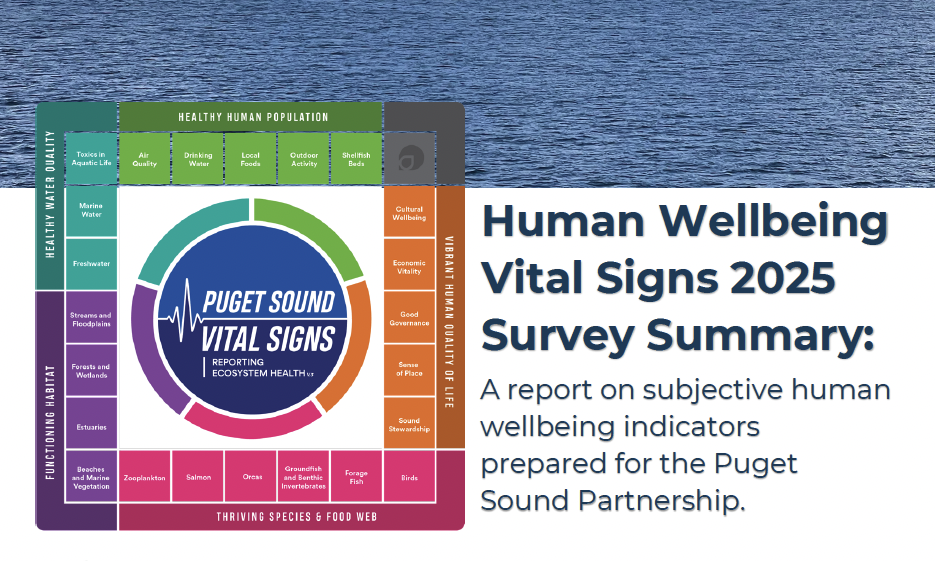
This report covers the fourth Human Wellbeing survey iteration to monitor human wellbeing vital signs. The Vital Signs are monitored to assess the overall health of the ecosystem in the Puget Sound, including aspects that directly measure human quality of life and healthy human populations. These indicators are considered "subjective" as they are based on or influenced by personal feelings, opinions, and experiences of respondents living in the Puget Sound.
Unless otherwise listed, there were no significant differences between 2018, 2020, 2022, and 2024 survey results:
2024 Survey Response Rate: 23%
Good Governance: 4.19 on a scale of 1-7 (where 1 is strongly disagree and 7 is strongly agree)
- Score equates to ‘neutral’ response. Respondents do not feel strongly in agreement or disagreement about how the environment around them is managed and whether they feel heard in decision making.
Local Foods: 1.36 on a scale of 1-5 (where 1 is never and 5 is >10 times/season)
- The majority of residents never collected \or harvested local foods.
Sound Stewardship: 3.30 on scale of 1-5 (where 1 is never and 5 is almost daily)
- Residents engage in stewardship activities at least once a month, or, ‘occasionally’.
Cultural Wellbeing: 3.84 on a scale of 1-5 (where 1 is dissatisfied and 5 is satisfied)
- Residents feel ‘neither satisfied nor dissatisfied’ with their level of participation in cultural traditions related to the natural environment.
Sense of Place is composed of 3 indicators
Sense of Place: 5.47 on a scale of 1-7 (where 1 is strongly disagree and 7 is strongly agree)
- Residents ‘somewhat agree’ that they have a sense of place associated with the Puget Sound.
Psychological Wellbeing: 4.07 on a scale of 1-5 (where 1 is 1-4x/year and 5 is almost daily)
- Residents experience inspiration or stress reduction from the outdoors almost once a week, or ‘regularly.
Overall Life Satisfaction: 5.92 on a scale of 1-5 (where 1 is dissatisfied and 7 is satisfied)
- Residents feel ‘somewhat satisfied’ with their life.
- This result is not comparable to previous scores due to a change in the question.
Outdoor Activity is composed of 2 indicators
Nature-Based Recreation:
- Fall outdoor activity patterns Gardening/yardwork (73% of residents), use of paved paths/trails (55%), and unpaved paths/trails (51%) were the most frequently engaged activities (more than once per month). There were slight, non-significant declines in gardening/yardwork and wildlife viewing.
- Spring outdoor activity Gardening/yardwork (81%), use of paved paths/trails (60%), and wildlife viewing/birding (59%) were the most common activities (more than once per month). There were non-significant decreases in gardening/yardwork and wildlife viewing since 2020.
Nature-Based Work:
- 10.4% of respondents said their work involved time outdoors, lower than previous years.
- Roughly 53% of those respondents work more than 10 hours per week.