Plankton

The word “plankton” comes from the Greek for “drifter” or “wanderer.” An organism is considered plankton if it is carried by tides and currents, and cannot swim well enough to move against these forces. Some plankton drift this way for their entire life cycle. Others are only classified as plankton when they are young, but they eventually grow large enough to swim against the currents. Plankton are usually microscopic, often less than one inch in length, but they also include larger species like some crustaceans and jellyfish.

Scientists classify plankton in several ways, including by size, type, and how long they spend drifting. But the most basic categories divide plankton into two groups: phytoplankton (plants) and zooplankton (animals).

--Source: NOAA National Ocean Service
Related Articles

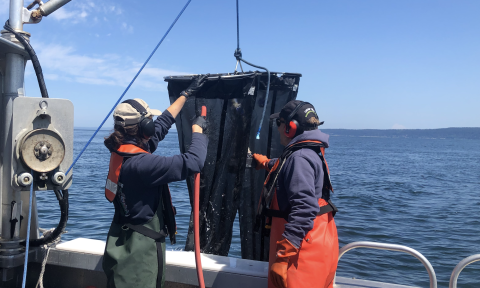
Zooplankton are critical to the marine food web, but until recently there have been few surveys of the zooplankton community in Puget Sound. Ongoing monitoring is now revealing a system full of complexity and surprises. The following article was commissioned by the Habitat Strategic Initiative Lead (HSIL), a cross-agency team co-led by the Washington Departments of Fish and Wildlife and Natural Resources.

In many parts of Puget Sound, hypoxic waters are thought to be at least in part due to overgrowth of microscopic algae, which is triggered by excess nitrogen. That means it’s important to understand the dynamics of primary productivity – the rate at which those microscopic algae, known as phytoplankton, produce organic matter through photosynthesis and in this way provide the base of the food web. Researchers are investigating different types of phytoplankton and rates of primary productivity throughout the Salish Sea, and seeking to understand how primary productivity is likely to change as climate change alters patterns of coastal upwelling and freshwater flow into the Sound.

Diverse communities of microscopic organisms called phytoplankton make up the base of the aquatic food web. In that role, they are essential to the tiny animals that eat them, but phytoplankton are not dependent on others. Thanks to chlorophyl, these tiny organisms can generate their own energy from nutrients and sunlight. Despite their critical importance to a great diversity of sea life in Puget Sound, phytoplankton can also contribute to low-oxygen conditions, and some can be harmful in other ways.