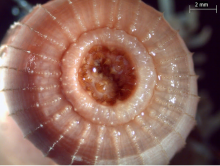
Priapula are a small phylum of small, worm-like animals found in Puget Sound. They occur in most seas, both tropical and polar, at a variety of depths, from shallow coastal waters to as far down as 7,200 meters.
By Dany Burgess & Angela Eagleston of the Washington State Department of Ecology
The Puget Sound Nearshore Ecosystem Restoration Project (PSNERP) works to assess the health of Puget Sound nearshore environments and provides strategies for their protection and restoration.
By Puget Sound Nearshore Ecosystem Restoration Project
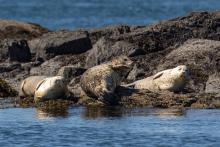
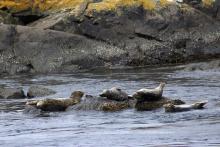
A 2020 article in the journal Frontiers in Marine Science looks at harbor seal stranding and necropsy findings in the San Juan Islands to assess age-related stranding trends and causes of mortality. The harbor seal (Phoca vitulina richardii) population in the Salish Sea has been at equilibrium since the mid-1990s. This stable population of marine mammals resides relatively close to shore near a large human population and offers a novel opportunity to evaluate whether disease acts in a density-dependent manner to limit population growth.
By Elizabeth A. Ashley, Jennifer K. Olson, Tessa E. Adler, Stephen Raverty4, Eric M. Anderson, Steven Jeffries and Joseph K. Gaydos
A 2022 article in the journal Environmental Science & Policy looks at how knowledge exchange across organizations influences science-based ecosystem recovery in Puget Sound. The University of Washington Puget Sound Institute describes its work to identify and communicate key scientific findings that support funding and policy decisions on an ecosystem scale.
A 2014 paper in the journal PLoS ONE examines differences between foraging behavior of harbor seals based on haulout site locations, seasons, sexes and times of day. The authors hypothesize that these factors may help explain the variability in diet among harbor seals observed at different haul-out site groups in the Salish Sea.
By Kenady Wilson, Monique Lance, Steven Jeffries, Alejandro Acevedo-Gutiérrez
The Pathogens Prevention Reduction and Control agreement between the Environmental Protection Agency and the Washington State Department of Health focuses on the prevention and reduction of pathogen pollution in Puget Sound through the management of human and animal waste. The primary objectives of the agreement include restoring shellfish growing areas, avoiding shellfish closures, and protecting people from disease.
A pale species, bluish areas being ampler than in most other Aeschnas. Face greenish blue, more or less overspread with brownish except on sides of the frons and facial lobes of postclypeus. Black crossbands on fronto-clypeal suture and on both front and rear margins of labrum. Black T spot above has an ill-defined front margin; its stalk is widened to its confluence with black of vertex. Top of...
This is the Puget Sound Water Quality Action Team's third report on key indicators of Puget Sound's Health. We prepared the report in response to the Washington State Legislature's request to evaluate efforts to protect Puget Sound. The report includes updated information on the 17 indicators presented in 2000 as well as information on two new indicators.
Thousands of different compounds are produced and used as part of our daily lives. Examples include pharmaceuticals (NSAIDs, birth control pills, etc), personal care products (sun screen agents, scents, preservatives, etc), food additives (artificial sweeteners) and compounds used in industrial and commercial applications (flame retardants, antibiotics, etc). Advances in analytical methods have allowed the detection of many of these compounds in the environment.
Fishes, birds, and mammals (including humans) serve as top-level carnivores in the Puget Sound ecosystem. With the exception of humans, these organisms have a diet that consists almost entirely of fish or other vertebrates.
By Sound Science Contributors; NOAA Fisheries, Northwest Fisheries Science Center