

Advanced Search
Or
Oct 30, 2013
Eyes Over Puget Sound: Surface Conditions Report - October 28, 2013
Puget Sound conditions are normalizing after seven months of lower oxygen. Calm, dry, cool, and foggy mornings abruptly changed on October 28 to sun and strong northerly winds. Red-brown blooms and abundant jellyfish in south Puget Sound inlets appeared as we flew to the coast. Blooms were still visible near ocean beaches and inner bays. Grays Harbor had abundant surface debris with green algae in North Bay. We spotted red-brown blooms in rivers and sloughs in Willapa Bay, as well as schooling fish near sandbanks. Many patches of suspended sediment appeared in shallow water unrelated to tidal currents and remain unexplained.

Nov 23, 2013
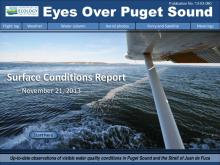
Eyes Over Puget Sound: Surface Conditions Report - November 21, 2013
After weeks of clouds and warmer air, blue skies and cold temperatures set in. Strong tidal fronts and sediment-rich brackish plumes leave Whidbey Basin and move into Admiralty Reach. A pod of Orcas follows the edge of the plume heading north! Red-brown blooms continue in Henderson, Eld, and northern Budd Inlets. Long organic debris lines are numerous in northern Budd Inlet, Hood Canal, and in Central Sound north of Edmonds (Triple Junction). Conditions in the water column in Puget Sound continue to normalize after seven months of lower oxygen. Water is very clear for this time of the year, particularly in the north.
Dec 30, 2013
Eyes Over Puget Sound: Surface Conditions Report - December 31, 2013
The year 2013 in pictures: Low oxygen conditions persisted from January into August and broke a two-year anomaly of more favorable water quality conditions (lower temperature and salinity and higher dissolved oxygen). Dramatic Noctiluca blooms appeared one month earlier than normal (May), lasted for two months, and coincided with lower oxygen. Large jellyfish patches persisted over the winter but then were less visible for the rest of the year. Large drifting algal mats appeared in August.

Feb 06, 2014
Eyes Over Puget Sound: Surface Conditions Report - February 4, 2014
Air temperatures have fallen due to unusually weak northern winds bringing in cold air. A dry beginning to winter causes low river flows. This dry winter brings new Puget Sound conditions with colder saltier waters observed in the northern regions. Oxygen has stabilized again within expected ranges. Suspended sediments along wind and wave exposed beaches add artful brushstrokes to the Puget Sound waterscape. Jellyfish are still going strong in Eld Inlet. Oil seen leaking from a boat in Commencement Bay and Ecology’s Spills Program responds. Our intern, Clifton, brings renewed passion to monitoring!

Mar 26, 2014
Eyes Over Puget Sound: Surface Conditions Report - March 24, 2014
River flows are above normal and air temperatures are increasing slowly. The spring phytoplankton bloom is slow to develop with visible blooms limited to smaller bays such as Sequim and Bellingham Bays. Noctiluca observed in East Sound on Orcas Island, coinciding with high numbers of jellyfish. Debris lines are mostly confined to Hood Canal. Pockets of colder water observed in Central Sound and Hood Canal, likely from the colder, saltier conditions that developed during the winter in the northern regions. Oxygen is variable yet close to expected ranges. Sizable oil sheens were sighted in Gig Harbor and Carr Inlet.

Apr 23, 2014
Eyes Over Puget Sound: Surface Conditions Report - April 21, 2014
Air temperatures have been slightly warmer and river flows are higher. Blooms are present only in Whidbey Basin and isolated bays. The water column otherwise is relatively clear. Sediment rich water is entering from the Stillaguamish River. Debris lines were visible in Hood Canal and North Sound. Multiple reported oil sheens seen in Lake Washington Ship Canal. Generally, the year 2014 started colder and saltier throughout Puget Sound. Oxygen is lower in Whidbey Basin, Central and South Sound, but higher in Hood Canal. Upwelling favorable conditions stimulate a spring phytoplankton bloom off the Washington coast.

May 14, 2014
Eyes Over Puget Sound: Surface Conditions Report - May 12, 2014
The weather changed from cool, cloudy and southerlies, to sunny warm conditions and light northerly winds on Mother’s Day. At the water surface, blooms and large debris lines occur in Bellingham, Padilla, and Samish Bays, Hood Canal, East Sound, and the Straits, as well as the finger inlets of South Sound. Large amounts of sediment-laden water from Port Susan are flowing into Central Basin. Turquoise water mixing to the surface in places around the San Juan Islands. After some trouble-shooting of the hardware and communication system, we will resume collecting Victoria Clipper data next week. Meet Eyes Under Puget Sound: Sediment Monitoring Program at Ecology.

Jun 25, 2014
Eyes Over Puget Sound: Surface Conditions Report - June 23, 2014
Onshore winds have been keeping the Puget Sound lowlands cool and cloudy, but sunlight and warmer temperatures are returning. Large organic mats of surface debris in Hood Canal, Padilla Bay, and Lay Inlet; many are macro-algae. Strong red-brown blooms in Discovery Bay, East Sound, and parts of Georgia Basin. Sediment-rich water north of San Juan Islands. Jelly fish are increasing in numbers. Colder, saltier conditions in early 2014 and lower oxygen in Whidbey Basin, Central, and South Sound continue. Hood Canal remains unusually cold. At our Mukilteo mooring, temperatures are similar to last year, but salinity and dissolved oxygen follow the Puget Sound-wide trend. Guest feature on phytoplankton monitoring, plus an in-depth look at our mooring program. Our technology now hitching a ride on the state ferries!

Jul 30, 2014
Eyes Over Puget Sound: Surface Conditions Report - July 28, 2014
Warmer and sunnier days result in higher than normal river flows from the Skagit and Nisqually. Biological activity in the water column is high. Abundant organic surface debris in Hood Canal, Padilla Bay, and many Inlets. Red-brown blooms in South Sound, Discovery Bay, and regions of Bellingham Bay. Different blooms in Skagit Bay, Padilla Bay, and Sinclair Inlet. Jelly fish are numerous in all southernmost South Sound Bays. Hood Canal remains cold but Puget Sound-wide temperatures are now warmer and less salty. Data from the Victoria Clipper and our sampling in the Strait provides important information on water exchange with the ocean.
