Fish in the family Salmonidae (salmon, trout, and charr) play potentially integral roles in the upland freshwater, nearshore and pelagic marine ecosystems and food webs of Puget Sound.
By Tim Essington, Terrie Klinger, Tish Conway-Cranos, Joe Buchanan, Andy James, Jessi Kershner, Ilon Logan, and Jim West for the Puget Sound Science Update
Migration patterns have apparently reawakened for the Elwha River's wild steelhead. Studies show that the fish may have retained much of their genetic drive despite 100 years of being trapped behind dams. We continue our series 'Returning home: The Elwha's genetic legacy' with part two of seven.
Here we focus on strategies that address broad-scale impacts in Puget Sound. We discuss perhaps the two must ubiquitous drivers, human footprint and climate change, recognizing that all other strategies must be imbedded within the context of these ultimate drivers. This review concentrates on publications that focus on Puget Sound, or at least the Pacific Northwest, including: Clanc...
This version of the Puget Sound Science Update provides an initial evaluation of food web indicators, but is not intended to be comprehensive. Highlights include the evaluation of individual species or species complexes as food web indicators due to their key functional roles (e.g., forage fish, jellyfish), and the identification of existing data sources for assessing food web struc...
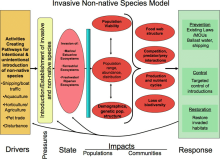
Non-native species are those that do not naturally occur in an ecosystem. A non-native species is considered invasive when it is capable of aggressively establishing itself and causing environmental damage to an ecosystem. Plants, animals, and pathogens all can be invasive. Typical traits of an invasive species include: 1) generalist; being able to survive in a variety of physical a...
In this last section, we briefly present a framework for establishing connections between potential indicators of ecosystem biophysical conditions and human well-being in Puget Sound. The framework also provides a way of characterizing existing and future studies and data that are relevant to an element of the set of potential HWB indicators.
1. Connections between biophy...
Many groups have been formed around the goal of saving salmon, but few people talk about a concerted effort to save microscopic creatures. Whether or not a pro-bug movement catches on, future strategies to save salmon are likely to incorporate ideas for restoring streambound creatures known as benthic invertebrates.
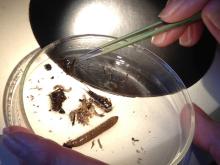
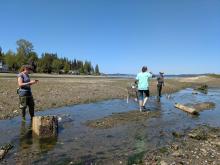
Crab Team members maintain a massive surveillance program to track the population’s advance, while researchers probe the inner workings of the invasive species.
New technology is helping to remove deadly “ghost nets” that have been lost in the depths of Puget Sound. It is part of an effort that saves millions of animals every year, but managers say better reporting of these lost nets by fishermen is still needed.