The Washington Department of Fish and Wildlife has published a comprehensive set of guidelines for managing shoreline development such as bulkheads and seawalls.
By Johannessen, J., A. MacLennan, A. Blue, J. Waggoner, S. Williams, W. Gerstel, R. Barnard, R. Carman, and H. Shipman
Cooler and wetter conditions early in 2017 have set the stage for a favorable supply of freshwater. River flows are all above normal due to melting of the abundant snowpack from warmer May air temperatures. This is creating significantly fresher conditions in Puget Sound surface waters. Algae blooms are limited to some yellow-green blooms growing in bays near the Kitsap Peninsula and blooms near estuaries of the Skagit, Stillaguamish, and Puyallup Rivers. Red blooms are present in rivers feeding into Willapa Bay. Also see what is “blooming” in the sediments of Puget Sound.
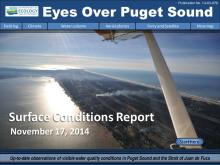
A recent cold spell hits Puget Sound lowlands, interrupting this year’s warmer air temperatures. The warm ocean coincides with new maximum water temperatures observed throughout Puget Sound in October! Hood Canal’s higher dissolved oxygen and cold water anomalies are disappearing. November brings cold water from Whidbey Basin into Puget Sound with moderate levels of chlorophyll fluorescence. Abundant smacks of jellyfish in finger inlets of South Sound observed from our flight. Red-brown blooms remain strong in smaller bays of South Sound. Visible suspended sediments in the coastal estuaries from rain, wind, and waves. Playing in the water? Visit our BEACH program.
Although fall and winter were warm, February brought cold snowy weather and low river flows. Despite colder air temperatures, the productive season has already started in Hood Canal and Holmes Harbor. Puget Sound waters were warmer than expected through January, and the warmest waters were in Hood Canal, possibly creating a thermal refuge for cold-sensitive species such as anchovies. We saw lots of sea lions feasting on anchovies in Case Inlet, and we may have captured some herring spawning activity. Unusual for mid-winter, we saw jellyfish patches in Eld and Budd inlets. See the new publication about ocean acidification featuring twenty-five years of our marine monitoring data!
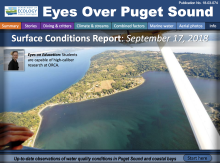
After a dry and sunny summer extending well into October, air temperatures are cooler than normal and precipitation has increased allowing rivers to regain strength. Despite a dry summer, Puget Sound is fresher this year than the past 17 years. As of September, warmer temperatures remained in South Sound. In October, surface water in the Straits however began to cool and the influence of rivers can be seen in our ferry data. Leaves drift on the water in South Sound and smaller blooms are confined to inlets as the productive season winds down. Meet our new intern and discover if Puget Sound really has sea spiders.
Puget Sound conditions are normalizing after seven months of lower oxygen. Calm, dry, cool, and foggy mornings abruptly changed on October 28 to sun and strong northerly winds. Red-brown blooms and abundant jellyfish in south Puget Sound inlets appeared as we flew to the coast. Blooms were still visible near ocean beaches and inner bays. Grays Harbor had abundant surface debris with green algae in North Bay. We spotted red-brown blooms in rivers and sloughs in Willapa Bay, as well as schooling fish near sandbanks. Many patches of suspended sediment appeared in shallow water unrelated to tidal currents and remain unexplained.
Air temperatures have remained high with precipitation and river flows below normal, extending the summer’s unusual conditions. Water temperatures were warmer in August, perhaps too warm for bull kelp and some salmon species in South Sound. In contrast, Hood Canal, North Sound, and the San Juan Islands provide optimal growth temperatures for herring and salmon. Many terminal inlets of Puget Sound are experiencing extensive red-brown blooms. Jellyfish patches are developing in South Sound finger Inlets and remnants of floating macroalgae occur in the nearshore areas of South Sound and in Useless Bay. At times floating organic material we see from the air ends up on the shoreline were our BEACH team documents it.
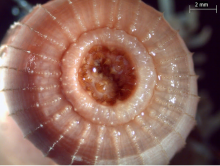
Priapula are a small phylum of small, worm-like animals found in Puget Sound. They occur in most seas, both tropical and polar, at a variety of depths, from shallow coastal waters to as far down as 7,200 meters.
By Dany Burgess & Angela Eagleston of the Washington State Department of Ecology
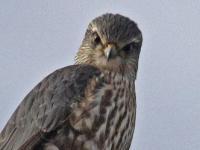
A small falcon with pointed wings, a strongly barred tail, a hooked bill, and heavy streaking below; upperparts are gray-blue in males, dark brown in females; overall, plumage is much darker in the Pacific Northwest than in central Canada and the Midwest; average length 31 cm, wingspan 64 cm (NGS 1983).
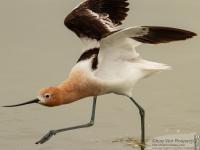
A large slender shorebird with a long, slender, recurved bill (longer and straighter in males than in females), long spindly legs, and a long neck; wings and back are boldly patterned with black and white; belly and flanks are white; head and neck and rusty in breeding plumage, gray in basic plumage; juveniles have a cinnamon wash on the head and neck; average length 46 cm (NGS 1983).