

Sperm whales: A rarity in the Salish Sea
Overview
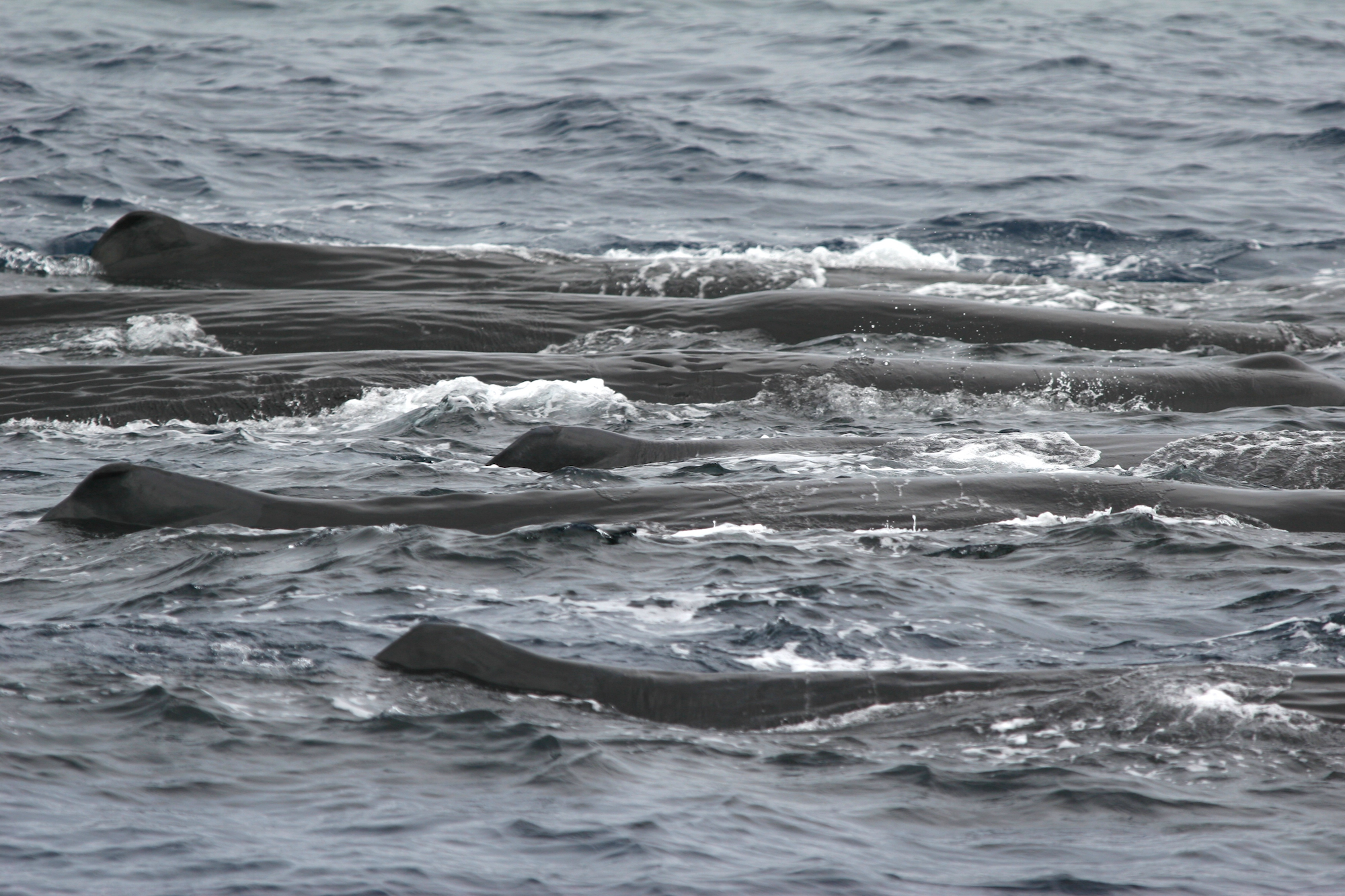
Immortalized in "Moby Dick," Herman Melville’s classic tale of ‘man vs. nature,’ the sperm whale is what most people envision when they think of a whale. In reality, the sperm whale is a very distinctive species, unlike any other living marine mammal. Their huge size, boxcar-like body shape, and angled blow make them easy to recognize in the field, and their deep diving habits and complex social structure fascinate scientists and lay people alike. Their extensive global range does not include most inshore, protected waters as favored habitat. As such, sperm whales are very rare in Puget Sound and the Salish Sea, with only a single documented record of a sighting in Haro Strait in 2018.
Status, trends & events
Sperm whales (Physeter macrocephalus) have been aptly described as ‘ocean nomads’ (Mizroch and Rice 2013) and they range widely throughout the world’s oceans. Unlike most other species of large whales, evidence for distinct populations is rare, and there may be more mixing of sperm whales in different ocean basins and even different hemispheres than in other marine mammal species. NOAA Fisheries recognizes only a single stock for management in US waters (the California/Oregon/Washington stock), though there is little doubt that those animals range south into Mexico, north into British Columbia, and offshore into the oceanic Pacific.
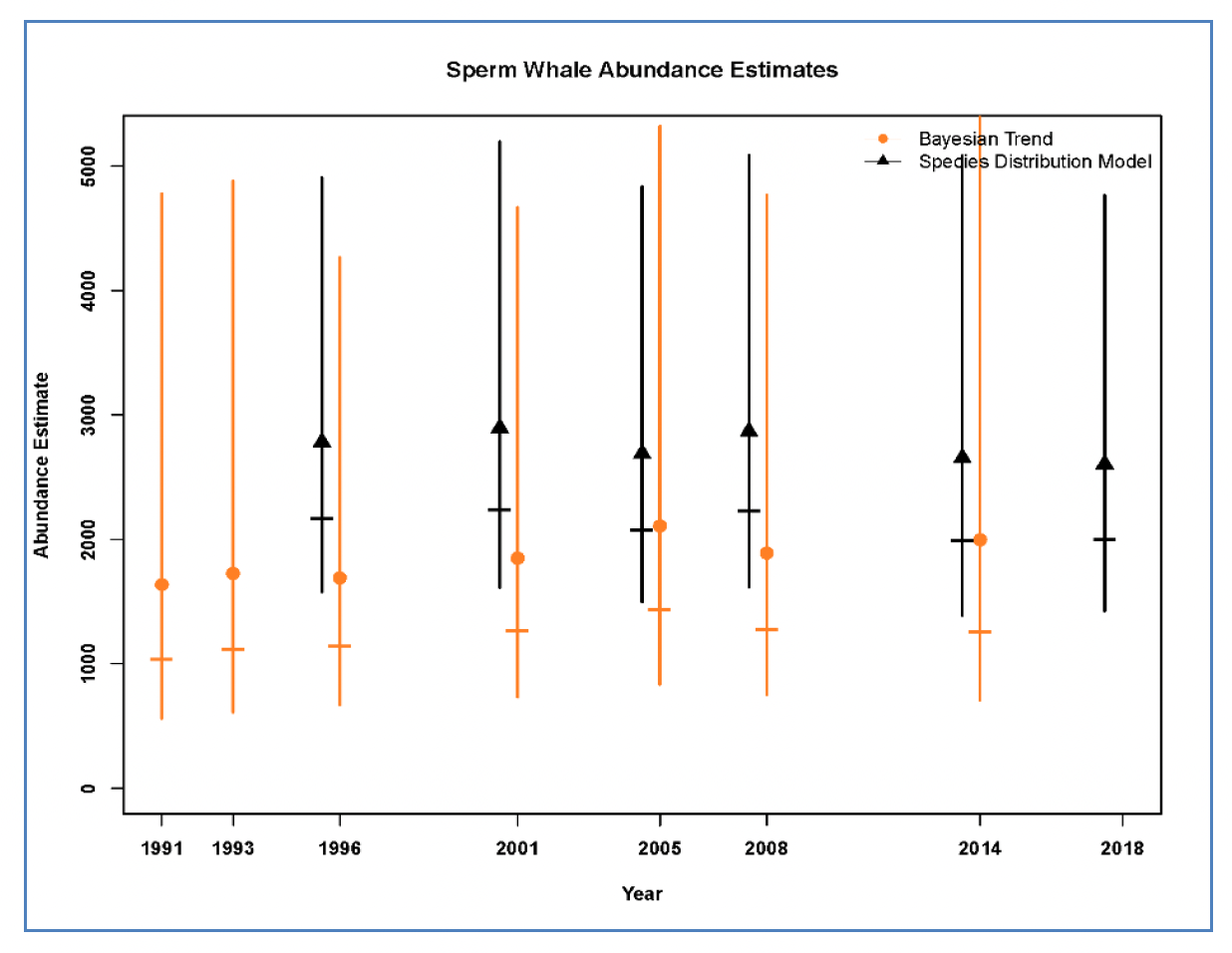
Though not in any immediate danger of extinction globally, the sperm whale is listed as Endangered under the US Endangered Species Act and is considered ‘Depleted’ and a ‘Strategic Stock’ under the US Marine Mammal Protection Act. This is mostly due to lingering effects of the two phases of whaling that targeted sperm whales throughout the world’s oceans (see Natural History and Biology below). Current anthropogenic sources of mortality in US west coast waters come primarily from fisheries bycatch and vessel strikes. Evidence for both in our waters is rare, but it is likely that these factors are underestimated by current data. The current best estimate of the number of sperm whales that inhabit the US West Coast Exclusive Economic Zone, or EEZ (defined as the California/Oregon/Washington stock), is 2,606 (CV = 0.14), and their numbers appear to be relatively stable (Carretta et al. 2023).
Natural history
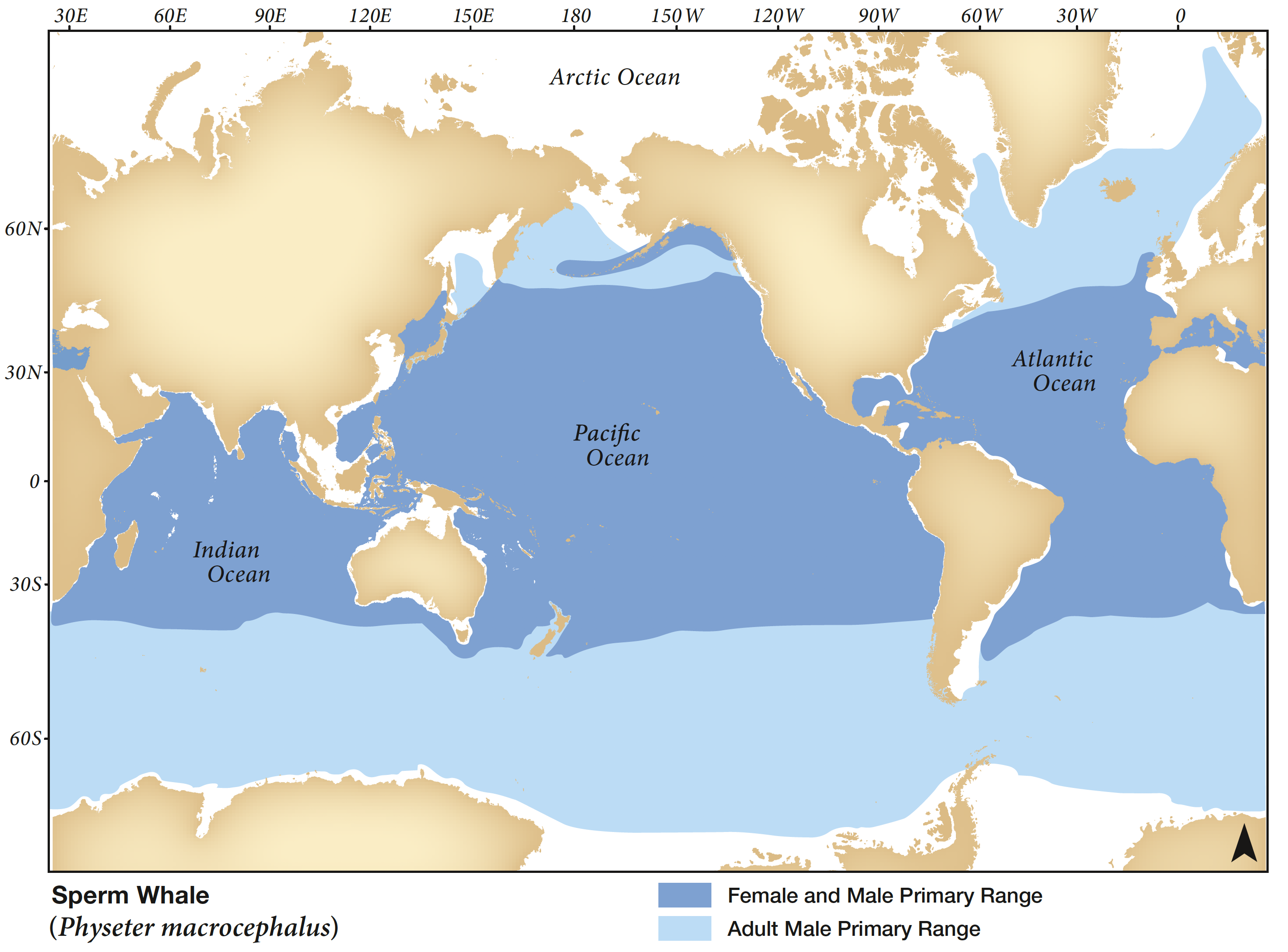
The general habitat preferred by sperm whales is deep water beyond the edge of the continental shelf with enhanced primary productivity, where the deepwater squid that form the bulk of their diet are abundant. Whalers in the 19th century discovered many of these places through trial and error and referred to the main ones they found as “grounds”. These then became the main focus of their searches for whales to hunt. Bathymetric features such as submarine canyons, seamounts, and shelves with steep edges are especially favored by the whales for their enhanced feeding opportunities (Mizroch et al. 2026). While sperm whales can be found from the equator to near the ice edges in both hemispheres, they are unusual in that there is a strong sexual difference in habitat preferences in relation to latitude. Females of all ages and young males not yet sexually mature are found almost exclusively in tropical to warm temperate waters within 40° of the equator. Adult males use these areas when searching for mates but spend much of their time feeding in cold temperate and subpolar waters (see Fig. 4).
Sperm whales, as denizens of deep waters, are quite rare in the inshore waters of Washington and British Columbia (though they are not uncommon on the outer coasts). However, 20th century coastal whaling operations in BC did occasionally report catching this species in some of the waters over the continental shelf of Dixon Entrance, Hecate Strait, and Queen Charlotte Sound (Ford 2014). These occurred mostly from the months of April through September, though this was certainly affected by a seasonal bias in the months of whaling effort (see Gregr et al. 2000). None of the older species reviews of marine mammals in Puget Sound/Salish Sea reported any sperm whale records for the area (e.g., Scheffer and Slipp 1948; Everitt et al. 1979, 1980; Angell and Balcomb 1982; Osborne et al. 1988; Calambokidis and Baird 1994; Norman et al. 2004; Ford 2014). Ford (2014) did report picking up sperm whale clicks in 1984 on a fixed hydrophone in Telegraph Cove, in Johnstone Strait, BC, though the whale was never seen. As far as is known, the only documented record of a sperm whale in the Salish Sea was a 31 March 2018 encounter of a male swimming in Haro Strait, near the San Juan Islands (see links). This was a known male, estimated at about 45 feet in length, who had been seen earlier in February that year in central BC, and he was named Yukusam.
Large deepwater squid of the genera Moroteuthis, Dosidicus, Mesonychoteuthis, Taningia, and Architeuthis are the preferred prey of sperm whales, though they also feed on smaller cephalopods, demersal fishes, and occasionally even crustaceans. Male sperm whales generally eat larger prey than do females, and fish make up a larger part of their diet as well. Non-food items are sometimes found in sperm whale stomachs, including various sorts of flotsam and jetsam, but it is not known why they ingest these items (Mizroch et al., 2026).
Biology
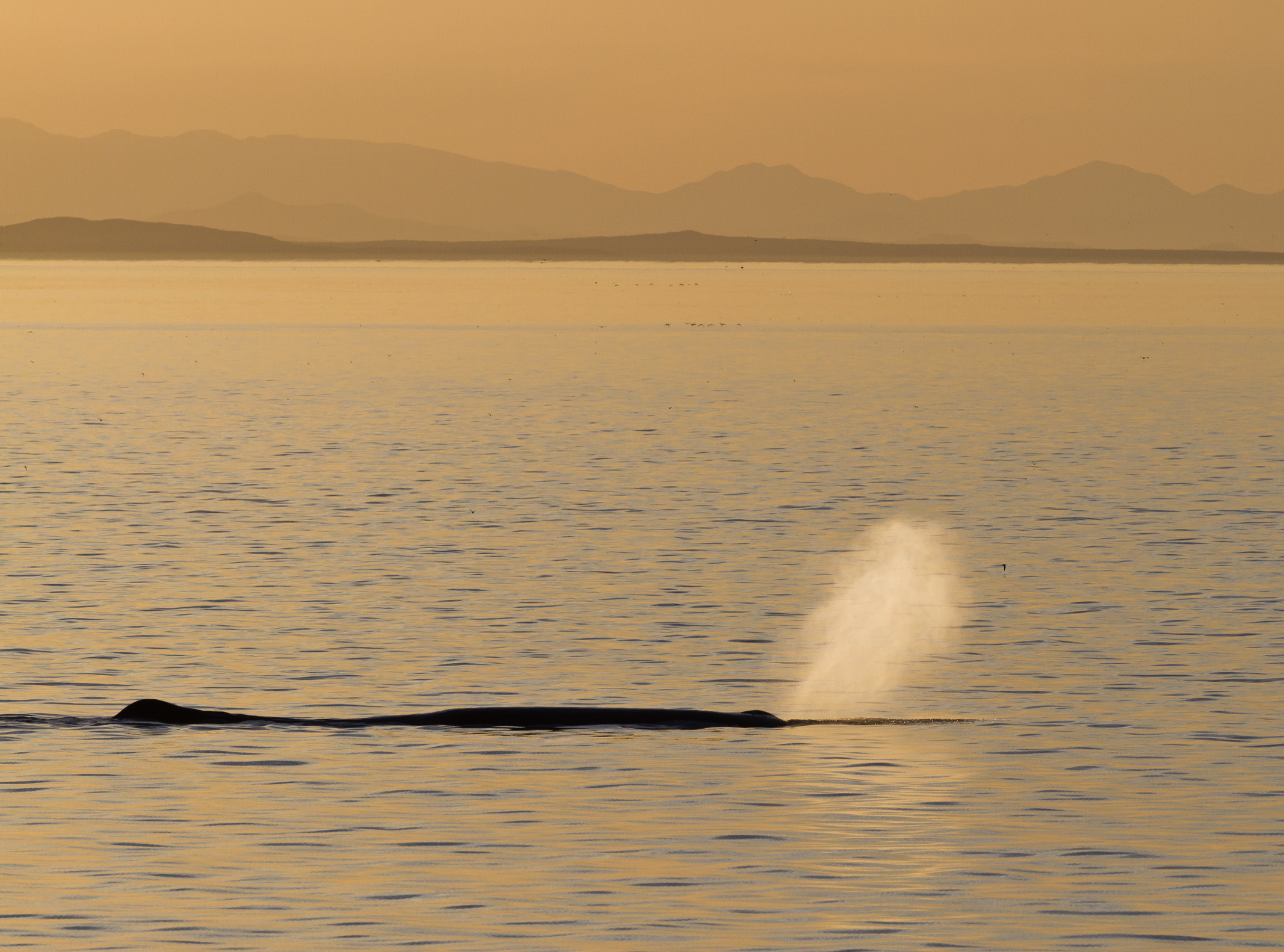
The sperm whale is the largest species of toothed cetacean, and the largest predator that currently lives on the planet (the larger species of baleen whales are better described as “grazers’). They are extremely sexually dimorphic, with females growing to 12.5 m, and males reaching 19.2 m and 57,000 kg in weight. This sexual dimorphism is more extreme than in any other species of whale or dolphin. Newborns are about 1,000 kg in weight and 3.5-4.5 m in length. With a huge head shaped like a boxcar, which may make up to 1/3 of their total length, sperm whales are bizarre-looking creatures. There is a single blowhole, which is located at the very front of the forehead and is offset to the left. Their color is mostly black to dark gray (which can look brownish in some lighting), with variably shaped white areas around the mouth and often on the underside. Anomalously white individuals (some perhaps albinos) have been reported many times, and the fictional “Moby Dick” was actually based on real white whales encountered by whalers. There are no erupted teeth in the upper jaw, and 18-26 pairs of teeth in the lower jaw, shaped like pointed cones or blunt pegs (the latter mostly in old individuals). The blow is angled forward and to the left at about 45°, and is bushy reaching up to about 5 m high (Jefferson et al. 2015).
Sperm whale group organization revolves around stable social units composed of typically 3-25 females of all ages, and their offspring. These pods are maternally based and are characterized by unique acoustic calls, and the communal rearing and protection of young. However, males leave these social units at ages of 6-16 years, around the time before they reach sexual maturity. From that point on the males lead lives in which they either gather with other “bachelor” males or are essentially solitary. These bulls (as they are called) roam widely throughout the colder waters of the world to feed and occasionally visit the warm tropical/subtropical waters where the females are found, associating briefly with social units for mating opportunities (Mizroch et al. 2026).
To a large extent, the sounds made by sperm whales are clicks, although some tonal sounds (described as trumpets, squeals, and pips) are also produced. The clicks fall into four categories: (1) usual clicks, (2) creaks, (3) codas, and (4) slow clicks. Usual clicks are primarily used in echolocation for long-range detection of prey. Creaks are apparently used to home in on and update the positions of detected prey. Codas are stereotyped click patterns that are used mostly by members of social units in distinct repertories for communication (and possibly for identification). Slow clicks are only known to be produced by adult males, and their function or functions are unknown, but may act as an acoustic display related to breeding, similar to song in some baleen whales (Mizroch et al. 2026).
Other than humans, the only significant predator of sperm whales is the killer whale (Orcinus orca) (Mizroch et al. 2026). The west coast’s mammal-eating Bigg’s killer whales (O. orca rectipinnus) have been observed to attack sperm whales on occasion, but the deep-diving habits, tight social structure, and large size of sperm whales probably do not make them very desirable targets. The orcas seem to prefer pinnipeds, porpoises, and gray whales (Eschrichtius robustus) as prey. Sperm whales also have specific defense mechanisms in which young calves are shielded from attack by adults, although these may not always be effective (Reeves et al. 2006). Sharks may take bites out of sperm whales now and then but are not considered a mortality threat. Overall, predation is not likely an important factor in regulating the size of most sperm whale populations.
Around the world, sperm whale numbers appear to be declining in some areas, and stable or even increasing in others (Whitehead and Shin 2022). As mentioned above, there is no evidence for a decline in numbers off the US west coast. Throughout much of the 18th and 19th centuries sperm whales were the major target of a global fishery (so-called Yankee whaling) using sail-powered ships and hand-thrown harpoons, established and led by Americans from Nantucket, Massachusetts, and nearby ports. Again, in the middle and latter part of the 20th century sperm whales were targeted, this time in a highly mechanized fishery that used steam-powered ships, exploding harpoons fired from deck-mounted cannons, and in some areas factory ships to process carcasses. The result of all this was the decimation of sperm whale numbers from about 1.95 million before large-scale whaling began to about 844,000 by its end (Whitehead and Shin 2022). North Pacific whaling operations killed hundreds of thousands of sperm whales. Along the west coast of North America, coastal whaling stations hunted sperm whales in both British Columbia and the US (mainland and Alaska), with about 1,000 taken by the US operations from 1919 to 1971 (Clapham et al. 1997). Sperm whale numbers have bounced back somewhat, but lingering effects and new threats (such as ship strikes, bycatch in fisheries, pollution, and habitat degradation issues) may have slowed their recovery.
There have been no dedicated studies within Puget Sound or the Salish Sea, given the species’ rarity in these waters. Thus very little is known about their behavior or how they might use these waters. It is certainly possible that reports of sperm whales in inshore Washington and BC waters will increase in future years, especially as they continue to rebound from the catastrophic effects of the two phases of whaling that pursued them. Any reports of sightings, strandings, or other records of sperm whales in the Salish Sea should be reported to NOAA in the US, or Department of Fisheries and Oceans in Canada.
Data sources & gaps
Most status information in this report comes from Carretta et al. (2023). While some monitoring and information gaps for this species exist, there is generally adequate information to determine the status and approximate trends of this species along the West Coast. Information specific to the Salish Sea or Puget Sound, however, is largely lacking.
Methods & statistics
Methods of determining the population status of the California/Oregon/Washington stock of sperm whales mostly comes from vessel-based line-transect analysis, and Bayesian and habitat-based species distribution modeling (see Carretta et al., 2023).
References
Angell, T., & Balcomb, K. C. (1982). Marine Birds and Mammals of Puget Sound. Puget Sound Books.
Calambokidis, J., & Baird, R. W. (1994). Status of marine mammals in the Strait of Georgia, Puget Sound and the Juan de Fuca Strait and potential human impacts. In R. C. H. Wilson, R. J. Beamish, F. Aitkens, & J. Bell (Eds.), Review of the marine environment and biota of Strait of Georgia, Puget Sound and Juan de Fuca Strait (Vol. 1948, pp. 282-303). Canadian Technical Report of Fisheries and Aquatic Sciences.
Carretta, J. V., Oleson, E. M., Forney, K. A., Weller, D. W., Lang, A. R., Baker, J., Orr, A. J., Hanson, B., Barlow, J., Moore, J. E., Wallen, M., & Brownell Jr., R. L. (2023). U.S. Pacific marine mammal stock assessments: 2022. NOAA Technical Memorandum NMFS-SWFSC, 684, 404 pp.
Clapham, P. J., Leatherwood, S., Szczepaniak, I., & Brownell, R. L. (1997). Catches of humpback and other whales from shore stations at Moss Landing and Trinidad, California, 1919-1926. Marine Mammal Science, 13(3), 368-394.
Everitt, R. D., Fiscus, C. H., & DeLong, R. L. (1979). Marine mammals of northern Puget Sound and the Straits of Juan de Fuca. NOAA Technical Memorandum ERL-MESA, 41, 141 pp.
Everitt, R. D., Fiscus, C. H., & DeLong, R. L. (1980). Northern Puget Sound marine mammals (EPA-600/8-80-139).
Ford, J. K. B. (2014). Marine mammals of British Columbia. Royal British Columbia Museum, Victoria, British Columbia, Canada. 460pp. ISBN 978-0-7726-6734-2.
Gregr, E. J., Nichol, L., Ford, J. K. B., Ellis, G., & Trites, A. W. (2000). Migration and population structure of northeastern Pacific whales off coastal British Columbia: An analysis of commercial whaling records from 1908-1967. Marine Mammal Science, 16(4), 699-727.
Jefferson, T. A., Webber, M. A., & Pitman, R. L. (2015). Marine Mammals of the World: A Comprehensive Guide to Their Identification, Second Edition. Academic Press/Elsevier.
Mizroch, S. A., Dale W. Rice. (2013). Ocean nomads: Distribution and movements of sperm whales in the North Pacific shown by whaling data and Discovery marks. Marine Mammal Science, 1629(2):E136-E165.
Mizroch, S., Jefferson, T. A., Clarke, C. M. K., Eguiguren, A., Alava, J. J., & Rice, D. W. (2026). Sperm whale Physeter macrocephalus Linnaeus, 1758. In T. A. Jefferson (Ed.), Ridgway and Harrison’s Handbook of Marine Mammals: Volume 3: River Dolphins and Larger Toothed Whales (pp. 241-311). Elsevier.
Norman, S. A., Bowlby, C. E., Brancato, M. S., Calambokidis, J., et al. (2004). Cetacean strandings in Oregon and Washington between 1930 and 2002. Journal of Cetacean Research and Management, 6(1), 87-100.
Osborne, R., Calambokidis, J., & Dorsey, E. (1988). A Guide to Marine Mammals of Greater Puget Sound. Island Publishers.
Reeves, R. R., Berger, J., & Clapham, P. J. (2006). Killer whales as predators of large baleen whales and sperm whales. In J. A. Estes, D. P. DeMaster, D. F. Doak, T. M. Williams, & R. L. Brownell (Eds.), Whales, Whaling, and Ocean Ecosystems (pp. 174-187). University of California Press.
Scheffer, V. B., & Slipp, J. W. (1948). The whales and dolphins of Washington State, with a key to the cetaceans of the west coast of North America. American Midland Naturalist, 39, 257-337.
Whitehead, H., & Shin, M. (2022). Current global population size, post-whaling trend and historical trajectory of sperm whales. Science Reports, 12(1), 19468. https://doi.org/10.1038/s41598-022-24107-7
Acknowledgements
This article is funded in part by the University of Washington Puget Sound Institute with assistance from the Puget Sound Ecosystem Monitoring Program's Marine Mammals Working Group.
Licensing & attribution
Data and products from the PSEMP Marine Mammal Work Group are governed by a Creative Commons BY-NC-SA license. Attribution should be to: “PSEMP Marine Mammal Work Group” with a link back to https://psemp.net/mmwg.