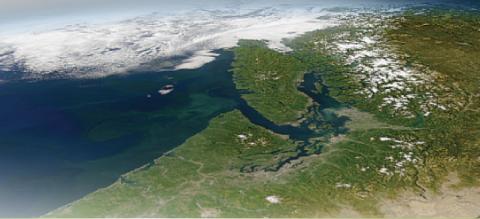
The Puget Sound basin includes at least thirteen major river systems and numerous tributaries, which can be classified as rainfall-dominated, snowmelt-dominated, or transitional (Ross 2006, Cayan 1996, Bach 2002). Rainfall-dominated rivers exhibit peak flows during winter; snowmelt-dominated rivers have peak flows in late spring and late fall with low winter flows. Transitional rivers exhibit less pronounced high or low flows in the late fall and late spring, and winter. Hydrologic flow patterns are important both ecologically and in terms of consumptive resources. Alteration of historic flow patterns may cause ecological harm and supply disruptions (Wiley and Palmer 2008, Poff et al. 1997). Hydrologic flow regimes in Puget Sound rivers have been altered through the construction of dams for flood control or power generation, or by changes in land cover and climate. Flows in the Skagit, Nisqually, Green, Skokomish, and Cedar rivers are regulated by dams (Puget Sound Partnership 2009c).
Sources:
Overview
A 2018 report from the University of Washington Puget Sound Institute analyzes trends in summer stream flows and finds they are declining, but not necessarily because of abstractions by humans.