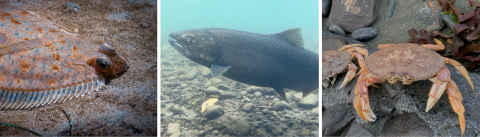
Low dissolved oxygen levels put aquatic life in Puget Sound at risk – but not everywhere. A combination of careful monitoring efforts and powerful computer models are now enabling scientists to identify which areas of our regional waters are most prone to low oxygen levels, when, and why. This article is part of a series of reports funded by King County about the quest to define healthy oxygen levels in Puget Sound.
This article is the latest in a series about computer models and their uses within the Puget Sound ecosystem. Today, we look at the Salish Sea Model, one of several models in the region helping to predict water circulation, water quality and food-web relationships.
Biologist and science writer Eric Wagner recently returned from a trip to observe pigeon guillemots on Protection Island. He wonders: How much do we really know about the health of seemingly abundant bird populations?
The marine heat wave that struck the Pacific Ocean in late 2013 also caused large changes in temperature in the Salish Sea, but scientists are still puzzling over the impacts of those changes on Puget Sound's food web. The so-called "blob" of warmer than average water was thought to have increased the production of plankton, which potentially benefits creatures like herring and salmon that feed on the tiny organisms. A new paper in the journal Frontiers in Marine Science calls that interpretation into question, pointing to a computer model that links the cause to higher-than-normal river flows in the region.