

Before they became invasive species in North America, European green crabs evolved for millions of years in their native territories along the Atlantic coasts of Europe and North Africa, from Norway to Mauritania. In Europe, green crabs are commonly called just “shore crabs.”
Carl Linnaeus, known as the father of modern taxonomy, named the green crab species Cancer maenas, changed by later taxonomists to Carcinus maenas. “Meanas” is derived from the Greek word “mainades,” which translates to “raving ones” or “mad woman.” The term is associated with the frenzied female followers of the Greek god Dionysus. Nobody knows what Linnaeus was thinking when he chose this name, but it could relate to the green crab’s behavior.
Both “Cancer” and “Carcinus” — the genus names — are derived from karkinos, the Greek word for “crab,” experts say. These two groups of crabs are among more than 1,700 crab genera and 11,000 crab species in the world today, according to the Crab Database.
In their native lands, green crabs have adapted to a variety of changing environmental conditions, leading to a genetic makeup that makes them formidable invaders. They not only survive a wide range of temperatures and salinities, but they also consume a variety of prey and live in all sorts of habitats.
In contrast, species not forced to live in a wide range of conditions — including many native crabs in Puget Sound — tend to focus their energy on avoiding predators and specializing in finding prey within their existing habitats. This can be a successful strategy for survival under normal conditions, but it can make native species more vulnerable to rapid change or when confronted with formidable invaders, as described in the Smithsonian website NEMESIS.
The green crab invasion in North America is traced to 1817, when the alien species was found in New Jersey and New York, no doubt arriving in the ballast of one or more sailing ships. At that time, a ship’s ballast was typically rocks, pig iron or sand. By 1900, the green crab population was established throughout New England and up into Maine, where it took a major economic toll on the softshell clam industry. Later, during the 1980s, the species spread rapidly north into Canada, eventually reaching Newfoundland in 2007.

The delayed spread into Canada to the north has been identified as a separate invasion of green crabs arriving from northern parts of Europe where the waters are colder. Physiological and genetic studies show a genetic difference that may be linked to temperature tolerance. A cluster of genes, including some related to cardiac structure and function, have been shown to play a role in the crab’s response to temperature changes.
In studies of different populations in both the U.S. and Europe, Carolyn Tepolt, a genetics researcher with Woods Hole Oceanographic Institution, found that these gene clusters could be providing a strong advantage for green crab populations as they adapt to new conditions, including introductions to new locations.
On the West Coast, studies by Tepolt and others have shown a consistency in the genome among crabs almost everywhere, from California to British Columbia, including the inland waters of Puget Sound. These findings support the idea that the West Coast invasion was started with a single introduction of crabs in San Francisco Bay. Through most of its West Coast range, green crabs retain a similar genetic makeup, suggesting a free flow of genes from place to place for this highly mobile species.
Exceptions to the genetic similarity include Canada’s Sooke Basin, once considered a likely source of the original Puget Sound invasion. It turns out that the Sooke population is considered genetically isolated. The first crabs in Sooke were probably brought there, perhaps during a transfer of shellfish from the west side of Vancouver Island, Tepolt said, and the population has been growing without much outside influence. That’s how Sooke Basin could be ruled out as the source of the initial green crab invasion in Puget Sound.
The genetic isolation may be partly the result of the small opening at the entrance to Sooke Basin, keeping green crab larvae from entering. That does not mean, however, that larvae from the Sooke population aren’t getting out to the wider world.
“Sooke is really interesting,” Tepolt said. “It’s kind of a reverse Hotel California; nobody is coming in, but larvae are leaving,” she explained with her reference to the song “Hotel California by The Eagles.
In fact, hybrid crabs are now being found in Puget Sound and on the coast. Their genome contains genetic variations from both the West Coast population and from Sooke Basin crabs. First-generation hybrids are easy to distinguish genetically, Tepolt said, but over time interbreeding leaves various mixtures of the two populations.
On another front, Tepolt currently is involved in a state-funded project to sequence the entire green crab genome. This will allow scientists working with various green crab populations to compare the genetic makeup to a “reference” genome. The outcome could make it easier to investigate the actions that particular genes play and to fill in information about how green crabs respond to changing conditions.
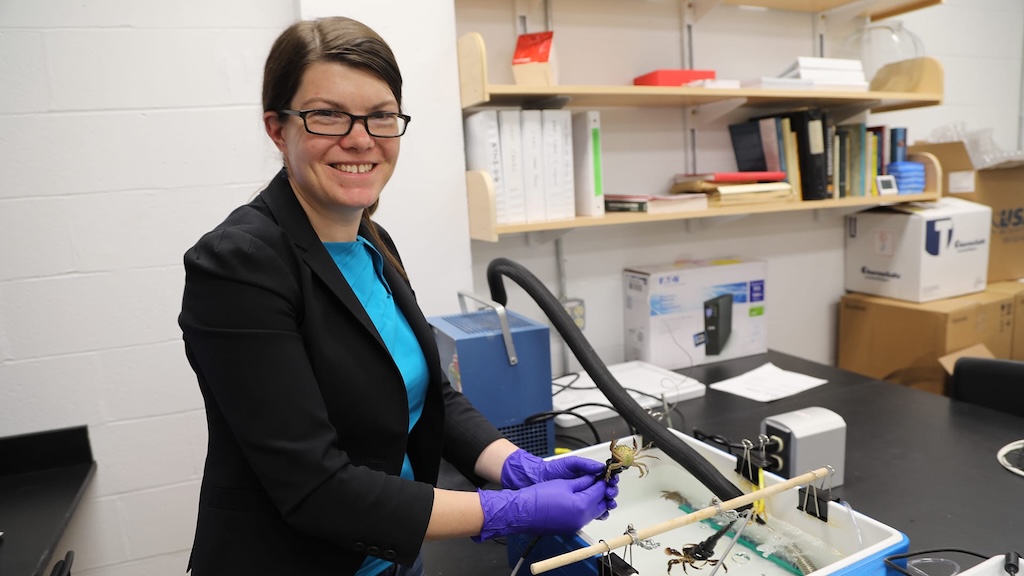
Because of their complex genomes, crabs and other crustaceans are difficult to sequence, Tepolt said. Only with recent advances in technology has the project even become possible. The Washington Legislature last year approved $185,000 to carry out the project, which is scheduled to have some results by the end of this year.
Tepolt, who has been studying green crabs for nearly 20 years, says the Washington Sea Grant Crab Team’s trapping effort is invaluable in many ways
“From my perspective, one of the coolest, most impressive things is that Crab Team folks had the foresight to organize a search for an incursion that might take place,” she said. “Being able to take genetic samples at the outset and with ongoing, consistent sampling protocols is very rare.”
Green crabs sampled since the outset of the invasion can provide a complete genetic history of an introduction by a non-native species. Lessons learned, she said, can be used to combat not only green crabs but other invasive species.
As part of the ongoing effort, Crab Team members also sort and count every native species they catch in their traps before releasing everything but green crabs. This catch-and-release effort provides clues to changing aquatic populations and ecosystems throughout Puget Sound.
Another layer of genetic intrigue
While the genetic makeup of a green crab determines the general traits that make it successful as an invasive species, researchers are coming to understand that individual green crabs can alter their physiology and behavior and even reshape their claws when confronted with new environmental conditions. This capability, known as “phenotypic plasticity,” involves an innate response to changes in the environment.
“Plasticity” refers to the ability to change, and “phenotype” is the outward characteristics of an individual, such as physical form, physiological condition and behavior. Phenotypic plasticity is common among animals, often helping them to survive, but the degree of plasticity seems to be higher among animals that face frequent environmental changes, experts say.
Yaamini Venkataraman, working with Carolyn Tepolt, investigated how green crabs responded to temperatures outside their comfort zones, particularly looking at crabs with a “cold-adapted” gene variant versus those with a “warm-adapted” variant, as identified by Tepolt in previous studies.
“Genetically, you might have a fixed optimal temperature,” Venkataraman said, “but plasticity allows you to be more flexible. I might love the temperature at 75 degrees, but when it gets colder, I can put on a jacket. Plasticity is the organismal equivalent to that.”
In one experiment, Venkataraman tested the condition of crabs by turning them upside down and seeing how long it took for them to turn themselves back over. Following careful procedures, crabs were “shocked” by gradually exposing them to water well above the normal temperature but below lethal conditions. One group of crabs was shocked once, then after four days shocked again. The other group was shocked only once. Based on their ability to turn over, the group with a previous heat shock turned over much quicker than those without such “priming.”
“Our work highlights how thermal plasticity contributes to the broad thermal tolerance of successful non-indigenous species, even after a substantial loss of genetic diversity,” states Venkataraman’s research paper published in Integrative and Comparative Biology. “We found that crabs exhibit potentially beneficial plasticity in response to sub-lethal heat stress.”
An earlier study found that green crabs could even change the strength of their claw muscles during molting, depending on the available food supply. One group of young crabs was fed hard-shelled snails, while another got the soft flesh of fish, according to the 1984 report by researcher N.J. Abby-Kalio in Nigeria. The claw muscles of the snail-eaters developed stronger closing forces, allowing them to break the shells more easily, whereas those grown on fish were not able to break the snail shells.
A similar 2009 study by Canadian researchers Timothy C. Edgell and Rémy Rochette reared one group of green crabs on softshell snails while another group of crabs was fed snails with shells too hard to break. The softshell-crushing group grew stronger claws, while the second group grew longer, thinner claws that could probe into the unbreakable shells to reach their prey.
These studies show that plasticity can influence not just morphology — the crab’s body condition — but also its closely linked feeding behavior. Plasticity in claw strength and shape is not unique to green crabs, though it varies greatly among crab species and responds not just to prey selection but to other environmental conditions.
For example, green crabs cannot seem to get away from the powerful influence of temperature, even when it comes to phenotypic plasticity, as revealed in a 2008 study by Ashley Baldridge (PDF), an ecologist at NOAA’s Great Lakes Environmental Research Laboratory. She found that crabs grown in warm water and served hardshell snails would grow more powerful claws. In contrast, those grown under similar conditions but in cold water (near the lower end of their temperature range) were not able to take advantage of their inherent plasticity.