Advanced Search
Or
Sep 24, 2019
Of ratfish, Loch Ness monsters and stuffed sharks: A conversation with the authors of the book 'Fishes of the Salish Sea'
The first comprehensive guide to the fishes of the Salish Sea is the culmination of more than 40 years of research by University of Washington authors Ted Pietsch and Jay Orr. The new three-volume set includes descriptions and illustrations for every fish species known to have been documented here, all gathered from an exhaustive search of libraries, aquariums, fish collections and even one restaurant.

Sep 26, 2019
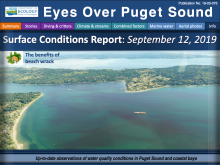
Eyes Over Puget Sound: Surface Conditions Report - September 12, 2019
This year, air temperatures were warmer than in previous years, and this pattern is predicted to continue. Precipitation was low and is now improving, yet river flows remain low. By August, Puget Sound surface water temperatures were 0.6 °C warmer across all regions; this could have shifted the timing of optimal temperatures for some marine organisms. In September, blooms are limited to inlets. Jellyfish are abundant in Sinclair Inlet, and anchovies reside in Eld Inlet. Macroalgae are still plentiful. Learn about the benefits of beach wrack and a DNA barcoding project supported by Ecology.
Oct 24, 2019
Status and trends for West Coast transient (Bigg’s) killer whales in the Salish Sea
Officially known as West Coast transients but increasingly referred to as Bigg’s killer whales, these marine mammal-eating orcas (Orcinus orca) are spending increasing time in the Salish Sea to consume their marine mammal prey including harbor seals, Steller sea lions, and harbor and Dall’s porpoise. They range from Southeast Alaska to California, but over the last 15 years more members of the population are spending increasing time in the inland waters of Washington State and British Columbia (Houghton et al. 2015, Shields et al. 2018). They have no predators (except perhaps occasionally other Bigg’s killer whales - see Towers et al. 2018), but are at risk from anthropogenic effects, including toxics and noise pollution (Ford et al. 2007).

Oct 14, 2019
History of UW Oceanography by Eugene Collias
Notes and biography about the history of the department of oceanography at the University of Washington (1903-1980) as reported by oceanagrapher Eugene Collias. Report courtesy of the Collias estate.

Oct 18, 2019
Tracking the trash: Inside a marine debris survey
Volunteer researchers are tracking the plastic and other debris washing up on Puget Sound's beaches. They hope the data can be used to protect sea creatures from the growing amounts of trash littering the world's oceans. [A version of this article first appeared in the COASST blog.]

Oct 21, 2019
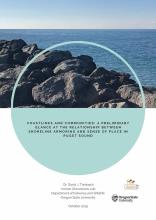
Coastlines and communities: A preliminary glance at the relationship between shoreline armoring and sense of place in Puget Sound
A 2019 report from Oregon State University examines how community members, including non-property owners, value shorelines in Puget Sound. The report emphasizes the impacts of shoreline armoring on survey respondents' sense of place in the region.
Oct 21, 2019
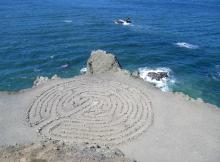
Enhancing the resilience of Puget Sound recovery: A path through the maze of resilience thinking
A 2019 report from the University of Washington Puget Sound Institute examines the application of 'resilience thinking' to Puget Sound protection and restoration.
Oct 31, 2018
Puget Sound Shoreline Parcel Segmentation Report
A 2014 report prepared by Coastal Geologic Services, Inc. examines spatial patterns in Puget Sound shoreline characteristics at the parcel-unit scale. It was developed in support of a social marketing strategy by state agencies to reduce shoreline armoring in the region.
Nov 05, 2019
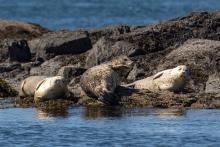
The occurrence of heavy metals in harbor seals of the San Juan Islands
A 2019 article in the Journal of Wildlife Diseases looked at trace element concentrations of heavy metals in the livers of harbor seals that died and stranded in the San Juan Islands. The study indicated exposure to trace elements (naturally occurring, human-introduced, or both) in the Salish Sea; however, the study reports that trace element toxicity is not a major threat to harbor seal health.