

Advanced Search
Or

Jul 15, 2019
Salish Sea Model looks at climate impacts on the nearshore
A 2019 paper in the Journal of Geophysical Research: Oceans outlines how the Salish Sea Model describes the impacts of climate change, sea level rise and nutrient loads on the region's nearshore environment.

Jul 19, 2019
Ancient harvests: A history of Salish Sea herring
Scientists believe that herring have been a staple of Salish Sea food and culture since humans first arrived here at least 12,500 years ago. That importance has continued into modern times, even as herring numbers have declined in parts of the region.

Aug 07, 2019
Eyes Over Puget Sound: Surface Conditions Report - July 29, 2019
In July, the recent trends of warm, dry conditions lessened; however, river flows remain low. Extensive macroalgae drifted through South and Central Sound and washed up on beaches. Macroalgae growth is fueled by excessive nutrients and sunshine. When it washes onto the beach, it is called beach wrack, and it can be a health risk to beachgoers because of bacteria it can harbor. From our aerial photography, we saw that Southern Hood Canal looks tropical because of a bloom of coccolithophores coloring the water turquoise. Schools of fish congregate in South Sound and southern Hood Canal. Jellyfish are abundant in Quartermaster Harbor.

Dec 15, 2019
Rate of ocean acidification may accelerate, scientists warn
Last summer, scientists met at the University of Washington to address alarming findings concerning the rapid acidification of the world's oceans. Experts at that symposium warned that wildlife in the Salish Sea, from salmon to shellfish, may start to see significant effects from changing water chemistry within the next 10 to 20 years. This article summarizes the symposium's key findings and was commissioned and edited by the Washington Ocean Acidification Center which hosted the gathering. Funds for the article were provided by the Washington state legislature. [A version of this article was originally published by the Washington Ocean Acidification Center.]

Aug 21, 2019
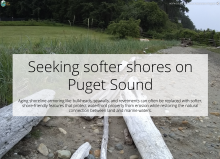
Story map: Seeking softer shores on Puget Sound
A 2019 story map produced by the University of Washington Puget Sound Institute in collaboration with the Washington Department of Fish and Wildlife shows how shoreline armoring can often be replaced by softer, shore-friendly features.
Aug 21, 2019
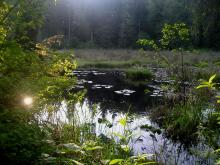
Connections between terrestrial, freshwater, and marine habitats
Freshwater habitat in the Puget Sound region consists of rivers, marshes, streams, lakes and ponds that do not have any saltwater input. Many species depend on these freshwater resources, including salmon, salamanders, frogs, and beavers.
Sep 16, 2018
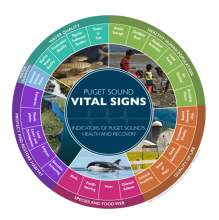
Puget Sound Vital Signs
The Puget Sound Vital Signs are measures of ecosystem health that guide the assessment of progress toward Puget Sound recovery goals. They were adopted by the Puget Sound Partnership at the state of Washington to help guide local, state and federal ecosystem recovery efforts. Each of the six Puget Sound recovery goals are expressed with one or more Vital Signs. Vital Signs represent an important component of the ecosystem (e.g. marine water, economic vitality). Each component is, in turn, represented by one or more indicators. The indicators are specific measures of Puget Sound conditions, including human wellbeing, while ecosystem recovery targets are policy statements that express desired future conditions for human health and quality of life, species and food webs, habitats, water quantity, and water.
Sep 25, 2019
'Early migration gene' tied to unique population of Chinook
Spring and fall Chinook salmon were thought to be alike until researchers discovered a gene for early migration. Now, federal biologists and legal experts are struggling to decide if spring Chinook should be granted their own legal protection under the Endangered Species Act.
