This article provides an overview and a link to further information about the Chinook Salmon Implementation Strategy. Implementation Strategies (Strategies) are plans for accelerating progress toward the 2020 ecosystem recovery targets for the Puget Sound Vital Signs. The Strategies are developed collaboratively with technical, professional, and policy experts and with local and regional input. They are funded by the Environmental Protection Agency.
Guadalupe Water-nymph is a submerged aquatic annual with slender, branching stems up to about 7 dm long. The opposite, ribbon-like leaves, usually with additional leaves in their axils, are 0.5-2 cm long and have minutely toothed margins and enlarged bases. Tiny unisexual flowers, both male and female on the same plant, are borne singly, without stalks, in the axils of leaves. The male flowers h...
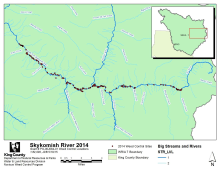
The final report on a knotweed removal and native plant project from grant PO-00J08401 to King County DNR for the grant entitled: Protection and enhancement of the riparian buffers in WRIA 7 through restoration and stewardship.
By King County Department of Natural Resources and Parks Water and Land Resources Division
The Salish Sea extends across the U.S.-Canada border, and includes the combined waters of the Strait of Georgia, the Strait of Juan de Fuca, Puget Sound Basin and the San Juan Islands (see map).
The name Salish Sea was proposed by Bert Webber in 1989 to reflect the entire cross-border ecosystem. Both Washington State and British Columbia voted to officially recognize the na...
During June, near normal air temperatures and continued low precipitation have resulted in highly variable freshwater inputs to Puget Sound. A large Noctiluca bloom extends across the South Central Basin of Puget Sound. Coccolithophores are blooming in Hood Canal. Macroalgae is drifting as mats on the water in Port Madison, South Central Basin, and South Sound. They are also piling up on beaches in South and Central Puget Sound and Whidbey Basin. Juvenile fish are migrating out of the estuaries and meeting a complex thermal habitat. New infrared images tell the story. Meet our ocean acidification expert, Stephen Gonski.
A 2022 article in the journal Environmental Science & Policy looks at how knowledge exchange across organizations influences science-based ecosystem recovery in Puget Sound. The University of Washington Puget Sound Institute describes its work to identify and communicate key scientific findings that support funding and policy decisions on an ecosystem scale.
Species and their habitats are a foundation of the ecosystem framework, but there is currently no generally agreed upon habitat classification system for Puget Sound. The closest thing for its marine and nearshore environments may be Dr. Megan Dethier’s 1990 resource A Marine and Estuarine Habitat Classification System for Washington State. Much of the work for that document was done in the general vicinity of Puget Sound, and it has been an influential resource for major habitat mapping efforts in the region, such as Shorezone.
The year 2014 in pictures: In 2014, Puget Sound and Hood Canal behaved distinctly different in temperature and dissolved oxygen. In Puget Sound, generally warmer conditions, abundant and diverse algal blooms, and large pools of organic material persisted along with lower oxygen, high jellyfish abundances, and a lot of suspended sediment. On the other hand, Hood Canal was colder, more oxygenated, and algae blooms were rare. People and planes: past and present.