

Humpback whales of the Salish Sea
Overview
Humpback whales have made a remarkable recovery in Puget Sound and throughout the Salish Sea. While their numbers vary through the season, they can be seen in almost any month of the year. In essence, this has been a return to waters they formerly used prior to commercial whaling that wiped out the local population. Humpback whales around the world have made strong recoveries from whaling and now number some 30,000 in the North Pacific but there are some major differences in how populations in different areas have fared. Humpbacks are baleen whales that engulf small prey including krill and schooling fish and show a remarkable variety of feeding behaviors including cooperative feeding. Despite recovery, they still face a variety of human impacts including entanglement in fishing gear and ship strikes.
Natural History
Overall status and trends
Humpback whales occur in oceans throughout the world, generally migrating seasonally from higher latitude feeding areas to winter low latitude breeding areas. In the North Pacific, they utilize four primary winter breeding areas: Central America, Mexico, Hawaii, and several areas of southern Japan and the Philippines in the Western North Pacific. Whales from Central America and the Western North Pacific are considered endangered and those from Mexico threatened, while those from Hawaii are not listed under the U.S. Endangered Species Act. Feeding areas in the North Pacific extend from southern California around to Alaska and then to Russia and northern Japan.
In the 20th century, during the modern era of commercial whaling, humpback whales were heavily exploited and their population was decimated throughout their range. North Pacific humpback whale populations were thought to have numbered about 15,000 prior to commercial exploitation in the twentieth century (Rice 1978). However, this estimate was based on whaling data that may have been inaccurate. Approximate numbers in the North Pacific immediately following the cessation of commercial whaling have been estimated at 1,400 (Gambell 1976) and 1,200 (Johnson and Wolman 1984). Humpback whales were hunted from whaling stations, including those based in San Francisco Bay, through 1966 when hunting was banned by the International Whaling Commission. Since then, most humpback whale populations have made strong recoveries.
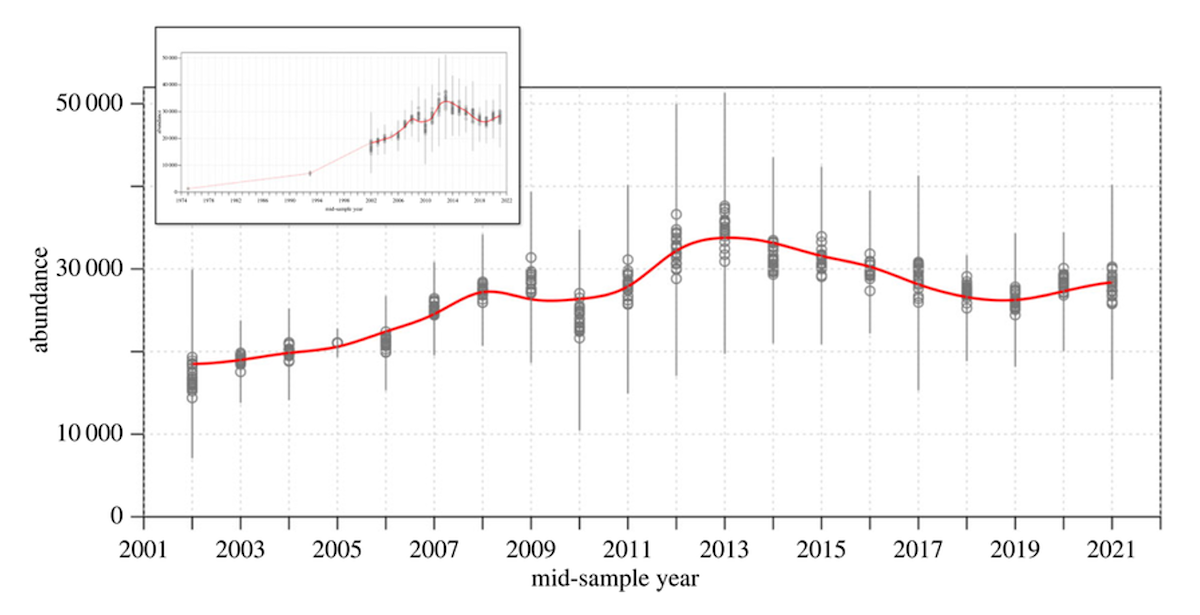
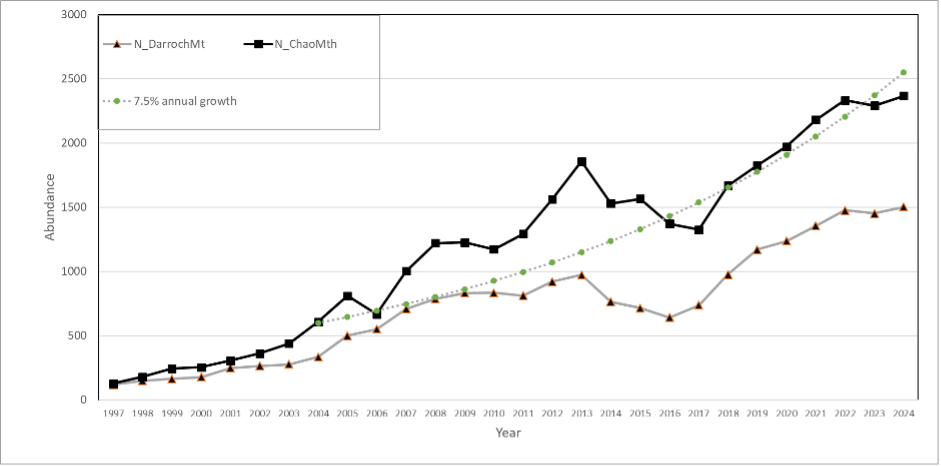
A massive collaborative study called the SPLASH project, estimated the 2004-2006 overall North Pacific humpback whale abundance at just under 20,000 (Calambokidis et al. 2008, Barlow et al. 2011). This was one of the largest international collaborative studies of whales ever conducted and involved over 50 research groups and more than 400 researchers in 10 countries. This estimate was more than three times the previous Pacific-wide estimate from 1991 to 1993 (Calambokidis et al. 1997, 2001). More recent estimates of humpback whale abundance in the North Pacific (Figure 1), showed a decline since the peak abundance in the early 2010s, apparently driven by a decline in feeding areas in Alaska during the marine heat wave that hit in the mid 2010 (Cheeseman et al. 2024). This overall population decline occurred despite increasing numbers of humpbacks along the U.S. West Coast, including the Washington/southern British Columbia feeding areas (Calambokidis and Barlow 2020, Figure 2), though the marine heat did appear to affect the distribution of humpback whales along the West Coast and contribute to an increase in whale entanglements (Santora et al. 2020).
History in the Salish Sea
Historical whaling for humpback whales by both the Makah (Huelsbeck 1988) and Quileute (Robertson and Trites 2018) in Washington may have even exceeded that for the more nearshore gray whales. In the modern era of commercial whaling, humpback whales were taken from whaling stations based in Washington (Bay City) and on Vancouver Island (numerous locations). Of greatest relevance to Puget Sound and the Salish Sea is the short period of whaling from the whaling station at Page’s Lagoon near Nanaimo, British Columbia. Starting in 1907, whalers targeted humpback whales in the Salish Sea during winter months when conditions were not suitable for whaling on the open ocean. While they only reportedly killed a few hundred humpback whales in their three years of operations, combined with thousands of humpback whales taken from whaling stations operating in outside waters, it was enough to cause the complete disappearance of humpback whales from the Salish Sea for the next 100 years. Whaling also ended an early fledgling whale-watching operation in the Salish Sea that even resulted in some opposition to the expansion of whaling to these waters (Trites 2014).
In addition to whaling in the Salish Sea, humpback whales of this same population were being hunted from Washington’s outer coast into southern British Columbia from a number of whaling stations. This included Bay City near Westport, Washington where about 2,000 humpback whales were killed between 1911 and 1925 (Scheffer and Slipp 1948). Whaling stations at Coal Harbor, Kyuquot, and Sechart along the west coast of Vancouver Island, killed over 4,000 humpback whales from 1905 to 1965 (Gregr et al. 2000). Whaling in these areas typically showed declining humpback catches over time indicating they were depleting the population to levels where it was no longer economically viable to target them; a situation some call economic extinction.
Recovery and return to the Salish Sea
It is tempting to think about what the historical pre-whaling use of the Salish Sea was like for humpback whales, but there are little hard data to really know. From the number of tribes that relied on early pre-commercial whaling of humpbacks and the large number that were taken in commercial whaling prior to depletion we know that humpback whales were certainly abundant here. It is especially intriguing to think that so many humpbacks remained here through winter months despite the permitted taking of hundreds of whales in winter from the Paige’s Lagoon whaling site. Even into the 1940’s, humpback whales were considered the most common of the large whales visiting what we now call the Salish Sea (Scheffer and Slipp 1948).
In 1966, the International Whaling Commission imposed a ban on commercial whaling for humpback whales to protect the remaining animals after the greater population had been driven to economic extinction. By then humpback whales were only rare visitors to Puget Sound and they were no longer considered a species regularly seen in Greater Puget Sound (Osborne et al. 1988, Everett et al. 1980). Sightings were so rare that the occurrence of two humpback whales (CRC-13002 and 13003) observed from June 22nd through June 25th, 1988, was considered unusual enough that it was worthy of close documentation and publication of a note about them (Calambokidis and Steiger 1990). As an aside, while we did not know much about those two whales at the time, their photo-IDs have since been matched. They have not been re-sighted in the Salish Sea, but feed primarily in northern British Columbia and Southeast Alaska waters and are Hawaii winter breeders.
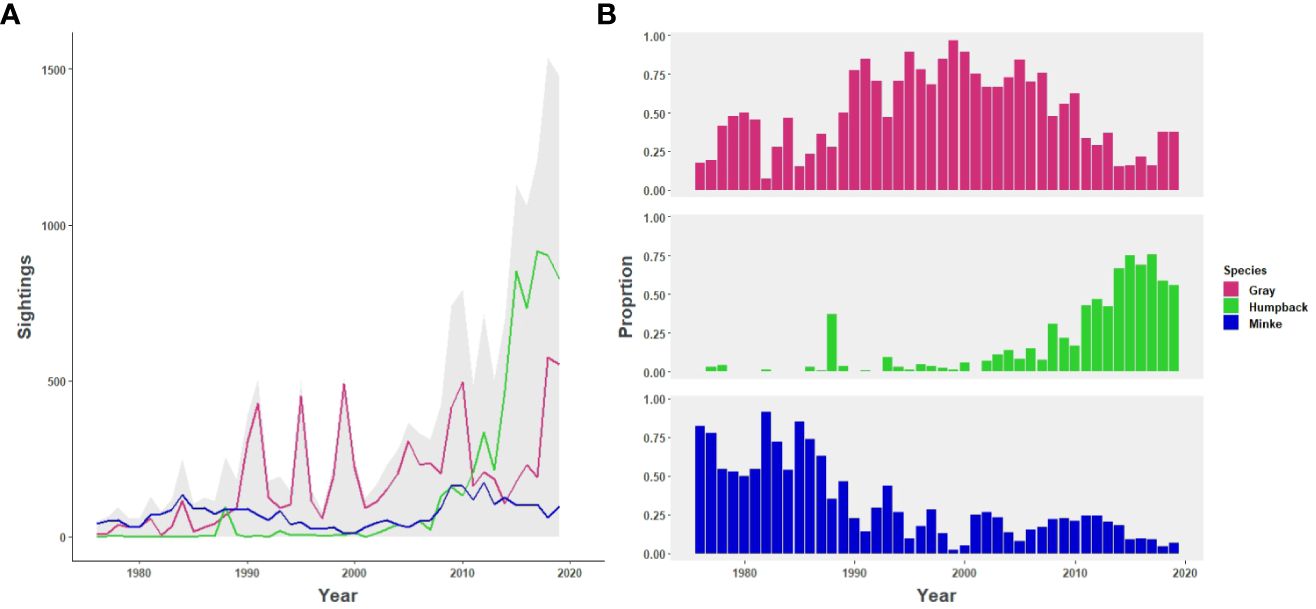
Even while the numbers of humpback whales remained low in the Salish Sea, surveys off the northern Washington Coast revealed consistent areas with dense concentrations of humpback whales, including the entrance of the Strait of Juan de Fuca (Calambokidis et al. 2004). Sighting reports from whale watch operators and the public (Figure 3) show a steady increase of sighting reports of humpback whales in the Salish Sea (Miller 2020, Olson et al. 2024). Humpback whales are now one of the primary species whale-watch operators in the Salish Sea target in their trips. A wide variety of humpback whale vocalizations are heard underwater in the Salish Sea, especially early and late in the season when male humpback whales engage in singing (recordings of local humpback whale vocalizations are available at Orcasound). Similar to the return of humpback whales to the Salish Sea, the return of humpback whales to other portions of their range have also been documented (Markowitz et al. 2024).
Distribution and habitat
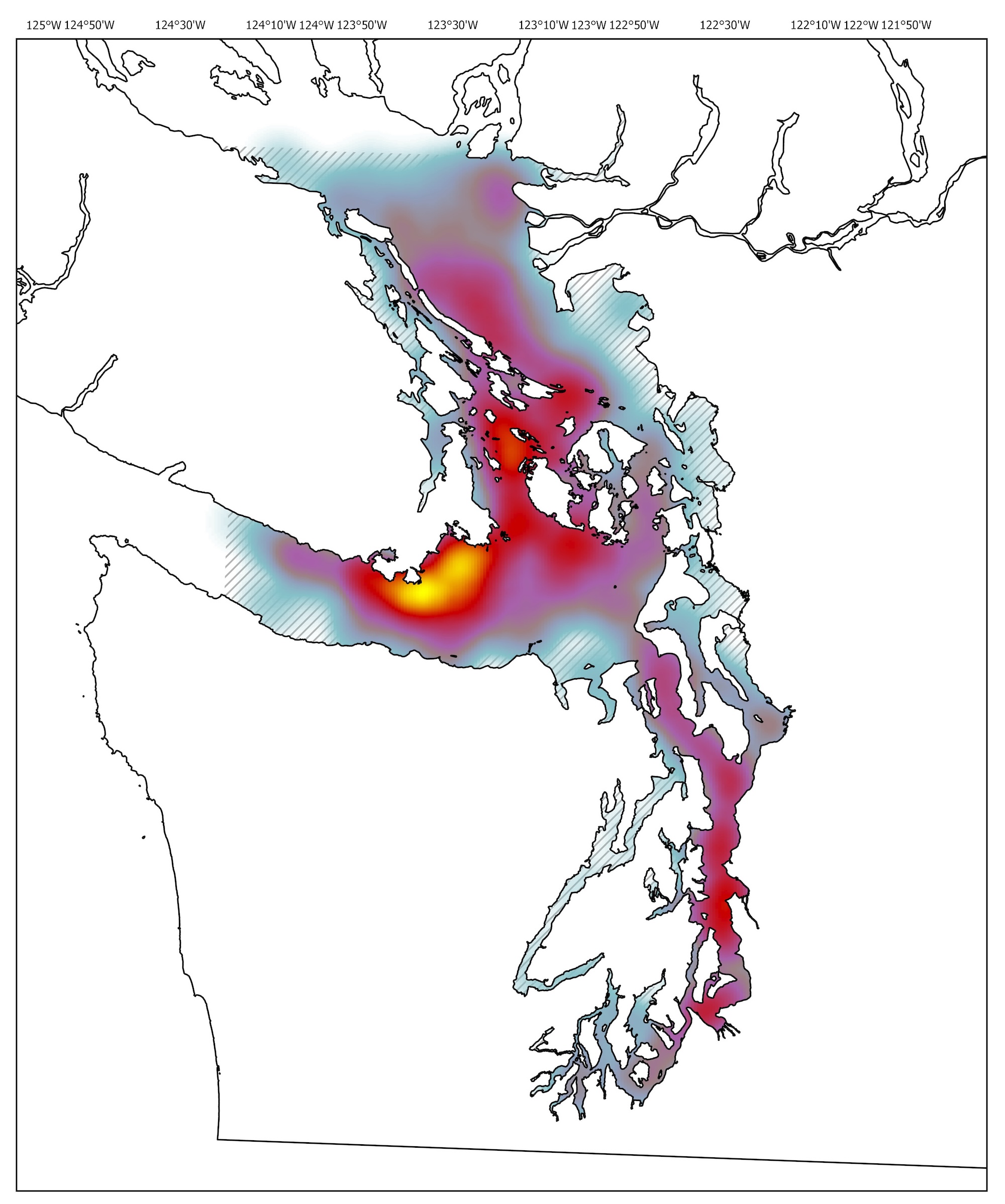
Humpback whales are now distributed widely through the Salish Sea including Puget Sound. Primary areas of concentration include the middle of the central and western Strait of Juan de Fuca where aggregations of 100 or more humpback whales sometimes concentrate to feed on krill. Two different pictures have emerged on their main areas of concentration. Reports of humpback sightings from the North-central part of the Strait of Juan de Fuca (Figure 4, Olson et al. 2024, Miller 2020) are biased by observer locations and under-represent areas like the western portion of the Strait of Juan de Fuca where research surveys by Cascadia Research and others have found some of the densest whale aggregations. Based on a combination of sighting, survey, and tagging data, the central and western Strait of Juan de Fuca were recently designated as Biologically Important Feeding Areas for humpback whales on the U.S. West Coast (Calambokidis et al. 2024). Some individuals show preference for specific areas (see sections on Big Mama and Big Daddy) that are sometimes highly visible. One whale (CRC-19820, given the name Malachite) has been seen over multiple years and extended periods near Tacoma and Dalco Passage in Puget Sound, often feeding extremely close to shore.
Migration, stock structure, and movements/interchange
Humpback whales using the Salish Sea migrate to multiple winter breeding grounds, and Washington/southern British Columbia humpback whales have been documented going to all the known winter breeding areas in the North Pacific (Calambokidis et al. 1997, 2001, 2007, Darling et al. 1996). As discussed in the overall status and trends section, humpbacks in the Salish Sea are considered endangered, threatened, or are not listed depending on their breeding destinations. Like other large whales and marine mammals, all are protected under the Marine Mammal Protection Act.
An analysis of over 9,000 identification encounters of humpback whales in the Salish Sea during May to October from 2017-2023 (between 47 and 49 N and east of 124.25 W) identified 770 different individuals (Cascadia Research unpublished data). Overall, 449 of the 770 (58%) had been positively identified on a winter breeding area. Of those, 54% were from the threatened Mexico distinct population segments (DPS) and 48% from the non-listed Hawaii DPS. The percentages exceed 100% because a few animals matched multiple areas showing their philopatry can waver. Only 4% matched the endangered Central America DPS, which also includes Southern Mexico. Also, there have been a small number of whales documented going to small endangered western North Pacific breeding grounds (Darling et al. 1996). While humpback whales primarily do not feed in the wintering areas, feeding has been observed in some areas including Mexico (Ransome et al. 2024) and Nicaragua (De Weerdt et al. 2022).
The story of Big Mama
One dramatic example of the recovery of humpback whales in the Salish Sea is an individual given the name Big Mama (CRC-15122: Shaw and Malleson 2024). Big Mama is one of the most iconic humpback whales in the Salish Sea and a symbol of the species’ remarkable return to these waters following the end of commercial whaling. She was first photographed off Race Rocks on 4 November 1997 by Mark Malleson and then again off Victoria on 22 October 1998 by Brian Gisborne. Big Mama has been positively identified >300 times through 2024 and is the best example of a humpback making consistent, annual appearances in the region. When identified in 1998 she was estimated to be a yearling or juvenile and so was likely born in 1997 or possibly 1996. Her presence is widely credited with marking the beginning of the return of humpback whales to the Salish Sea. Since her first sighting in 1997, Big Mama has been responsible for bringing at least 20 individual humpbacks into the Salish Sea; through eight of her own calves and as a grandmother and great-grandmother to at least 12 additional whales (Figure 5). This has been documented by Mark Malleson, Tasli Shaw, and other groups like the Department of Fisheries and Oceans Canada (DFO) and the Marine Education and Research Society (MERS).

Not only do Big Mama and her descendants represent an impressive number of different whales, they also account for a disproportionate number of the sightings in the Salish Sea, representing a minimum of an amazing 1,696 photo-ID encounters through 2024. For the central Salish Sea (eastern and central Strait of Juan de Fuca and San Juan Islands; 48-49 N and east of 124 W), they represent 2% of the individuals seen but account for 11% (1,230) of all humpback whale encounters in this region. In some years she and her descendants represent as much as 40% of the encounters.
As an indication that humpback whale calves learn their migration routes from their first period with their mother, Big Mama and her descendants share the same feeding and area in the Salish Sea. They also share the same migratory destination of Hawaii (where known). Coincidentally, a mother and calf (CRC-13503 with calf 13647) identified on 16 October 1998 in the same area as Big Mama have also been resighted through 2024, though unlike Big Mama and her descendants, these two are not as loyal to the Salish Sea and go to Mexico for breeding.
In another way, Big Mama and her offspring have been instructive. While many of the humpback whales sighted in the Salish Sea overlap with those seen just outside the straits of northern Washington and Southern British Columbia, Big Mama and her offspring represent more recruitment from within the Salish Sea (Figure 6). As a matriarch whose return may have influenced the reoccupation of these historic feeding grounds by other humpbacks, Big Mama represents the resilience and recovery of a species once pushed to the brink.

Big Daddies
Inspired by the story of Big Mama, we are motivated to tell the story of two individuals that told a contrasting story to Big Mama. Because of this contrast, we have called each of these whales Big Daddy. We do not know the sex of the first (CRC-13571) (no biopsy sample has been collected), but we are confident he is male because despite 17 encounters in 9 different years spanning from 1983 to 2023, he has never been seen with a calf. Also, for one sighting on the breeding ground, this whale was an escort in a competitive group, a role consistent with a male. This whale has been seen in Mexico over six different years from 1983 to 2023, with most of these sightings in the offshore Revillagigedo Islands and some off mainland Mexico. The only feeding areas where he has been seen are off the north Washington Coast, confirmed in five different years from 1998 to 2021. All of these have been just outside the Salish Sea in Juan de Fuca Canyon and on the bank west of the Canyon (the Prairie). Another Big Daddy is CRC-13526 seen from 1989 to 2022. He has been sighted in Mexico in 13 different years, primarily at the Revillagigedo Islands from 1989 to 2022, and sighted in 4 years off the coast of northern Washington.
While not quite as impressive a sighting history as Big Mama and with no documented offspring to track, our two Big Daddies shows how humpback whales in these waters tend to have favorite areas. Just as Big Mama has only been seen a few times outside of the Salish Sea, these two whales have never been sighted in the Salish Sea (Figure 7).

Predators and prey
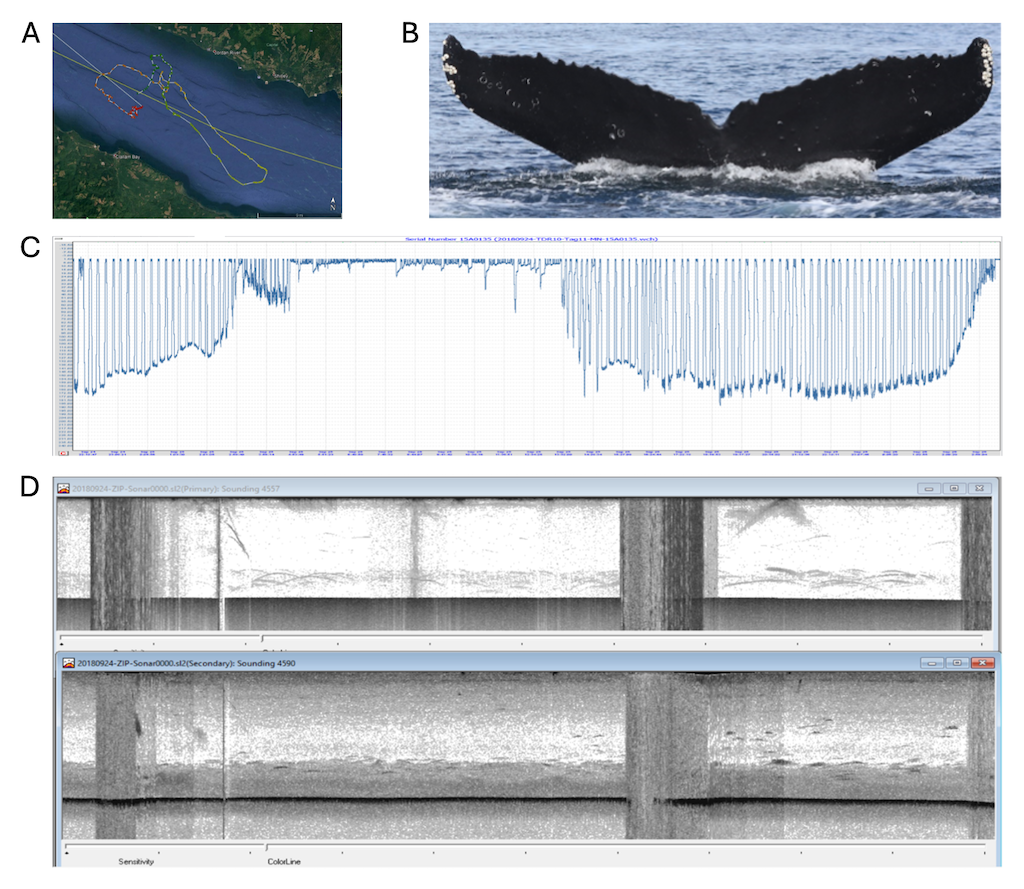
Humpback whales require high prey densities to make their engulfment and filter feeding strategy cost-effective (Goldbogen et al. 2015, 2017). Worldwide, humpback whales generally feed on both krill and small schooling fish, and this appears to be true in the Salish Sea. Archival tags attached to humpback whales in the central and western Strait of Juan de Fuca by Cascadia Research and Fisheries and Oceans Canada revealed animals feeding most typically on krill layers near the bottom. In Figure 8 we show one such example from a tag deployed on a humpback whale in the Strait of Juan de Fuca by Cascadia Research on 24 September 2018. There were about 25 humpback whales in the western part of the Strait of Juan de Fuca and the dive records from this, and four other tags deployed, indicated animals were primarily feeding during the day at 130 to 170 meters and making more shallow dives at night. Echo sounder readings showed an apparent krill layer at 120-155 meters that these whales appeared to be targeting. In other areas, including inside Puget Sound and in the eastern Strait of Juan de Fuca, humpback whales have been observed feeding on small schooling fish, which may be a more common prey in these areas. The status of fish species like herring and anchovies in the Salish Sea has been mixed, with recoveries in some areas and declines in others.
Humpback whales are preyed on by killer whales and about 20% of humpback whales feeding off the U.S. West Coast bear scars of having survived a killer whale attack (Corsi et al. 2020). This is a higher rate than in most other areas of the North Pacific (Steiger et al. 2008). Most killer whale attacks are on calves less than 6 months old since most of the scars from these attacks are already present when calves are seen on the feeding grounds in the summer and fall. The proportion of calves killed by killer whales is not known but it is thought that avoiding these attacks is one driver for humpback whales to migrate and give birth in tropical coastal areas where killer whales are less common (Corkeron and Connor 2001, Ford and Reeves 2008). Humpback whales often show very active and aggressive surface behavior in the presence of killer whales and are considered a species that fights rather than flees in response to killer whale attacks (Ford and Reeves 2008) and have also been observed exhibiting seemingly protective altruistic behavior in the presence of killer whales engaged in attacking other species (Pitman et al. 2016)
Threats
Entanglements
Entanglements have been a growing concern for humpback whales along the U.S. West Coast, particularly since 2015 when a sharp increase was noted there primarily linked to humpback whales and the commercial Dungeness crab fishery (Tackaberry et al. 2022, NOAA 2024). It is believed that most whale entanglements do not get reported, so available reports may represent a small fraction of the true number occurring. Almost a quarter of humpback whales along the U.S. West Coast show scars from having survived an entanglement (Cascadia Research unpublished data).
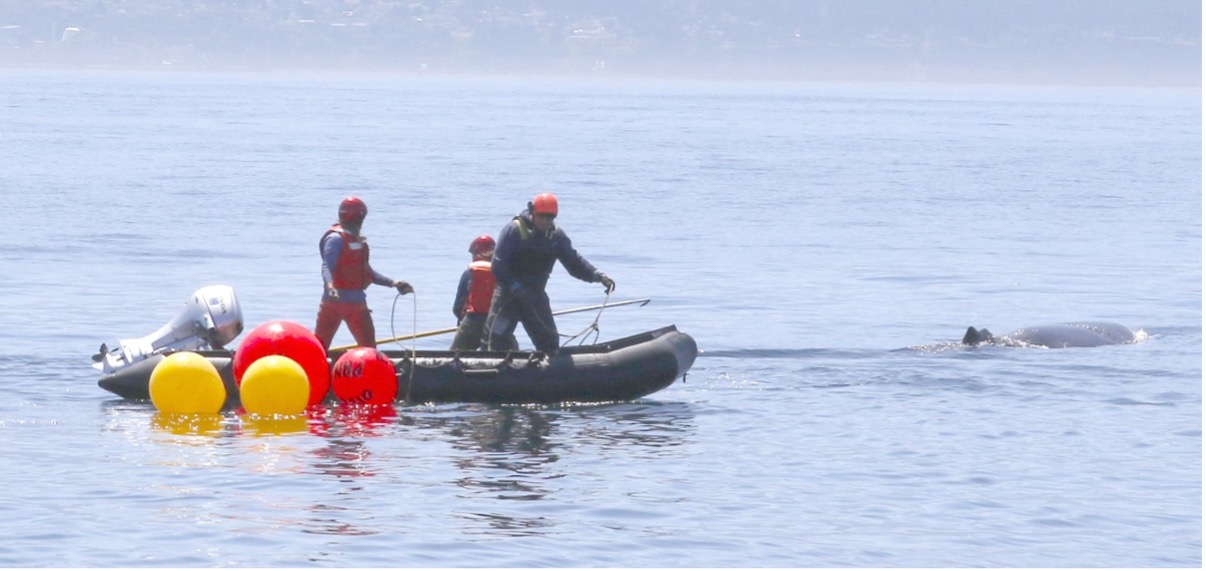
In 2024, Cascadia Research and collaborators along the U.S. West Coast launched the Partnership for West Coast Whale Entanglement Action to research the causes of whale entanglement, inform strategies to reduce them, more effectively disentangle whales, and improve our ability to measure the rates and trends in entanglements. This has borne fruit already with a joint team from Cascadia Research and the Whale Museum successfully disentangling a humpback whale in the Strait of Juan de Fuca in July 2025, and again in August 2025 (Figure 9).
Ship strikes
Ship strikes are considered a major source of mortality for large whales including humpback whales along the U.S. West Coast (Rockwood et al. 2019). Examination of stranded whales in Washington showed ship strike injuries were a major cause of death of large baleen whales other than gray whales (Douglas et al. 2008). Tagging studies have revealed that humpback, blue, and fin whales are most vulnerable to ship strikes at night when they spend a significantly greater portion of time near the surface where they are most vulnerable to being hit by ships (Calambokidis et al. 2019).
There were four well-documented vessel strikes of humpback whales in Puget Sound and the Salish Sea in recent years. Two of these were in Puget Sound:
- 28 May 2019: A Washington State Ferry hit a humpback whale in Elliot Bay and presumably killed the whale. After the whale surfaced just in front of the Wenatchee departing Coleman dock and was struck by the bow, blood was observed and the whale was last seen at Pier 66, 30 minutes after the strike.
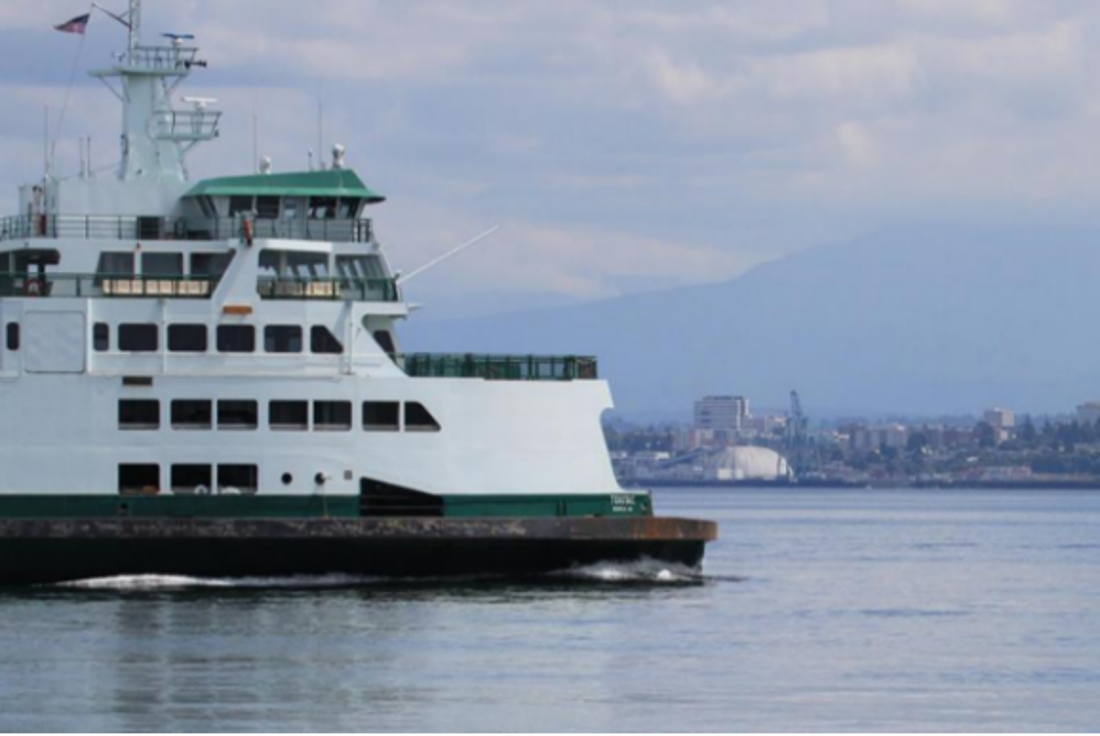
- 6 July 2020: A humpback was struck by another Washington State Ferry, and the strike was witnessed and photographed by Bart Rulon (Figure 10) from the Puget Sound Express whale-watching vessel. A positive fluke ID indicated this was CRC-18526, a whale first seen and recorded off Victoria BC on 19 July 2017 who has not been seen again since the incident, indicating it was likely killed.
Although the strike was witnessed in both cases, in neither case was a carcass found or recovered, supporting the thought that ship strike mortalities often go undocumented.
In 2025, two high profile vessel strikes seriously injured or killed humpback whales in the Strait of Georgia:
- The first incident occurred on 17 October just off Vancouver, BC, where a high-speed catamaran-style fast passenger vessel called a Hullo ferry, struck a humpback whale. Three days later, on 20 October, whale watch operators encountered a humpback calf within a few miles of the collision site, identified as “Skipper” (who was born to CRC-15969 “Zig Zag” in 2025) and documented a fresh, deep laceration near the dorsal fin that was consistent with injuries caused by a vessel strike.
- The second incident occurred on 23 October, when a whale watch vessel, also a high-speed catamaran, collided with a humpback whale north of Vancouver while transiting. Two days later, a deceased humpback whale was discovered on Keats Island, near the site of the collision, and was identified as CRC-19881 “Wisp,” a four-year-old female that was suspected to be the whale that was hit.
While these recent situations have drawn widespread attention, they may not be representative of the overall ship strike risk humpback whales face in the region. Only a small proportion of large whale mortality is documented, as most whales sink and do not wash ashore. This likely holds true for vessel strikes where actual incidences are likely much higher than reported, particularly in less populated areas where there are few observers present. Documented cases like the ones we detail above involving ferries and whale watch vessels are more likely to be reported due to the number of people on board, which makes collisions more likely to be seen. Strikes by smaller vessels are also more likely to be reported, as the collision would be more noticeable. In contrast, large cargo ships may not detect a collision, and it is unlikely to be witnessed. Many cargo ships travel at high speed through areas of higher whale density (described below) and any injured or deceased whale in those areas would be unlikely to be observed or to wash up.
Humpback whale feeding areas overlap with major shipping routes in several parts of the Salish Sea (Figure 11). Archival tag deployments by Cascadia Research in a study conducted with the Department of Fisheries and Oceans Canada revealed whales spent high proportions of their time feeding in the central portion and entrance of the Strait of Juan de Fuca.
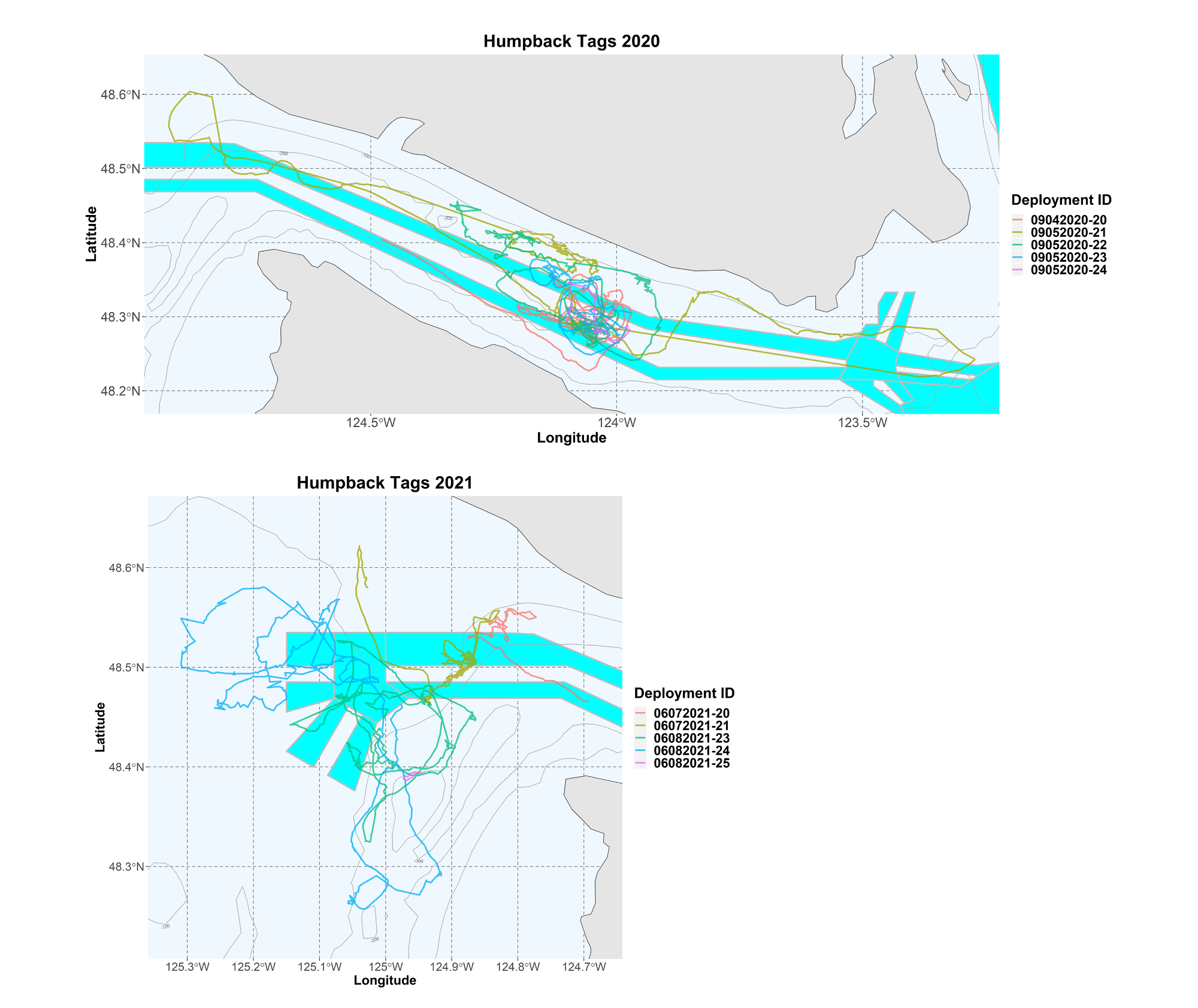
Unfortunately, these also are areas that overlap with the designated shipping lanes (Figure 12). Similarly, a trained observer placed on cargo ships transiting between Seattle and the San Francisco Bay area recorded multiple zones of overlap between shipping routes and high whale concentration, including the entrance to the Strait of Juan de Fuca (Flynn and Calambokidis 2019, Cascadia Research unpublished data).
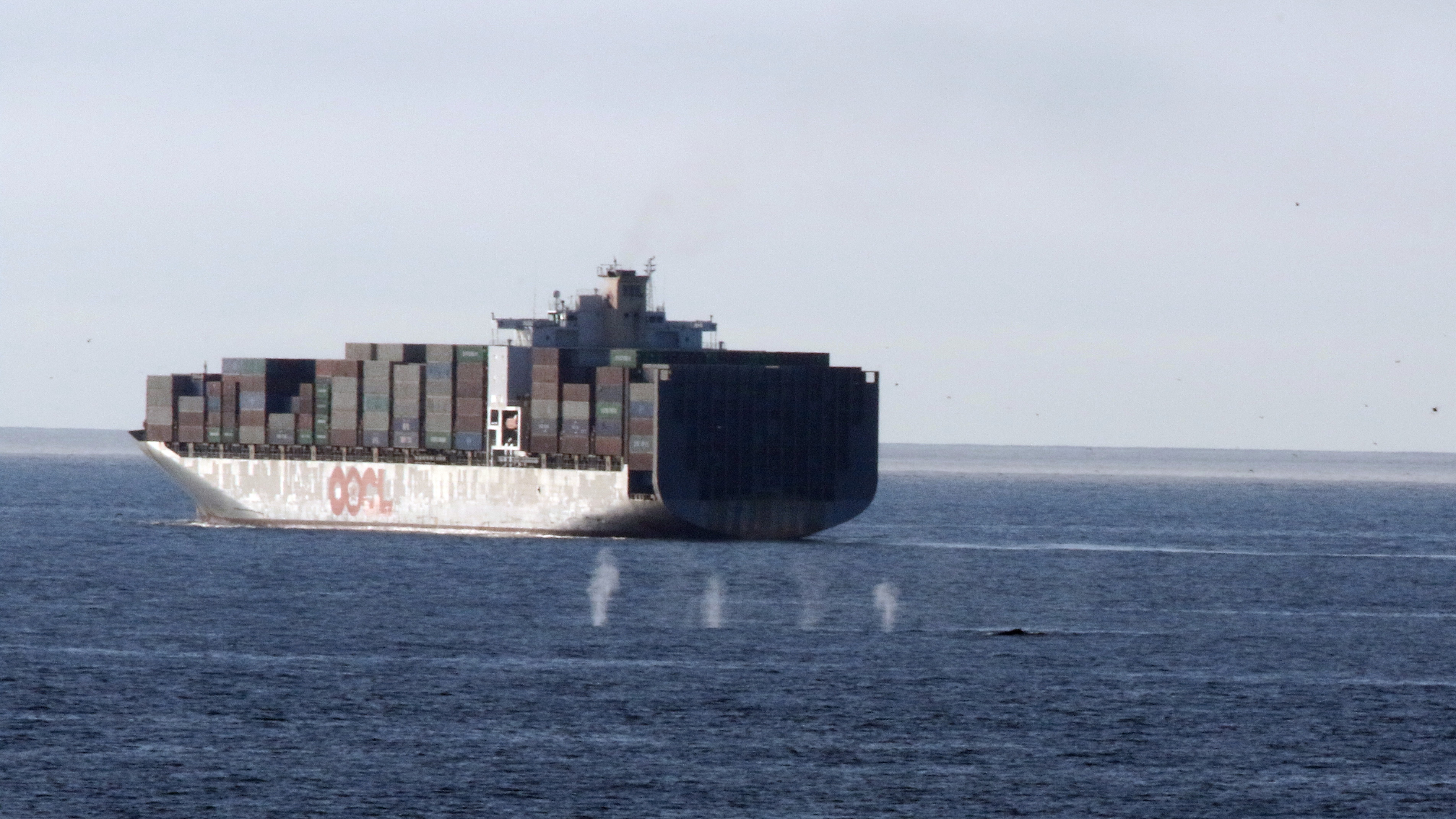
There are a number of approaches to try to reduce ship strikes of humpback whales and other large whales:
- Refine designated shipping lanes to try and avoid areas of whale concentration
- Shift transit routes of vessels along the U.S. West Coast offshore once they leave shipping lanes
- Require slowdown of ships in areas of high whale density
- Support efforts to incentivize adherence to voluntary slow-downs including providing information on real-time whale occurrence but unfortunately these do not solve the ship strike issue or obviating the need for the measures above
- Improved awareness by vessel operators on how to avoid whales
Additional information is available at Whale Alert and the Marine Education & Research Society ("See a Blow? Go Slow").
Boat traffic and whale watching
With the return of humpback whales in larger numbers to the Salish Sea and increased restrictions around approaching killer whales, commercial whale-watching trips have increasingly relied on humpback whales as a key species of interest for their trips. This has primarily occurred in areas in the eastern Strait of Juan de Fuca and the Strait of Georgia near the ports where these vessels primarily base. Areas of humpback whale concentration off the northern Washington coast and in the western portions of the Strait of Juan de Fuca remain largely inaccessible to whale-watch vessels. While it has been important to protect killer whales, especially the Southern Residents from disturbance and vessel noise, some of these measures have been enacted without consideration of the secondary effect of increasing approaches to humpback whales.
Literature cited
Barlow, J., Calambokidis, J., Falcone, E. A., Baker, C. S., Burdin, A. M., Clapham, P. J., Ford, J. K. B., Gabriele, C. M., LeDuc, R., Mattila, D. K., Quinn, T. J., Rojas-Bracho, L., Straley, J. M., Taylor, B. L., Urbán R., J., Wade, P., Weller, D., Witteveen, B. H., & Yamaguchi, M. (2011). Humpback whale abundance in the North Pacific estimated by photographic capture–recapture with bias correction from simulation studies. Marine Mammal Science, 27(4), 793–818. Humpback whale abundance in the North Pacific estimated by photographic capture-recapture with bias correction from simulation studies
Calambokidis, J., & Barlow, J. (2020). Abundance estimates for blue and humpback whales along the U.S. West Coast using data through 2018 (NOAA Tech. Memo. NMFS-SWFSC-634). U.S. Department of Commerce, NOAA.
Calambokidis, J., & Steiger, G. H. (1990). Sightings and movements of humpback whales in Puget Sound, Washington. Northwestern Naturalist, 71, 45–49.
Calambokidis, J., Falcone, E. A., Quinn, T. J., Burdin, A. M., Clapham, P. J., Ford, J. K. B., Gabriele, C. M., LeDuc, R., Mattila, D., Rojas-Bracho, L., Straley, J. M., Taylor, B. L., Urbán R., J., Weller, D., Witteveen, B. H., Yamaguchi, M., Bendlin, A., Camacho, D., … Wade, P. R. (2008). SPLASH: Structure of populations, levels of abundance and status of humpback whales in the North Pacific (Final report for Contract AB133F-03-RP-00078). Cascadia Research.
Calambokidis, J., Fahlbusch, J. A., Szesciorka, A. R., Southall, B. L., Cade, D. E., Friedlaender, A. S., & Goldbogen, J. A. (2019). Differential vulnerability to ship strikes between day and night for blue, fin, and humpback whales based on dive and movement data from medium-duration archival tags. Frontiers in Marine Science, 6, Article 543. Differential Vulnerability to Ship Strikes Between Day and Night for Blue, Fin, and Humpback Whales Based on Dive and Movement Data From Medium Duration Archival Tags
Calambokidis, J., Kratofil, M. A., Palacios, D. M., Lagerquist, B. A., Schorr, G. S., Hanson, M. B., Baird, R. W., Forney, K. A., Becker, E. A., Rockwood, R. C., & Hazen, E. L. (2024). Biologically important areas II for cetaceans within U.S. and adjacent waters – West Coast region. Frontiers in Marine Science, 11, 1283231.
Calambokidis, J., Steiger, G. H., Ellifrit, D. K., Troutman, B. L., & Bowlby, C. E. (2004). Distribution and abundance of humpback whales and other marine mammals off the northern Washington Coast. Fisheries Bulletin, 102(4), 563–580.
Calambokidis, J., Steiger, G. H., Straley, J. M., Herman, L. M., Cerchio, S., Salden, D. R., Urbán R., J., Jacobsen, J. K., von Ziegesar, O., Balcomb, K. C., Gabriele, C. M., Dahlheim, M. E., Uchida, S., Ford, J. K. B., Ladrón de Guevara, P., Yamaguchi, M., Sato, F., Mizroch, S. A., … Rasmussen, K. (2001). Movements and population structure of humpback whales in the North Pacific. Marine Mammal Science, 17(4), 769–794.
Calambokidis, J., Steiger, G. H., Straley, J. M., Quinn, T., Herman, L. M., Cerchio, S., Salden, D. R., Yamaguchi, M., Sato, F., Urbán, J. R., Jacobsen, J., von Ziegesar, O., Balcomb, K. C., Gabriele, C. M., Dahlheim, M. E., Higashi, N., Uchida, S., Ford, J. K. B., Miyamura, Y., … Rasmussen, K. (1997). Abundance and population structure of humpback whales in the North Pacific basin (Final Contract Report 50ABNF500113). Southwest Fisheries Science Center.
Cheeseman, T., Barlow, J., Acebes, J. M. V., Audley, K., Bejder, L., Birdsall, C., Bracamontes, O. S., Bradford, A. L., Byington, J., Calambokidis, J., … Clapham, P. (2024). Bellwethers of change: Population modelling of North Pacific humpback whales from 2002 through 2021 reveals shift from recovery to climate response. Royal Society Open Science, 11(2), 231462.
Cheeseman, T., Southerland, K., Park, J., Olio, M., Flynn, K., Calambokidis, J., Jones, L., Garrigue, C., Frisch Jordan, A., Howard, A., & Reade, W. (2022). Advanced image recognition: A fully automated, high-accuracy photo-identification matching system for humpback whales. Mammalian Biology, 102(3), 915–929.
Corkeron, P. J., & Connor, R. C. (1999). Why do baleen whales migrate? Marine Mammal Science, 15, 1228–1245.
Corsi, E., Calambokidis, J., Flynn, K. R., & Steiger, G. H. (2021). Killer whale predatory scarring on mysticetes: A comparison of rake marks among blue, humpback, and gray whales in the eastern North Pacific. Marine Mammal Science, 38(1), 223–234.
Curtis, K. A., Calambokidis, J., Audley, K., Castaneda, M. G., De Weerdt, J., García Chávez, A. J., Garita, F., Martínez-Loustalot, P., Palacios-Alfaro, J. D., Pérez, B., Quintana-Rizzo, E., Ramírez Barragan, R., Ransome, N., Rasmussen, K., Urbán Ramírez, J., Villegas Zurita, F., Flynn, K., Cheeseman, T., Barlow, J., … Moore, J. (2022). Abundance of humpback whales wintering in Central America and Southern Mexico from a one-dimensional spatial capture-recapture model (NOAA Tech. Memo. NMFS-SWFSC-661).
De Weerdt, J., Calambokidis, J., Pouplard, E., Pouey-Santalou, V., Patulny, C., Kochzius, M., & Clapham, P. (2022). Abundance, distribution and behavior of humpback whales (Megaptera novaeangliae) along the Pacific coast of Nicaragua, Central America. Marine and Freshwater Research. Abundance, distribution and behaviour of humpback whales (Megaptera novaeangliae) along the Pacific coast of Nicaragua, Central America
Douglas, A. B., Calambokidis, J., Raverty, S., Jeffries, S. J., Lambourn, D. M., & Norman, S. A. (2008). Incidence of ship strikes of large whales in Washington State. Journal of the Marine Biological Association of the United Kingdom, 88, 1121–1132.
Everitt, R. D., Fiscus, C. H., & DeLong, R. L. (1980). Northern Puget Sound marine mammals (EPA-600/7-80-139).
Flynn, K. R., & Calambokidis, J. (2019). Lessons from placing an observer on commercial cargo ships off the U.S. West Coast: Utility as an observation platform and insight into ship strike vulnerability. Frontiers in Marine Science, 6, Article 501.
Ford, J. K. B., & Reeves, R. R. (2008). Fight or flight: Antipredator strategies of baleen whales. Mammal Review, 38, 50–86.
Goldbogen, J. A., Cade, D., Calambokidis, J., Friedlaender, A. S., Potvin, J., Segre, P. S., & Werth, A. J. (2017). How baleen whales feed: The biomechanics of engulfment and filtration. Annual Review of Marine Science, 9, 367–386.
Gregr, E. J., Nichol, L., Ford, J. K., Ellis, G., & Trites, A. W. (2000). Migration and population structure of northeastern Pacific whales off coastal British Columbia: An analysis of commercial whaling records from 1908–1967. Marine Mammal Science, 16(4), 699–727.
Huelsbeck, D. R. (1988). Whaling in the precontact economy of the Central Northwest Coast. Arctic Anthropology, 25(1), 1–15.
Huelsbeck, D. R. (1994). The utilization of whales at Ozette. In S. R. Samuels (Ed.), Ozette Archaeological Project Research Reports (Vol. 2: Fauna, pp. 265–304). Washington State University.
Markowitz, T. M., Keener, W., Webber, M. A., Payne, A. R., Lane, R. S., Fahlbusch, J. A., & Calambokidis, J. (2024). New urban habitat for endangered humpback whales: San Francisco Bay. Aquatic Conservation: Marine and Freshwater Ecosystems, 34(3), e4107.
Miller, H. (2020). Relating the distribution of humpback whales to environmental variables and risk exposure (Master’s thesis). University of Washington.
Olson, J. K., Larson, S. E., Robertson, F. C., Miller, H., Morrigan, A., Berta, S., & Calambokidis, J. (2024). Utilizing long-term opportunistic sightings records to document spatio-temporal shifts in mysticete presence and use in the central Salish Sea. Frontiers in Conservation Science, 5, 1401838.
Osborne, R., Calambokidis, J., & Dorsey, E. M. (1988). A guide to marine mammals of Greater Puget Sound. Island Publishers.
Pitman, R.L., V.B. Deecke, C.M. Gabriele, M. Srinivasan, N. Black, J. Denkinger, J.W. Durban, E.A. Mathews, D.R. Matkin, J.L. Neilson, & A. Schulman‐Janiger. (2017). Humpback whales interfering when mammal‐eating killer whales attack other species: Mobbing behavior and interspecific altruism?. Marine Mammal Science, 33:7-58.
Ransome, N., Frisch-Jordán, A., Titova, O. V., Filatova, O. A., Hill, M. C., Cheeseman, T., Bradford, A. L., Urbán-Ramírez, J., Martínez-Loustalot, P., Calambokidis, J., Medrano-González, L., Burdin, A. M., Fedutin, I. D., Loneragan, N. R., & Smith, J. N. (2023). A trans-Pacific movement reveals regular migrations of humpback whales (Megaptera novaeangliae) between Russia and Mexico. Endangered Species Research, 52, 65–79.
Robertson, F. C., & Trites, A. W. (2018). Ecology, archaeology, and historical accounts demonstrate the whaling practices of the Quileute tribe in Washington State. The SAA Archaeological Record, 18(4), 23–30.
Rockwood, R. C., Calambokidis, J., & Jahncke, J. (2017). High mortality of blue, humpback and fin whales from modeling of vessel collisions on the U.S. West Coast suggests population impacts and insufficient protection. PLoS ONE, 12(8), e0183052.
Santora, J. A., Mantua, N. J., Schroeder, I. D., Field, J. C., Hazen, E. L., Bograd, S. J., Sydeman, W. J., Wells, B. K., Calambokidis, J., Saez, L., Lawson, D., & Forney, K. A. (2020). Habitat compression and ecosystem shifts as potential links between marine heatwave and record whale entanglements. Nature Communications, 11, 536.
Scheffer, V. B., & Slipp, J. W. (1948). The whales and dolphins of Washington State with a key to the cetaceans of the west coast of North America. American Midland Naturalist, 39(2), 257–337.
Shaw, T. J. H., & Malleson, M. (2024). Humpback whales of the Salish Sea photo-identification catalogue (2024 edition).
Steiger, G. H., Calambokidis, J., Straley, J. M., Herman, L. M., Cerchio, S., Salden, D. R., Urbán R., J., Jacobsen, J. K., von Ziegesar, O., Balcomb, K. C., Gabriele, C. M., Dahlheim, M. E., Uchida, S., Ford, J. K. B., Ladrón de Guevara, P. P., Yamaguchi, M., & Barlow, J. (2008). Geographic variation in killer whale attacks on humpback whales in the North Pacific: Implications for predation pressure. Endangered Species Research, 4, 247–256.
Tackaberry, J., Dobson, E., Flynn, K., Cheeseman, T., & Calambokidis, J. (2022). Low resighting rate of entangled humpback whales within the California, Oregon, and Washington region based on photo-identification and long-term life history data. Frontiers in Marine Science, 8, 779448.
Trites, A. W. (2014). The marine mammals. In The Sea Among Us: The Amazing Strait of Georgia (pp. 183–210).
Acknowledgements
This species profile was produced by the Cascadia Research Collective with partial funding by the Encyclopedia of Puget Sound and the University of Washington Puget Sound Institute through a grant from the National Estuary Program at the Environmental Protection Agency. In-kind support and guidance were provided by the Puget Sound Ecosystem Monitoring Program. The profile was written by John Calambokidis and Alex Vanderzee, Cascadia Research Collective; with contributions and edits from Joe Gaydos, Scott Veirs, Christie McMillan, Tasli Shaw, Mark Malleson, Jessie Huggins, James Fahlbusch, and Jenn Tackaberry. Support for some of the work by Cascadia reported here was provided by NOAA and WDFW. We also thank other current and past staff at Cascadia who helped conduct some of this work including Kiirsten Flynn, Doug Sandilands, Elana Dobson, and Gretchen Steiger. Supplemental sighting information on Big Mama and some of the other whales discussed was provided by a number of sources including the Marine Education and Research Society (MERS), DFO Canada, and others.