

Nitrogen and carbon cycling in the marine system
Nitrogen cycling in marine systems
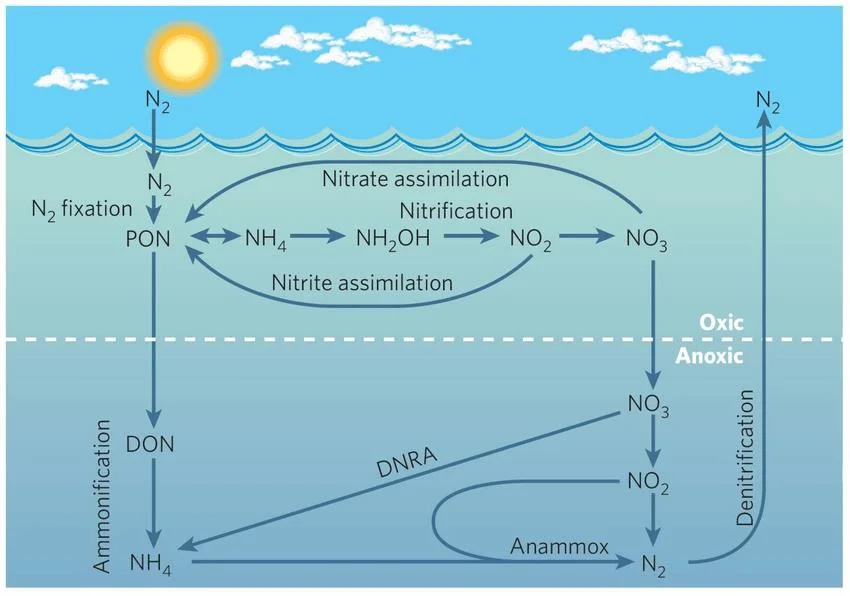
Nitrogen can occur in different forms in marine systems and can be biologically transformed depending on redox conditions, which are generally defined by the level of dissolved oxygen in the water. Predominant transformations include: fixation of nitrogen gas (N2) to particulate organic nitrogen (PON); mineralization of PON to ammonium (NH4+); nitrification, the oxidation of NH4+ to nitrate (NO3−) via nitrite (NO2−); and denitrification, the anaerobic reduction of NO3− to N2 via nitric oxide (NO) and nitrous oxide (N2O). See Figure 1.
The primary form of N in the marine system is Dissolved Inorganic Nitrogen (DIN) which includes nitrate, nitrite, and ammonium.
Generally speaking, nitrification occurs in the water column where there is sufficient oxygen to support these processes. Denitrification occurs in or near the sediment surface where there is little dissolved oxygen available for respiration. Mineralization can occur by aerobic or anaerobic processes. Mineralization releases NH4+ either into the water column or pore water of sediments where it is bioavailable. Mineralization in the sediments may result in a gradient with high NH4+ in the sediments leading to diffusive transport to the water column.
Primary losses of N from the marine system (not including advective transport out) are via denitrification and anaerobic ammonium oxidation (anammox), where inorganic N is converted to N2.
Primary production is based on nutrient availability
The process of the assimilation and conversion of inorganic carbon (carbon dioxide) and other inorganic nutrients into organic matter with the help of light by autotrophs such as phytoplankton is called primary production. A balance of elements such as carbon, nitrogen, and phosphorus is required to support the growth of phytoplankton (and, thus, to support primary production). The relative amounts of each of these has been determined based on the observed stoichiometric ratio of carbon, nitrogen, and phosphorus in marine phytoplankton and marine systems, which is approximately 106:16:1 for C:N:P (Redfield, 1934). That is, for every 106 atoms of carbon used, 16 atoms of N, and 1 atom of P are required to form biological material and support growth. And while the N:P ratio in algae and cyanobacteria varies according to localized conditions, species types, and nutrient availability (Geider and La Roche, 2002), the “Redfield Ratio” of 106:16:1 provides a benchmark to understand broad nutrient requirements for the phytoplankton growth that support marine food webs, including those of the Salish Sea. Large variations from that ratio can indicate nutrient limitations, which can limit primary production.
Primary production in the Salish Sea can be nitrogen limited
Primary production in the Salish Sea occurs in the photic zone, which is the top part of the water column that receives sufficient light to support photosynthetic activity. In the winter months, the solar radiation is low and primary production is limited by light availability. In the spring and summer, the duration and intensity of solar radiation is sufficient to support large-scale primary production to the extent that most of the available N in the photic zone is used up. In such cases, phytoplankton growth is N limited. Adding more N would then result in more phytoplankton growth and potentially eutrophication.
Newton et al. (1998) demonstrated that experimental nitrogen additions at sites in Budd Inlet resulted in increased primary production throughout the year, though there were much larger increases in the summer compared to the winter. Similarly, Newton and Van Voorhis (2002) observed a substantial increase in primary productivity in the photic zone in response to nutrient enhancements at stations in the Central Basin and Possession Sound, particularly in the summer months. The degree of response in primary productivity to nitrogen additions likely varies from year-to-year due to changes in offshore upwelling, timing and magnitude of freshwater inputs, etc.
Nitrogen transport into the photic zone can be limited by stratification
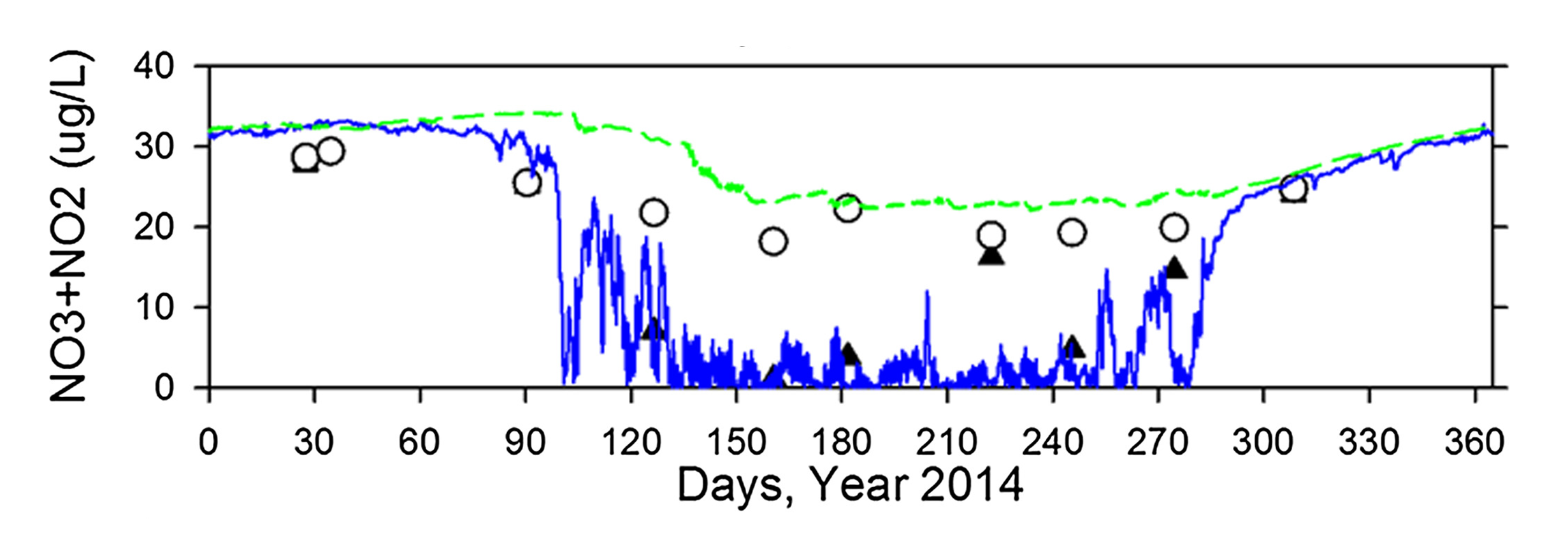
The Salish Sea is a stratified, two-layer system with a distinct upper layer ranging from 0-30 m in depth (Khangaonkar et al., 2017; Khangaonkar et al., 2011). The existence of the strong stratification can limit the vertical transport (via advection and diffusion) of N across and between the shallow layer and the deep layer. In periods of high productivity the N in the upper layer can become depleted and limiting (Khangaonkar et al., 2018). See Figure 2.
Particulate organic carbon can settle to sediments affecting oxygen demand
Particulate organic carbon (POC) can enter the Salish Sea through rivers or streams, through point source inputs, or from primary production in the photic zone. POC can physically settle out of the water column to the sediments where it contributes to oxygen demand in the bottom water and sediments, resulting in a decrease in dissolved oxygen.
References
Geider, R., La Roche, J., 2002. Redfield revisited: variability of C:N:P in marine microalgae and its biochemical basis. European Journal of Phycology 37, 1-17.
Khangaonkar, T., Long, W., Xu, W., 2017. Assessment of circulation and inter-basin transport in the Salish Sea including Johnstone Strait and Discovery Islands pathways. Ocean Modelling 109, 11-32.
Khangaonkar, T., Nugraha, A., Xu, W., Long, W., Bianucci, L., Ahmed, A., Mohamedali, T., Pelletier, G., 2018. Analysis of Hypoxia and Sensitivity to Nutrient Pollution in Salish Sea. Journal of Geophysical Research: Oceans 123, 4735-4761.
Khangaonkar, T., Yang, Z., Kim, T., Roberts, M., 2011. Tidally averaged circulation in Puget Sound sub-basins: Comparison of historical data, analytical model, and numerical model. Estuarine, Coastal and Shelf Science 93, 305-319.
Newton, J., Van Voorhis, K., 2002. Seasonal Patterns and Controlling Factors of Primary Production in Puget Sound’s Central Basin and Possession Sound. Washington State Department of Ecology, Olympia, WA.
Newton, J.A., Edie, M., Summers, J., 1998. Primary productivity in Budd Inlet: Seasonal patterns of variation and controlling factors, Puget Sound Research '98. Puget Sound Action Team, Olympia, WA.
Redfield, A., 1934. On the proportions of organic derivatives in sea water and their relation to the composition of plankton.(1934) In James Johnstone Memorial Volume. University Press of Liverpool, Liverpool, 177-192