

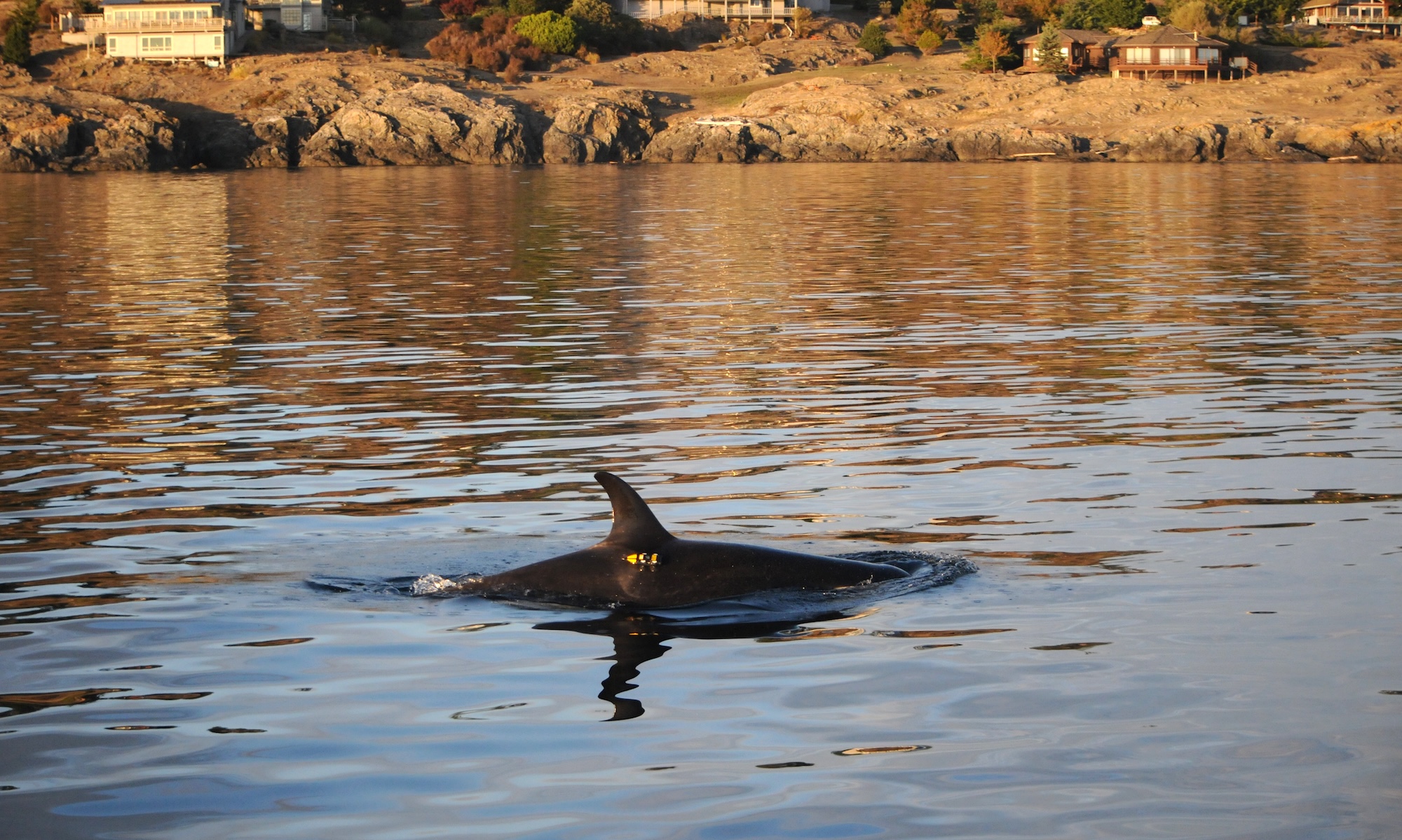
One morning in late September 2018, researchers in a small boat watched from a few hundred meters away as a three-year-old southern resident killer whale known as J53, or Kiki, swam with her mother, some older siblings, and other members of her matriline near the west side of San Juan Island. The whales were in a favored foraging and socializing area for this endangered population of orcas.
The researchers could hear the young whale babbling at the surface of the water and, at one point, one of her siblings chatting back to her. The previous day in the same area, they had observed J53 chase a salmon near the surface of the water and her older family members periodically come up to her, perhaps just checking in or perhaps sharing salmon they had caught. The scene was “really endearing,” remembers Marla Holt, a wildlife biologist at NOAA’s Northwest Fisheries Science Center in Seattle.
In the early afternoon, researchers scooped from the water their own quarry: a sleek electronic device about the size of a cell phone known as a digital acoustic recording tag (DTAG), which they had attached to J53’s back using a long pole the previous day. Suction cups on the underside of the device had gently adhered to her skin, enabling the tag’s onboard sensors and microphones to record her movements, dive depth, and the sounds she made and heard for almost a full 24-hour cycle. The tag would illuminate her activities during long hours when the research boat couldn’t follow.
DTAG data from J53 and nine other southern residents are analyzed in a paper published July 30 in Endangered Species Research. The study provides the most detailed picture yet of the nighttime activities of killer whales and raises fresh concerns about the ability of the southern residents to find and catch enough food – especially females like J53, who is now 11 years old. The population of the critically endangered southern residents has hovered in the mid-70s since 2017.
Most behavioral observations of killer whales are made during the day: scientists belong to a resolutely diurnal and visually oriented species, after all. But orcas are neither diurnal (which means active mostly during the day) nor nocturnal, sleeping in brief snatches throughout a 24-hour period. (Like other dolphins, they sleep with only one half of their brain at a time because they must consciously control their breathing.)
The new work is the first published study of nighttime DTAG data from any population of killer whales, says Holt, who led the analysis. Analysis of data from a similar study of northern resident orcas, led by scientists from Canada’s Department of Fisheries and Oceans, is ongoing.
The researchers analyzed southern resident foraging behavior by piecing together dive trajectories and audio from the DTAGs: the relatively slow, regular echolocation clicks that the whales use to search for their prey; the deep diving with increasingly faster clicks of hot pursuit that blur into a buzz on final approach; the satisfying crunch indicating a successful hunt.
Data from a previous DTAG study showed that noise from container ships, ferries, recreational boats, and other vessels plying the southern residents’ busy home waters in the Salish Sea impairs their daytime foraging efforts. Vessel traffic and lack of their preferred Chinook salmon prey are two of the primary threats to the southern residents’ survival.
Vessel traffic is heavier during the daylight hours, so the researchers wondered if nighttime would offer a respite when the whales could hunt more successfully. Since fish-eating orcas like the southern residents rely heavily on sound to zero in on their prey, they are not beholden to the sun to illuminate their foraging efforts.
The new study includes nighttime DTAG data from six whales: in addition to J53, the researchers tagged 15-year-old female L103 and 8-year-old male (and J53’s nephew) J47 in 2018, 9-year-old male L115 in 2019, 17-year-old male K37 in 2020, and 18-year-old female K36 in 2021. (The other four whales in the study, all males tagged in 2018, only yielded daytime data.)
The result is a study with a small sample size, but one that is balanced in terms of sex, age class, and representation of the three pods that make up the southern resident community and provides unprecedentedly rich data at the individual level. “I think it better describes individual behavior than anything else that we have,” says study team member and University of Washington Center for Ecosystem Sentinels biologist Jennifer Tennessen of the DTAG method. “We're basically riding on the back of a whale.”
The ride is relentless. The researchers identified a total of 9,839 dives for the 10 whales included in the analysis and 2,068 dives that included an echolocation bout indicating foraging. Just over half of overall dives and of foraging dives occurred at night. Data from K37 and K36, whose DTAGs also included GPS receivers, suggest that the whales have pretty much the same travel patterns throughout a 24-hour period.
“There’s no rest for these endangered whales,” says Holt. “They are attempting to find food day and night.”
Both males and females frequently search for prey with slow echolocation clicks during both daylight and nighttime hours, the tags revealed. Males pursue and attempt to capture prey more often than females, as evidenced by a higher probability of fast echolocation clicks and buzzes. Males also attempt to capture prey slightly more often at night than during the day.
But females are less likely to attempt to capture prey than males, and much less likely to do so at night than during the day. The researchers modeled the probability of buzzing on a deep dive of 260 meters: for females, that probability is 88% during the day, but just 21% at night.
That’s especially concerning because vessel disturbance seems to disrupt the foraging of females more than that of males, the previous daytime analysis showed. Southern resident females have different foraging habits than males: they tend to go after prey in shallower water, hunt with other females and young whales nearby rather than off on their own, and share their catch more often. Researchers don’t yet know how these differences relate to females’ lower nighttime prey capture efforts.
But the upshot is clear: “We aren't seeing a strong signature of them developing a strategy to compensate for noise,” Tennessen says.
The researchers plan future analyses of the DTAG data to link the noise an individual whale experiences over a 24-hour cycle to foraging and other behaviors, document their foraging efficiency during the day and at night, and compare DTAG data from southern residents and northern residents, whose range overlaps with that of the southern residents but whose population is increasing.
In the meantime, the findings underline the importance of measures that have been put in place to calm vessel noise in the Salish Sea during the daytime. “We need to protect their acoustic habitat,” Holt says.