Species: Orcinus orca pop. 5

Killer Whale - Northeast Pacific Southern Resident Population
Species

    Science Review:

    Articles:

    Annual census could show an increase of two killer whales among southern residents
    The news of two new southern resident orca calves this year marks the 50th anniversary of whale counts from the Center for Whale Research.
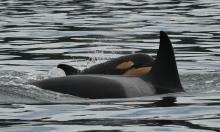
    An adult and a juvenile killer whale swimming next to each other
    Orcas by night: A rare look at the nighttime activities of endangered killer whales
    Killer whales are active both day and night, but most scientific research focuses on their daytime activities. A recent study looked at a small group of endangered southern residents to find out how often they hunt after the sun goes down. Ocean noise tends to decrease at night, potentially making it easier for the whales to catch salmon, but could they take advantage?
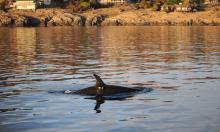
    A killer whale swimming in nearshore water with yellow digital acoustic recording tag visible near its dorsal fin and rocky coastline with homes behind.
    Abundance of pink salmon may be harming orcas
    Pink salmon now comprise nearly 80 percent of all adult salmon in the North Pacific. This record abundance is coming at a cost to other salmon species such as threatened Chinook, which compete with pinks for spawning territory. A new study shows that the ecological toll may extend all the way to endangered southern resident killer whales.
    Underwater view of many fish swimming in one direction.
    Under a new proposal, our local orcas — resident and Bigg’s killer whales — would each become a new species
    A scientific paper, published on March 27th, spells out the unique physical and genetic characteristics that should make each group a separate species, with the proposed scientific names Orcinus ater for residents and Orcinus rectipinnus for Bigg’s.
    Two pairs of killer whales swimming in open water with spray coming from their blow holes. Land with green trees and vegetation is in the near background.
    Southern resident orcas chase and sometimes kill porpoises. Why don’t they eat them?

    Puzzling encounters between endangered killer whales and harbor porpoises point to questions about prey availability and whale culture, scientists say. Are the whales playing, practicing their hunting skills, or is something else going on? 

    A killer whale surfaces with its head above water holding a harbor porpoise in its mouth.
    Inbreeding hinders population recovery among endangered Southern Resident killer whales

    While a scarcity of Chinook salmon and other environmental factors may be pushing the Southern Resident killer whales toward extinction, a new genetics study has revealed that inbreeding has been exerting a powerful, overriding influence upon the small, genetically isolated population.

    J27, a 32-year-old male orca named Blackberry, cruises off the Seattle waterfront in October 2012. Blackberry’s community, the endangered Southern Resident killer whales, are impaired by a high rate of inbreeding. Photo: National Marine Fisheries Service, taken under permit #16163
    Sightings of southern resident killer whales in the Salish Sea 1976−2014: the importance of a long-term opportunistic dataset

    A 2018 paper in the journal Endangered Species Research analyzes southern resident killer whale sightings in the Salish Sea between 1976 and 2014. 

    Southern resident killer whale breaching. Image courtesy of NOAA
    Orca captures for aquariums

    Between 1962 and 1973, at least 263 killer whales were caught or killed in the waters of British Columbia and Washington (Bigg and Wolman 1975). Twelve of these died during capture and fifty were kept for display in aquariums. The remainder of the captured animals escaped or were released. Twenty-seven of the whales kept as captive were taken from the population now designated as endangered southern-resident killer whales (Balcomb 2018). Of those captive whales, all but one have since died. The sole living whale, nicknamed Lolita, remains in captivity at the Miami Seaquarium.

    Balcomb, Ken. (2018). Center for Whale Research. Personal correspondence. 

    Bigg, M. A., & Wolman, A. A. (1975). Live-capture killer whale (Orcinus orca) fishery, British Columbia and Washington, 1962–73. Journal of the Fisheries Board of Canada, 32(7), 1213-1221.

    An orca show at Miami Seaquarium featuring southern-resident orca Lolita. Photo by Marc Averette. Avaiable through a Creative Commons Attribution 3.0 Ported license. https://commons.wikimedia.org/wiki/File:Miamiseaquariumlolita.jpg
    For declining orcas, food is fate

    Recent images of a mother orca appearing to grieve for her dead calf have brought worldwide attention to the plight of Puget Sound’s endangered Southern Resident orcas. As orca numbers decline, we look at how the effects of toxic chemicals on the whales are magnified even as the residents slowly starve from a general lack of Chinook salmon, their chief source of food. 

    J16 surfacing near Saturna Island, August 2012. Photo: Miles Ritter (CC BY-NC-ND 2.0) https://www.flickr.com/photos/mrmritter/7730710932
    Future of orcas takes center stage at Salish Sea conference

    Gov. Jay Inslee joined former Interior Secretary Sally Jewell to open three days of science talks at the Salish Sea Ecosystem Conference in Seattle. The conference includes about 700 scientific presentations on topics ranging from orcas to habitat restoration, from climate change to toxic chemicals.

    Former U.S. Secretary of the Interior Sally Jewell and WA Governor Jay Inslee helped kick off the Salish Sea Ecosystem Conference in Seattle on April 4, 2018. Photo: Jeff Rice/PSI
    Seals and sea lions may be slowing salmon recovery, hurting orcas

    Increased consumption of Chinook salmon by seals and sea lions in the Salish Sea “could be masking the success of coastwide salmon recovery efforts,” according to a new study published in the journal Scientific Reports. Endangered resident orcas are said to be declining in part due to a lack of available Chinook, the orcas' preferred prey.

    A young resident killer whale chases a chinook salmon in the Salish Sea near San Juan Island, WA. Sept 2017. Photo: (CC BY-SA 2.0) https://flic.kr/p/21wV8rV
    Killer whale miscarriages linked to low food supply

    New techniques for studying orcas have been credited with breakthroughs in reproductive and developmental research. Drones and hormone-sniffing dogs are helping scientists connect declines in food supply with low birth rates and poor health. Update: The research described in this 2016 article has now been published in the 6/29/17 issue of the journal PLOS ONE.

    Photogrammetry image of an adult female Southern Resident (J16) as she’s about to surface with her youngest calf, born earlier in 2015, alongside. Photo: NOAA Fisheries, Vancouver Aquarium
    Contaminants higher in resident 'blackmouth' Chinook

    Many of Puget Sound's Chinook salmon spend their entire lives in local waters and don't migrate to the open ocean. These fish tend to collect more contaminants in their bodies because of the sound's relatively high levels of pollution. 

    Chinook salmon (Oncorhynchus tshawytscha). Photo: WDFW
    New theory rethinks spread of PCBs and other toxics in Puget Sound

    Researchers are proposing a shift in thinking about how some of the region’s most damaging pollutants enter Puget Sound species like herring, salmon and orcas.

    Puget Sound's orcas are among the most contaminated marine mammals in the world. Photo: Minette Layne (CC-BY-2.0) https://en.wikipedia.org/wiki/Killer_whale#/media/File:Orca_porpoising.jpg
    Resident killer whales sometimes attack porpoises but never eat them

    The mysterious practice of killing porpoises may have a useful function, but it has yet to be fully explained, according to orca researcher Deborah Giles.

    A 6-year-old killer whale from L pod, known as L-73, chases a Dall’s porpoise in this historical photo taken in 1992. Photo: Debbie Dorand/Center for Whale Research
    Concerns rise over potential impacts of disease on the ecosystem

    From orcas to starfish to humans, disease affects every living creature in the ecosystem. Scientists are increasingly alarmed by its potential to devastate already compromised populations of species in Puget Sound.  

    Mist from the breath of killer whales is collected at the end of a long pole then tested for dozens of different types of bacteria. Photo: Pete Schroeder
    2013 Puget Sound Marine Waters Overview

    A report from the Puget Sound Ecosystem Monitoring Program provides an overview of 2013 marine water quality and conditions in Puget Sound from comprehensive monitoring and observing programs.

    2013 Puget Sound Marine Waters Overview
    Report: Washington State status report for the Killer Whale

    This 2004 report looks at the status of Washington's four killer whale populations.

    Killer whale (Orcinus orca). Photo by Joseph Gaydos.
    Killer whales in Puget Sound

    Three distinct groups of killer whales (Orcinus orca) occupy the coastal waters of the northeastern Pacific. These groups—northern and southern residents, transients, and offshores—are distinguished by diet, behavior, morphology, and other characteristics. Among these, southern resident and transient killer whales commonly are found in Puget Sound. Northern residents and offshore killer whales rarely enter Puget Sound (Wiles 2004, Kriete 2007), and therefore are not described in detail here.

    Killer whale (Orcinus orca). Photo courtesy of NOAA.
    Kingdom
    Animalia
    Phylum
    Craniata
    Class

    Mammalia

    Order

    Cetacea

    Family

    Delphinidae

    Genus

    Orcinus

    Classification
    Other Global Common Names
    Killer Whale - Southern Resident Population
    Informal Taxonomy
    Animals, Vertebrates - Mammals - Whales and Dolphins
    Formal Taxonomy
    Animalia - Craniata - Mammalia - Cetacea - Delphinidae - Orcinus - NMFS (2005) concurred with a Biological Review Team (BRT) conclusion that killer whales in the Puget Sound area (Southern Resident population) likely belong to an unnamed subspecies of resident killer whales in the North Pacific. This subspecies includes populations known as Southern Resident and Northern Resident, as well as the resident killer whales of southeast Alaska, Prince William Sound, Kodiak Island, the Bering Sea and Russia. It does not include transient or offshore killer whales. The BRT concluded that the Southern Resident population is discrete and significant with respect to the North Pacific resident taxon and therefore should be considered a Distinct Population Segment (DPS) under the U.S. Endangered Species Act.
    Habitat Type Description
    Marine
    Migration
    false - false - false
    Non-migrant
    false
    Locally Migrant
    false
    NatureServe Global Status Rank
    G4G5T1
    Global Status Last Reviewed
    2005-12-06
    Global Status Last Changed
    2005-12-06
    Conservation Status Map
    <img src="http://www.natureserve.org/explorer/servlet/GetMapGif?CA.BC=S1&US.WA=SNR" alt="Conservation Status Map" style="width: 475px; height: auto;" />
    Global Range
    The range during spring, summer, and fall includes the inland waterways of Puget Sound, Strait of Juan de Fuca, and Southern Georgia Strait (NMFS 2005). Sometimes whales of this DPS have occurred in the coastal waters off Oregon, Washington, Vancouver Island, and more recently off the coast of central California in the south and off the Queen Charlotte Islands to the north (NMFS 2005). Little is known about winter movements and range.
    ELEMENT_GLOBAL.79.732807