

All Articles
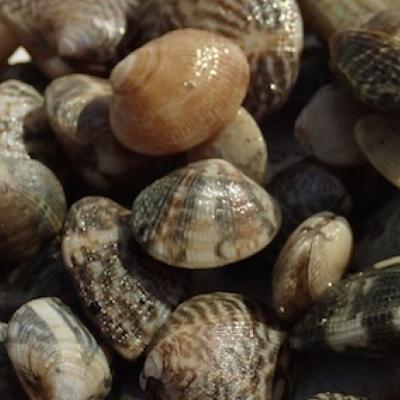
Extended abstract— Poisoning the body to nourish the soul: Prioritising health risks and impacts in a Native American community
This is an extended abstract of Poisoning the body to nourish the soul: Prioritising health risks and impacts in a Native American community by Jamie L. Donatuto, Terre A. Satterfield and Robin Gregory. The full article was published in Health, Risk & Society, Vol. 13, No. 2, April 2011, 103–127. The extended abstract was prepared for the Encyclopedia of Puget Sound by Jamie L. Donatuto.
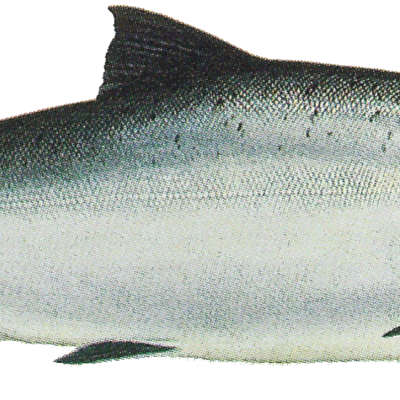
NOAA report establishes Chinook monitoring framework
A new Chinook monitoring framework is designed to build cooperation among managers and policymakers working across the Puget Sound watershed. The report, prepared by an independent team of scientists and released by NOAA, includes a regionally specific, common classification system for Chinook habitats and key ecological attributes.
Puget Sound Chinook Salmon recovery: a framework for the development of monitoring and adaptive management plans
The Puget Sound Recovery Implementation Technical Team has released a draft of a NOAA technical memorandum describing frameworks for adaptive management and monitoring of Chinook salmon in Puget Sound. Download the report.
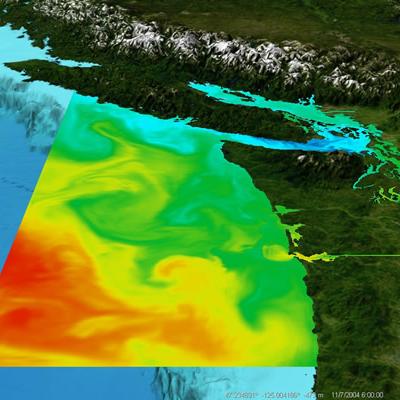
Water quality model development and application in Puget Sound and Georgia Basin
A recent summary includes information compiled in Winter 2013 by the modeling workgroup of the Puget Sound Ecosystem Monitoring Program (PSEMP). It describes several ecosystem modeling efforts in the region.
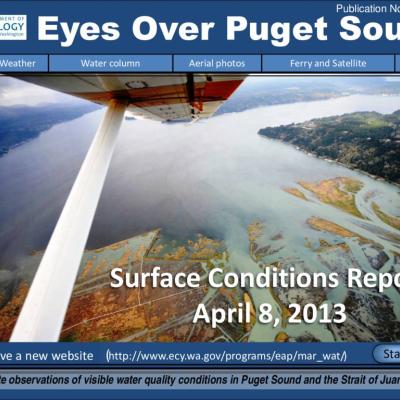
Eyes Over Puget Sound: Surface Conditions Report - April 8, 2013
For the last week sunshine was low and rivers and air temperatures have been higher than expected due to prevailing southerly winds. Heavy rains have resulted in long foam lines and large river plumes that are filled with sediment. Jelly fish patches have persisted through the winter in smaller bays. Are higher oxygen conditions seen over the last 2 years starting to disappear? We were busy in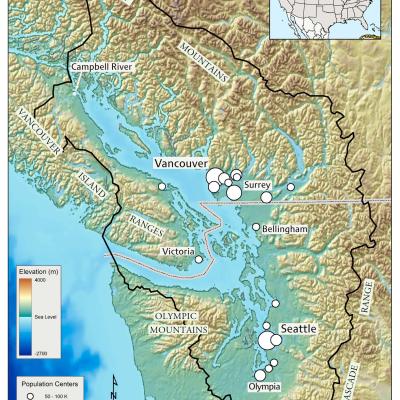
The Salish Sea
The Salish Sea extends across the U.S.-Canada border, and includes the combined waters of the Strait of Georgia, the Strait of Juan de Fuca, Puget Sound Basin and the San Juan Islands (see map).
The name Salish Sea was proposed by Bert Webber in 1989 to reflect the entire cross-border ecosystem. Both Washington State and British Columbia voted to officially recognize the name in late 2009. The
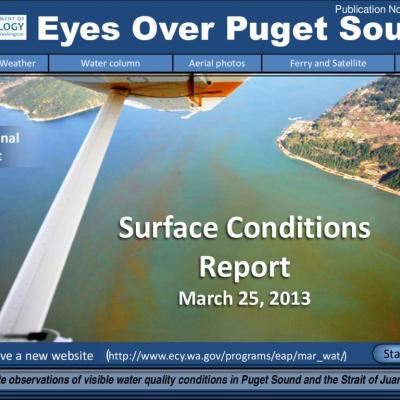
Eyes Over Puget Sound: Surface Conditions Report - March 25, 2013
Lower than expected air temperatures and sunshine are now both increasing; rivers are generally running high. Willapa Bay unfolds its beauty from a bird’s-eye view. The spring phytoplankton bloom is picking up in Puget Sound. A large red-orange-brown bloom persists in southern Hood Canal at a scale sufficient for the MODIS satellite to pick up. Jellyfish are still going strong in southern inlets
Eelgrass
Eelgrass (Zostera marina L.) is an aquatic flowering plant common in tidelands and shallow waters along much of Puget Sound’s shoreline. It is widely recognized for its important ecological functions, and provides habitat for many Puget Sound species such as herring, crab, shrimp, shellfish, waterfowl, and salmonids.
Ecosystem-based management
Ecosystem-based management (EBM) is an integrated, science-based approach to the management of natural resources that aims to sustain the health, resilience and diversity of ecosystems while allowing for sustainable use by humans of the goods and services they provide.

Marine forage fishes in Puget Sound
This is the executive summary from a technical report produced for the Puget Sound Nearshore Partnership on Valued Ecosystem Components (VEC). The entire document is included as a PDF with this summary.