

All Articles
Jamestown S'Klallam Tribe
The Jamestown S’Klallam tribe is one of several communities originating from the S’Klallam tribe (“strong people”), a cultural and linguistic group in the Salish Sea. The S’Klallam signed the treaty of Point No Point in 1855, which entitled them to a payment of $60,000 over 20 years and fishing rights at the “usual and accustomed places.” In 1874, a band of S’Klallams paid $500 for a 210-acre
Hoh Indian Tribe
The Hoh River (chalak'At'sit, or "the southern river") is central to the history, economy and culture of the tribe. Established in September of 1893, the Hoh Indian Reservation covers 443 acres of land on the west side of the Olympic Peninsula. The tribe shares a language with the Quileute. In 2010, additional land was transferred to the tribe under the Hoh Indian Tribe Safe Homelands Act, in
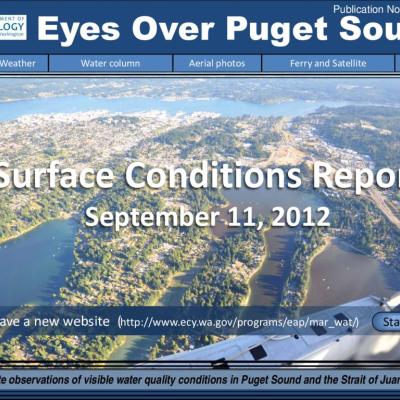
Eyes Over Puget Sound: Surface Conditions Report - September 11, 2012
River flows are below normal. Temperatures in Puget Sound are 12-14 °C. Extensive red-brown blooms in Inlets of South and Central Sound. Jellyfish are increasing in numbers. Low-moderate fluorescence in Central Sound. In Possession Sound dissolved oxygen decreased by 1.1 mg/L.
The Puget Sound Institute
The Puget Sound Institute is a cooperative agreement between the University of Washington, the U.S. Environmental Protection Agency, and the Puget Sound Partnership, seeking to catalyze rigorous, transparent analysis, synthesis, discussion and dissemination of science in support of the restoration and protection of the Puget Sound ecosystem.
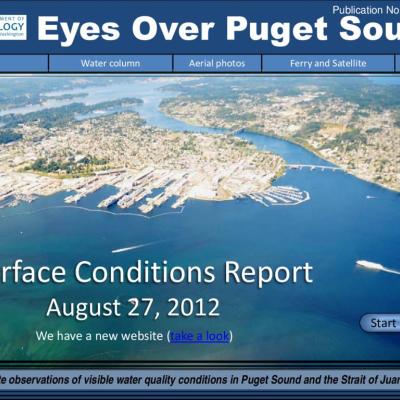
Eyes Over Puget Sound: Surface Conditions Report - August 27, 2012
Temperatures in Main Basin drop below 15 °C. Marco algae in Central Sound. Red-brown blooms in South Sound Inlets and parts of Central Sound. Jellyfish patches increasing in size in Sinclair and Budd Inlets. Low-Moderate fluorescence and turbidity in Main Basin and Admiralty Inlet.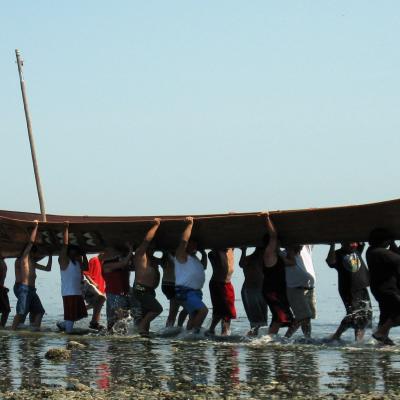
Traditional Ecological Knowledge
Traditional Ecological Knowledge (TEK), sometimes called Indigenous Knowledge, refers to cumulative knowledge and experience that indigenous cultures have of their environment. In the last thirty years, there has been growing interest in TEK as a resource for restoration and conservation projects.
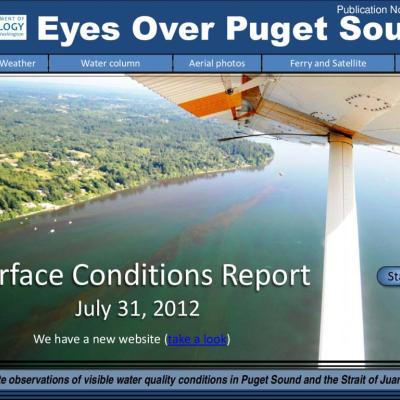
Eyes Over Puget Sound: Surface Conditions Report - July 31, 2012
In the south a persistent marine layer over the lowlands keep conditions cooler. River flows are high. Water temperatures approach 15 °C. High fluorescence in the Main Basin Extensive red-brown blooms in South Sound. In Whidbey Basin, higher DO and algal bloom in surface waters.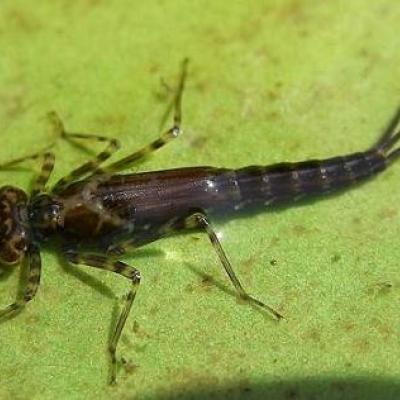
Featured resource: Puget Sound Stream Benthos
Puget Sound Stream Benthos is a data management project which monitors benthic invertebrates in streams and rivers in the Puget Sound region. The system is maintained and operated by King County and was the result of a joint effort between King, Pierce, and Snohomish Counties.
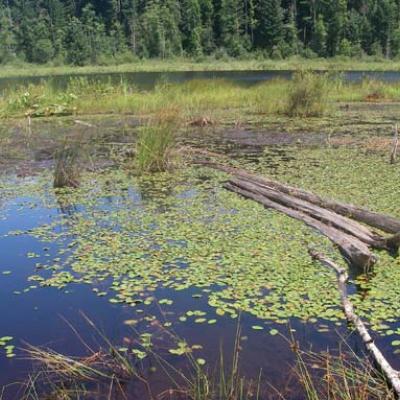
King County wetland habitat
Wetlands are recognized as critical ecosystems for biodiversity because of their disproportional use by wildlife and exceptional habitats for plants. It is their unique combination of shallow aquatic habitats and adjacent terrestrial conditions extending over a wide range of geomorphic and elevational settings that accounts for their ecological complexity and resultant richness. Because of their
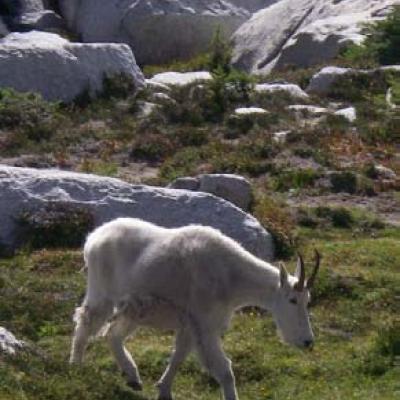
King County subalpine and alpine habitat
Except for a very small area in the SE corner of the County, the subalpine and alpine habitats are located in the North Cascades Ecoregion that occupies the NE quarter of King County. This ecoregion is composed of steeply dissected valleys that rise precipitously to the subalpine (montane) forests, meadows, and parklands and, in a short distance more, to the alpine ridges and peaks of the Cascade