Nearshore habitat

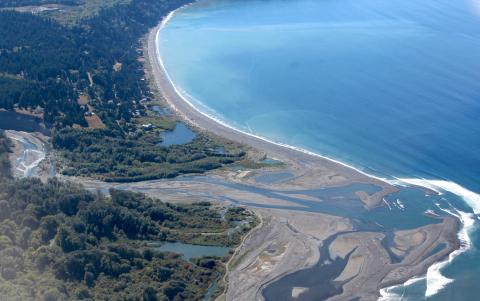
The nearshore habitat of Puget Sound is usually defined as the area from the bluffs that line the shore to the area where water becomes too deep for light to penetrate and allow plants to grow, measured relative to mean lower low water (MLLW). It includes marine habitat and estuarine habitat, but stops at the farthest reach of the tide into an estuary, or the point where saltwater no longer mixes with fresh. Within Puget Sound’s nearshore are many varied habitat types, including rocky and sandy beaches, mudflats, salt marshes, kelp and eelgrass beds, and lagoons.

Sources:

Puget Sound Nearshore Ecosystem Restoration Project: http://www.pugetsoundnearshore.org/technical_reports.html.

Overview

The Puget Sound Nearshore Ecosystem Restoration Project (PSNERP) works to assess the health of Puget Sound nearshore environments and provides strategies for their protection and restoration. 

PSNERP logo

Related Articles

Crab Team members maintain a massive surveillance program to track the population’s advance, while researchers probe the inner workings of the invasive species.

Puget Sound serves as the ultimate drainage destination for many rivers that carry fresh water from the Olympic and Cascade mountain ranges to the ocean. When this freshwater mixes with the ocean’s saltwater it creates biologically rich environments known as estuaries. These estuaries provide critical habitat for young salmon, migratory birds, and many other species including forage fish and marine mammals.

The rivers flowing into Puget Sound pass through 16 major deltas in seven sub-basins. Scientists estimate that 70–80% of Puget Sound’s historical delta habitats have been lost to human development since the early 1800s (Wildlife Management Institute, 2024)

Kayaker-scientist Brian Footen is back on the waters of Puget Sound this summer, paddling through inlets and circling islands on a 2,700-mile journey to photograph the shoreline and document natural and human-caused changes to the habitat.

This state-funded project is Brian’s second photographic trip along the sinuous shoreline throughout the entirety of the Sound, from Budd Inlet in the south to the San Juan Islands in the north, as well as the Strait of Juan de Fuca and Hood Canal. When conditions warrant, Brian uses a motorized skiff or inflatable raft, especially where strong currents impede his travels.

The project

Scientists at the Washington Department of Ecology along with many other researchers have spent years studying and debating the problem of low oxygen in Puget Sound. Now, many new developments — technical, scientific and legal — are reaching a critical stage and setting up a framework to make some major decisions. This is part four of a four-part series originally published in the Puget Sound Institute blog.

Biologist and science writer Eric Wagner recently returned from a trip to observe pigeon guillemots on Protection Island. He wonders: How much do we really know about the health of seemingly abundant bird populations?

The Swinomish Indian Tribal Community has begun constructing the first known clam garden to be built in modern times. They hope that what was once an ancient way of cultivating shellfish can now be a hedge against climate change.