Harbor seals

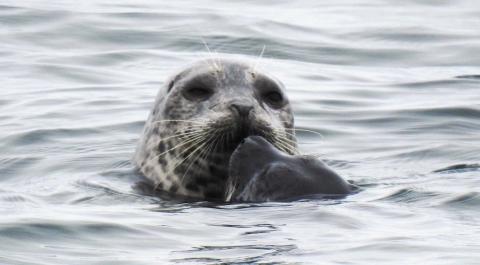
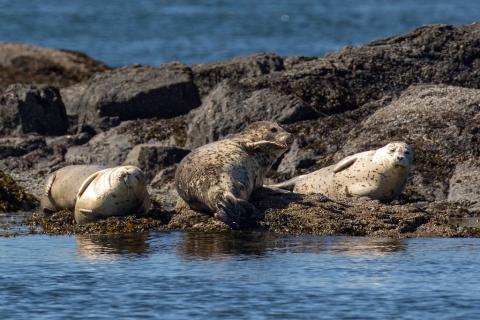
Harbor seals are found throughout the nearshore waters of Washington including Hood Canal, Puget Sound, the San Juan Islands, and the Strait of Juan de Fuca out to Cape Flattery. Harbor seal numbers were severely reduced during the first half of the twentieth century by a state-financed population control program. This bounty program ceased in 1960, and in 1972, harbor seals became protected under the federal Marine Mammal Protection Act (MMPA) and by Washington State. Their populations in Washington State have recovered since the 1970s and population sizes may be near a stable equilibrium level, perhaps reflective of the current carrying capacity of the environment. 

—Source: Puget Sound Science Review

Overview

Harbor seals (Phoca vitulina) are the most commonly seen marine mammals in the Salish Sea and can be found throughout the region year round. They have been intensively studied within the Salish Sea and this species profile provides an overview of what is known about them. It was produced for the Encyclopedia of Puget Sound by the SeaDoc Society. 
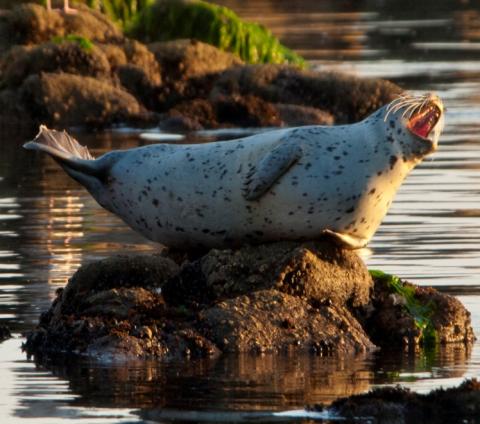
Harbor seal vocalizing on rock. Credit: G.E. Davis

Related Articles

A study published in Marine Mammal Science in June 2020 followed the movements and behavior of rehabilitated harbor seal pups after being released into the Salish Sea. The results suggest that although their movements differ from wild pups that have been weaned, the rehabilitated pups do successfully make the transition.

Tiny bone samples show that seals alter their diets as conditions change. The findings could help scientists understand whether seals are contributing to local salmon declines.

Last month's federal authorization to kill more than 700 sea lions to protect salmon runs along the Columbia River is prompting discussions of similar actions for harbor seals in Puget Sound. But experts say the situations are very different with many unanswered questions. 

A 2020 paper published in Frontiers in Marine Science describes details of the fungal disease Mucormycosis which has caused the death of harbor porpoises, harbor seals and one orca in Puget Sound in recent years. The authors discuss the implications for local marine mammals, specifically the endangered southern resident killer whale population.

A 2020 article in the journal Frontiers in Marine Science looks at harbor seal stranding and necropsy findings in the San Juan Islands to assess age-related stranding trends and causes of mortality. The harbor seal (Phoca vitulina richardii) population in the Salish Sea has been at equilibrium since the mid-1990s. This stable population of marine mammals resides relatively close to shore near a large human population and offers a novel opportunity to evaluate whether disease acts in a density-dependent manner to limit population growth.

A 2019 article in the Journal of Wildlife Diseases looked at trace element concentrations of heavy metals in the livers of harbor seals that died and stranded in the San Juan Islands. The study indicated exposure to trace elements (naturally occurring, human-introduced, or both) in the Salish Sea; however, the study reports that trace element toxicity is not a major threat to harbor seal health.