Harbor seals

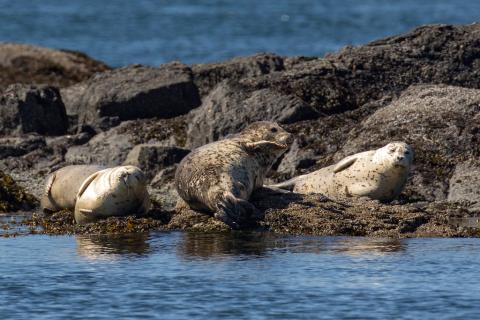
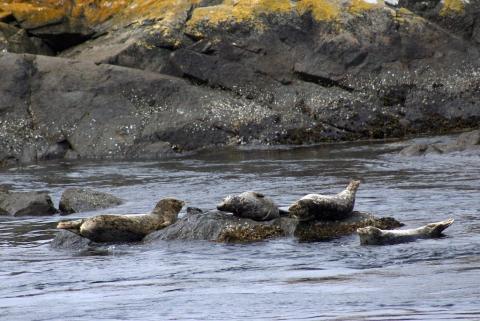
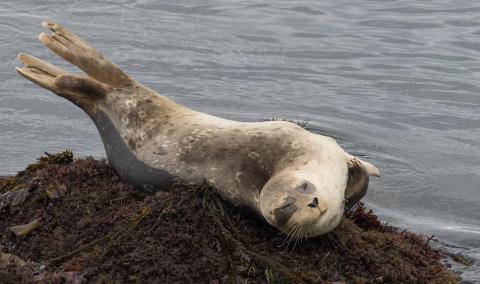
Harbor seals are found throughout the nearshore waters of Washington including Hood Canal, Puget Sound, the San Juan Islands, and the Strait of Juan de Fuca out to Cape Flattery. Harbor seal numbers were severely reduced during the first half of the twentieth century by a state-financed population control program. This bounty program ceased in 1960, and in 1972, harbor seals became protected under the federal Marine Mammal Protection Act (MMPA) and by Washington State. Their populations in Washington State have recovered since the 1970s and population sizes may be near a stable equilibrium level, perhaps reflective of the current carrying capacity of the environment. 

—Source: Puget Sound Science Review

Overview

Harbor seals (Phoca vitulina) are the most commonly seen marine mammals in the Salish Sea and can be found throughout the region year round. They have been intensively studied within the Salish Sea and this species profile provides an overview of what is known about them. It was produced for the Encyclopedia of Puget Sound by the SeaDoc Society. 
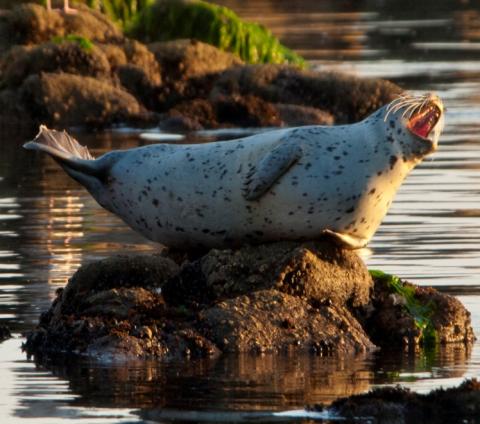
Harbor seal vocalizing on rock. Credit: G.E. Davis

Related Articles

A 2014 paper in the journal PLoS ONE examines differences between foraging behavior of harbor seals based on haulout site locations, seasons, sexes and times of day. The authors hypothesize that these factors may help explain the variability in diet among harbor seals observed at different haul-out site groups in the Salish Sea. 

As wildlife managers work to recover Puget Sound’s diminished Chinook population, a proposed white paper is expected to review the impacts of some of the salmon's chief predators. The study would include a section on potential management of seals and sea lions, prompting open discussion of a long taboo subject: Could officials seek to revise the Marine Mammal Protection Act — or even conduct lethal or non-lethal removal of seals and sea lions in some cases? Such actions are hypothetical, but we look at some of the ongoing discussions around the issue as prompted by a new resolution from the Puget Sound Leadership Council. 

A 2017 paper in the journal Aquatic Mammals reports that harbor seals in the Salish Sea are less concerned about predators when they become habituated to humans. 

Increased consumption of Chinook salmon by seals and sea lions in the Salish Sea “could be masking the success of coastwide salmon recovery efforts,” according to a new study published in the journal Scientific Reports. Endangered resident orcas are said to be declining in part due to a lack of available Chinook, the orcas' preferred prey.

Vessel traffic is increasing in the Puget Sound region. A 2017 article in the journal Aquatic Mammals looks at the potential impacts that increasing vessel disturbance may have on resident harbor seal populations and how future management decisions may need to look at variable buffer zones related to level of human activity.

A new study shows that increased populations of seals and sea lions are eating far more of Puget Sound’s threatened chinook than previously known, potentially hampering recovery efforts for both salmon and endangered killer whales.