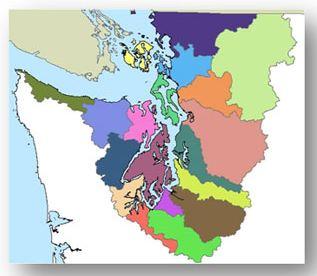
Puget Sound boundaries

There are several ways that scientists and managers have defined the boundaries of Puget Sound. To oceanographers, Puget Sound includes the waters from Admiralty Inlet and Deception Pass to the southern tip of Olympia. However, many management and conservation efforts incorporate the entire watershed—the land where rivers and streams drain into Puget Sound—as well as the Strait of Juan de Fuca, Hood Canal and the San Juan Archipelago. 

Source: Puget Sound Fact Book

Overview

The boundaries of Puget Sound and the Salish Sea are not always consistently defined by scientists and government agencies. This article clarifies the distinctions between oceanographic and watershed-based definitions of these geographic areas. 

Water Resource Inventory Areas (WRIA). Map: Kris Symer. Data source: WAECY.

Related Articles

Use our interactive map to determine if a geographic feature is within the boundaries of the Puget Sound or Salish Sea watersheds. The Puget Sound region includes the area within the United States while the Salish Sea region* encompasses the entire shaded area. Areas that influence circulation in the Salish Sea or eventually drain into the estuary are marked by broader boundaries.

The Salish Sea’s endangered southern resident orcas travel freely across the U.S.-Canada border, unconstrained by political boundaries. But while they don’t require passports, they can still face differing policies and conditions as they go back and forth between nations. We look at some of the ways that the United States and Canada compare in their efforts to protect the whales.

The Puget Sound ecosystem is shaped by its physical environment. This article looks at Puget Sound's geologic history as well as dynamic factors such as the flow of its rivers and currents.

A scientific assessment of current status and future trends in resource abundance and environmental quality in the Strait of Juan de Fuca, Strait of Georgia, and Puget Sound 

The Puget Sound Model was designed and built in the early 1950s at the University of Washington School of Oceanography as a research and teaching tool for understanding Puget Sound circulation patterns.

This project is a coarse-scale, systematic characterization of different areas within the Puget Sound watershed, aimed at providing a framework for land use discussions.