Puget Sound boundaries

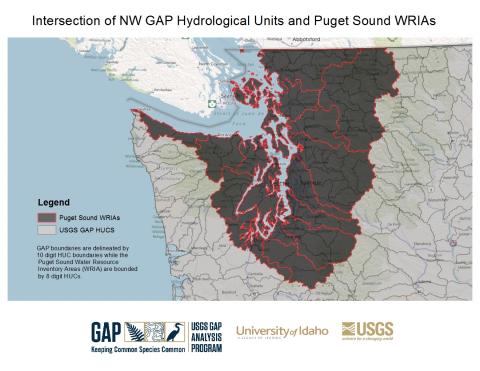
There are several ways that scientists and managers have defined the boundaries of Puget Sound. To oceanographers, Puget Sound includes the waters from Admiralty Inlet and Deception Pass to the southern tip of Olympia. However, many management and conservation efforts incorporate the entire watershed—the land where rivers and streams drain into Puget Sound—as well as the Strait of Juan de Fuca, Hood Canal and the San Juan Archipelago. 

Source: Puget Sound Fact Book

Overview

The boundaries of Puget Sound and the Salish Sea are not always consistently defined by scientists and government agencies. This article clarifies the distinctions between oceanographic and watershed-based definitions of these geographic areas. 

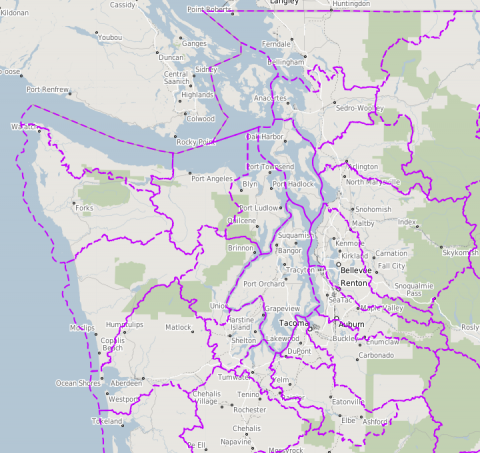
Water Resource Inventory Areas (WRIA). Map: Kris Symer. Data source: WAECY.

Related Articles

The Salish Sea extends across the U.S.-Canada border, and includes the combined waters of the Strait of Georgia, the Strait of Juan de Fuca, Puget Sound Basin and the San Juan Islands (see map).

The name Salish Sea was proposed by Bert Webber in 1989 to reflect the entire cross-border ecosystem. Both Washington State and British Columbia voted to officially recognize the name in late 2009. The name honors the Coast Salish people, who were the first to live in the region.

More information on the ecology and naming of the Salish Sea is available from the SeaDoc Society and Western

There are many ways of defining the boundaries of the Puget Sound watershed. Hydrologic unit codes (HUCs) are nationally standardized divisions that are often used by conservation agencies and national organizations.

The Encyclopedia of Puget Sound, in cooperation with the USGS, has developed a list of terrestrial vertebrates occurring within the Puget Sound basin.

The Washington State Department of Ecology and other state natural resources agencies have divided the Washington into 62 "Water Resource Inventory Areas" or "WRIAs" to delineate the state's major watersheds.