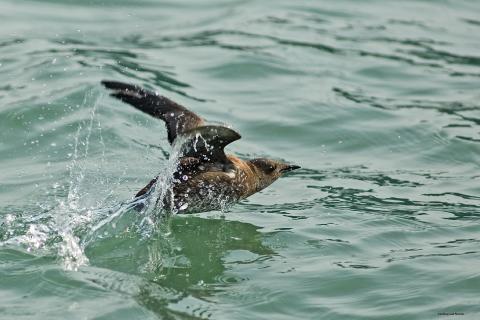
Marbled murrelets are a rare sight in Puget Sound. The threatened birds have declined severely in California, Oregon, and Washington, and biologists are intrigued by their summer presence in Commencement Bay.
Citizen science bird counts are providing more detail than ever about North American bird declines. While the overall numbers are discouraging, new levels of understanding may help conservation efforts. Biologist Eric Wagner writes that despite larger trends, species recovery can be important on a very small scale, perhaps a few birds at a time.
Pink salmon now comprise nearly 80 percent of all adult salmon in the North Pacific. This record abundance is coming at a cost to other salmon species such as threatened Chinook, which compete with pinks for spawning territory. A new study shows that the ecological toll may extend all the way to endangered southern resident killer whales.
Just last year, scientists published the first direct evidence that noise interferes with orca feeding behavior. Officials hope a new law establishing a larger buffer zone between boats and endangered southern resident orcas will mean quieter seas and healthier whales.
Recent discoveries of two new shark species in Puget Sound have sparked public interest and may encourage greater conservation efforts. In this seven-part series, Christopher Dunagan provides an overview of sharks in Puget Sound and some of the recent work among scientists to protect these often misunderstood creatures.
Soupfin sharks were not known to occur in Puget Sound until one was hooked by a fisherman in 2022. Scientists say warming oceans from a changing climate may be bringing more of the species into local waters. Our series on the sharks of Puget Sound continues with a closer look at soupfins and why they are being considered for inclusion on the Endangered Species List.
Local shark experts say people are often surprised to find that sharks are not ruthless eating machines; rather these animals display complex social behaviors and even personalities. They say the more that people learn about sharks, the more they will want to protect them. Our series on Puget Sound's sharks continues with part six of seven.
In the final installment of our series on sharks in Puget Sound, we look at how fishing regulations have changed to protect potentially vulnerable shark species. Experts say more regulations may be needed as research evolves.
The Stillaguamish River is home to what may be the most imperiled stock of Chinook salmon in all of Puget Sound. What scientists are learning here at the Stillaguamish estuary on Port Susan Bay could help turn the tide for these fish and other salmon around the region. E
Scientists are making the case that the world's orcas should be divided into two new species. Voting for the proposed change was scheduled to take place last week at the Society for Marine Mammalogy. [Update: Read about the decision here.]