Last summer, scientists met at the University of Washington to address alarming findings concerning the rapid acidification of the world's oceans. Experts at that symposium warned that wildlife in the Salish Sea, from salmon to shellfish, may start to see significant effects from changing water chemistry within the next 10 to 20 years. This article summarizes the symposium's key findings and was commissioned and edited by the Washington Ocean Acidification Center which hosted the gathering. Funds for the article were provided by the Washington state legislature. [A version of this article was originally published by the Washington Ocean Acidification Center.]
The Washington Department of Natural Resources is studying new ways of increasing ecologically important eelgrass habitat in Puget Sound. It is part of the state's effort to boost eelgrass 20% Sound-wide by 2020. So far, recovery of the species has fallen short of that goal, but transplanting efforts are showing promise.
Each winter and spring, researchers survey the sometimes spectacular spawning events of Puget Sound's Pacific herring. They have found wide swings in the fish's population and an overall decline in herring numbers since the 1970s, but little is known about the cause or what this might mean for the health of the food web. We spent a day with a biologist spotting herring eggs and considering the future of one of our region's most ecologically and culturally important fish species.
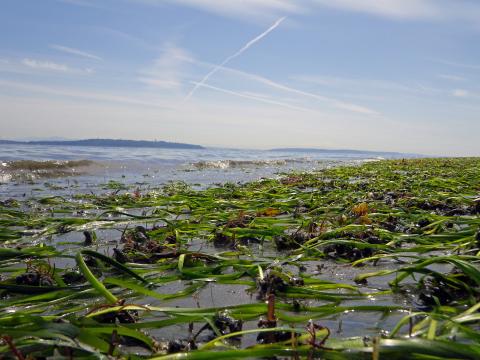
As critically important eelgrass declines in some parts of Puget Sound, scientists are trying to plant more of it. The health of the ecosystem may be riding on their efforts, but what they are finding is something that farmers have known for thousands of years: Getting something to grow may be harder than you think.
Ocean acidification could be up to twice as severe in fragile seagrass habitats as it is in the open ocean, according to a study published last April in the Proceedings of the National Academy of Sciences. The conditions may threaten Dungeness crabs by 2050 and will be especially pronounced in the winter, the study says.
New studies show that eelgrass wasting disease is more common in warmer waters, leading to concerns over the future effects of climate change on eelgrass populations in Puget Sound. We continue our series on science findings from the 2018 Salish Sea Ecosystem Conference.
Scientists want to know why eelgrass is on the decline in some areas of Puget Sound and not others. The answer will affect future strategies for protecting one of the ecosystem’s most critical saltwater plants.
Eelgrass, a marine plant crucial to the success of migrating juvenile salmon and spawning Pacific herring, is stable and flourishing in Puget Sound, despite a doubling of the region’s human population and significant shoreline development over the past several decades. [Story reprinted from UW Today.]
The region's famed mollusks provide more than just money and jobs. They offer what are called ecosystem services—a wide variety of benefits that humans derive from an ecosystem.
Scientists say eelgrass, an unassuming flowering plant found just off shore in Puget Sound, is vital to the health of the ecosystem. They also say the plant is declining. New and increasingly urgent efforts to restore it brought a group of researchers to the 2014 Salish Sea Ecosystem Conference.