

Species: Ascaphus truei
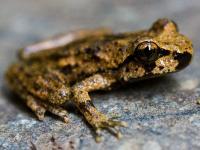
Coastal Tailed Frog
Species
Show on Lists
Encyclopedia of Puget Sound
Classification
Kingdom
Animalia
Phylum
Craniata
Class
Amphibia
Order
Anura
Family
Ascaphidae
Genus
Ascaphus
NatureServe

Classification
Other Global Common Names
Pacific Tailed Frog - grenouille-à-queue côtière
Informal Taxonomy
Animals, Vertebrates - Amphibians - Frogs and Toads
Formal Taxonomy
Animalia - Craniata - Amphibia - Anura - Ascaphidae - Ascaphus - Tailed frogs sometimes are placed in the family Leiopelmatidae. Stebbins (1985) placed them in the family Ascaphidae.
Ecology and Life History
Short General Description
A small frog with a tail-like appendage in males.
Migration
false - false - false
Non-migrant
false
Locally Migrant
false
Food Comments
Larva feed mostly on diatoms. Adults eat a wide variety of insects and other invertebrates.
Reproduction Comments
Breeds May-October, mostly in fall. Fertilization is internal; male has a tail-like copulatory organ. Clutch size averages 44-75; eggs are laid in July, hatch in August-September. Larval period lasts 2-4 years in mountains and northern areas, 1 year in a few coastal Oregon populations (Bury and Adams 1999) and in lowland streams of California (Wallace and Diller 1998). May not breed until 7-8 years old or 6-8 years after metamorphosis (Nussbaum et al. 1983).
Ecology Comments
Adult and subadult frogs usually are less commonly encountered than are larvae. For example, in California, Diller and Wallace (1999) found 693 A. truei larvae but only 32 metamorphosed individuals over four years in 54 of 72 randomly selected streams, though researchers have found higher densities in other areas. Diller and Wallace found 0.04-0.76 larvae per square meter (mean 0.24), whereas Hawkins et al. (1988) recorded mean densities of 0.58 to 4.40 larvae per square meter in three different classes of watersheds near Mt. St. Helens in Washington; two of the three sampled streams contained two larval cohorts.
Length
5
Conservation Status
NatureServe Global Status Rank
G4
Global Status Last Reviewed
2004-05-05
Global Status Last Changed
2001-10-05
Distribution
Conservation Status Map
<img src="http://www.natureserve.org/explorer/servlet/GetMapGif?CA.BC=S3&US.CA=S2&US.OR=S3&US.WA=S4" alt="Conservation Status Map" style="width: 475px; height: auto;" />
Global Range
FG - 20,000-2,500,000 square km (about 8000-1,000,000 square miles) - FG - Cascades and the Pacific Coast from southern British Columbia south to northwestern California (Nielson et al. 2001, Stebbins 2003).
Global Range Code
FG
Global Range Description
20,000-2,500,000 square km (about 8000-1,000,000 square miles)