

Species: Balaenoptera brydei
Bryde's Whale
Species
Show on Lists
Encyclopedia of Puget Sound
Articles:
Bryde’s whales are rarely seen in the Salish Sea, preferring warmer waters, but at least three have been documented here since 2010.
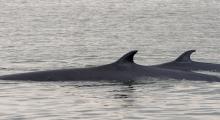
The reasons for the surprise visits are unknown, but changes in environmental conditions here or elsewhere are one possibility.

Classification
Kingdom
Animalia
Phylum
Craniata
Class
Mammalia
Order
Cetacea
Family
Balaenopteridae
Genus
Balaenoptera
NatureServe

Classification
Other Global Common Names
Ballena de Bryde
Informal Taxonomy
Animals, Vertebrates - Mammals - Whales and Dolphins
Formal Taxonomy
Animalia - Craniata - Mammalia - Cetacea - Balaenopteridae - Balaenoptera - systematics.
Ecology and Life History
Habitat Type Description
Marine
Migration
true - true - true - Some tropical populations may be sedentary, especially inshore form (IUCN 1991); temperate populations apparently are migratory. Apparently resident populations occur in the Gulf of Mexico and southeastern Caribbean (Leatherwood and Reeves 1983).
Non-migrant
true
Locally Migrant
true
Food Comments
Coastal and offshore populations apparently prefer schooling fishes (e.g., Tershy 1992), including pilchards, anchovies, herring, and mackerel; euphausiids are an important element of the diet in some areas (Leatherwood and Reeves 1983).
Reproduction Comments
Gestation lasts about 1 year. In the Northern Hemisphere, calving peaks in fall. Lactation lasts probably less than a year. Females give birth usually every second year. Sexually mature apparently in about 10 years (females) or 9-13 years (males).
Ecology Comments
Usually solitary or in small groups (e.g., Tershy 1992), though concentration have been observed in several areas (Leatherwood and Reeves 1983).
Length
1400
Conservation Status
NatureServe Global Status Rank
G4
Global Status Last Reviewed
2000-06-15
Global Status Last Changed
2000-06-15
Distribution
Conservation Status Map
<img src="http://www.natureserve.org/explorer/servlet/GetMapGif?US.CA=SNR&US.FL=SNR&US.GA=__&US.SC=SNR" alt="Conservation Status Map" style="width: 475px; height: auto;" />
Global Range
H - >2,500,000 square km (greater than 1,000,000 square miles) - H - Worldwide in subtropical and warm temperate oceans (see Rice 1998 for further information).
Global Range Code
H
Global Range Description
>2,500,000 square km (greater than 1,000,000 square miles)