

Species: Calidris canutus
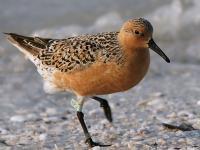
Red Knot
Species
Show on Lists
Encyclopedia of Puget Sound
Classification
Kingdom
Animalia
Phylum
Craniata
Class
Aves
Order
Charadriiformes
Family
Scolopacidae
Genus
Calidris
NatureServe

Classification
Other Global Common Names
Playero Canuto, Playero Árctico - Ruiva, Maçarico-de-Papo-Vermelho - bécasseau maubèche
Informal Taxonomy
<p>Animals, Vertebrates - Birds - Shorebirds</p>
Formal Taxonomy
Animalia - Craniata - Aves - Charadriiformes - Scolopacidae - Calidris
Ecology and Life History
Short General Description
A bird (sandpiper).
Migration
<p>false - false - true - Red knots migrate in large flocks northward through the contiguous United States mainly April-June, southward July-October (Bent 1927). Arrival in breeding areas occurs in late May or early June; most have departed breeding areas by mid-August. The species is more abundant in migration along the U.S. Atlantic coast than on the Pacific coast. Knots that visit Delaware Bay in spring come mostly from South America, and these have strong fidelity to migration stopover sites; those that winter in Florida are underrepresented during migration in New Jersey and Massachusetts. Migration through Costa Rica occurs late August-October and mainly mid-March to late April (Stiles and Skutch 1989). This species typically makes long flights between stops (Hayman et al. 1986). See Piersma and Davidson (1992) for information on knot migration.</p>
Non-migrant
false
Locally Migrant
false
Food Comments
Eats mainly mollusks, eggs of crab and horseshoe crab, insects, some seeds and small fishes; pecks and snatches at sand or mud, or probes. Horseshoe crab eggs are an important source of food for north-bound migrants at Delaware Bay (Botton et al. 1994).
Reproduction Comments
Lays clutch of usually 4 eggs, June-July. Incubation lasts about 20-25 days, by both sexes. Young are tended mostly by male (female leaves before fledging), leave nest soon after hatching, can fly at about 18 days (Terres 1980).
Ecology Comments
Nonbreeding: usually in compact flocks.
Length
27
Weight
148
Conservation Status
NatureServe Global Status Rank
G4
Global Status Last Reviewed
2005-10-04
Global Status Last Changed
2005-10-04
Distribution
Conservation Status Map
<img src="http://www.natureserve.org/explorer/servlet/GetMapGif?CA.AB=__&CA.BC=__&CA.LB=__&CA.MB=__&CA.NB=__&CA.NF=__&CA.NT=S2&CA.NS=__&CA.NU=SNR&CA.ON=__&CA.PE=__&CA.QC=__&CA.SK=__&US.AL=__&US.AK=S2&US.AR=__&US.CA=__&US.CO=__&US.CT=__&US.DE=__&US.DC=__&US.FL=__&US.GA=__&US.IL=__&US.IN=__&US.KS=__&US.KY=__&US.LA=__&US.ME=__&US.MD=__&US.MA=__&US.MI=__&US.MN=__&US.MS=__&US.MO=__&US.NE=__&US.NH=__&US.NJ=__&US.NY=__&US.NC=__&US.ND=__&US.OH=__&US.OK=__&US.OR=__&US.PA=__&US.RI=__&US.SC=__&US.SD=__&US.TN=__&US.TX=__&US.UT=__&US.VA=__&US.WA=__&US.WI=__&US.WY=__" alt="Conservation Status Map" style="width: 475px; height: auto;" />
Global Range
H - >2,500,000 square km (greater than 1,000,000 square miles) - H - Nesting range in North America is in northwestern and northern Alaska, and Canadian arctic islands east to Ellesmere and south to southern Victoria and Southhampton islands, probably also on Adelaide Peninsula and Mansel Island; nesting also occurs in the northern Palearctic.<br><br>During the boreal winter, the range in the New World extends mainly from coastal regions of southern California, Gulf Coast and Massachusetts south to Tierra del Fuego; generally rare north of southern South America; major South American nonbreeding areas are Tierra del Fuego and Patagonian coast of Argentina, especially Bahia Lomas (Morrison and Ross 1989). New World red knots principally occupy two areas: about 100,000 birds along Atlantic coast of southern Argentina, about 10,000 along Florida Gulf Coast, with no evidence of interchange between the 2 groups (Harrington et al. 1988). In the Old World, most red knots are in southern Europe, southern Asia, Africa, and the Australasian region during the boreal winter.<br><br>Nonbreeders occasionally summer in the winter range. <br><br>Delaware Bay is the most important spring migration stopover in the eastern United States (Clark et al. 1993, Botton et al. 1994).
Global Range Code
H
Global Range Description
>2,500,000 square km (greater than 1,000,000 square miles)