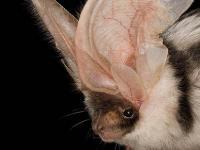
Species: Euderma maculatum

Spotted Bat
Species

    Huge pink ears (37-47 mm [Hall 1981] or 45-50 mm [Watkins 1977]); blackish dorsum with a large white spot on each shoulder and on the rump, and white patches at the posterior base of each ear; total length 107-115 mm; forearm 48-51 mm; 16-20 g; greatest length of skull 18.4-19.0 mm (small sample); supraorbital region of skull sharply ridged; no median sagittal crest; 34 teeth (Watkins 1977, Handley 1959, Hall 1981). The newborn young lack any indication of having the adult color pattern (van Zyll de Jong 1985). Four hours after birth, a male weighed 4 g and measured 59 mm in length; tail length was 20 mm, hind foot 11 mm, ear 12 mm, and forearm 21 mm.

    Source: Encyclopedia of Life

    Kingdom
    Animalia
    Phylum
    Craniata
    Class

    Mammalia

    Order

    Chiroptera

    Family

    Vespertilionidae

    Genus

    Euderma

    Classification
    Other Global Common Names
    Un Murciélago - oreillard maculé
    Informal Taxonomy
    Animals, Vertebrates - Mammals - Bats
    Formal Taxonomy
    Animalia - Craniata - Mammalia - Chiroptera - Vespertilionidae - Euderma - as generically distinct.

    Huge pink ears (37-47 mm [Hall 1981] or 45-50 mm [Watkins 1977]); blackish dorsum with a large white spot on each shoulder and on the rump, and white patches at the posterior base of each ear; total length 107-115 mm; forearm 48-51 mm; 16-20 g; greatest length of skull 18.4-19.0 mm (small sample); supraorbital region of skull sharply ridged; no median sagittal crest; 34 teeth (Watkins 1977, Handley 1959, Hall 1981). The newborn young lack any indication of having the adult color pattern (van Zyll de Jong 1985). Four hours after birth, a male weighed 4 g and measured 59 mm in length; tail length was 20 mm, hind foot 11 mm, ear 12 mm, and forearm 21 mm.

    Source: Encyclopedia of Life

    Short General Description
    A black bat with very large ears and prominent white spots.
    Migration
    false - false - false - Probably some migrate south for winter. At least for lower elevation locations, it appears not to migrate (WESTEC Services 1981). Possibly occupies coniferous stands in summer and migrates to lower elevations in late summer/early fall (Berna 1990, Barbour and Davis 1969). Present in southern British Columbia from at least May though August (Leonard and Fenton 1983).
    Non-migrant
    false
    Locally Migrant
    false
    Food Comments
    Insectivorous. Apparently feeds primarily on noctuid moths, sometimes beetles (Snow 1974; Schmidly 1977, 1991; Barbour and Davis 1969; van Zyll de Jong 1985). In British Columbia, flew 5-15 m above ground when foraging; foraging areas of different individuals overlapped (Wai-Ping and Fenton 1989). In southeastern Utah, fed on small insects within 2 m of the ground; sometimes captured insects on the ground (Poche and Bailie 1974), though this has been disputed. In Colorado, foraged at heights above 10 m (Navo et al. 1992). <br><br>One study stated that the bats hunted a regular beat and searched for prey in clearings in pine forest; the bat was extremely punctual in making its rounds and reached various points along its route at the same time every night. When in the clearings, the bat followed a definite circuit at or above treetop height. The bat spent approximately three to five minutes per clearing during the spring, and much longer during the summer, retracing its circuit in the clearing. The lengthier foraging in the summer is attributed to increased prey availability during the later season (van Zyll de Jong 1985). Another study found that a predictable pattern of foraging was observed in spring to midsummer (May to July), and a less predictable pattern later in the summer. At the beginning of the summer, foraging periods were long, and became shorter later in summer (van Zyll de Jong 1985). The contradiction in foraging strategies between the two studies was attributed to the variability of the bat's behavior in response to changes in one or more factors in the environment such a abundance and distribution of prey (Snow 1974). <br><br>The spotted bat hunts alone, and at least sometimes appears to maintain an exclusive foraging area (Leonard 1983). Neighboring bats show evidence of mutual avoidance and have been observed to turn away when encountering one another near the boundaries of their hunting areas. This mutual avoidance has been interpreted as a mechanism to avoid competition. When the neighbor is absent, an individual may show no hesitation in flying into an area avoided earlier. It is believed that a combination of the bat's echolocation call and conspicuous color pattern are used to maintain the spacing between bats (van Zyll de Jong 1985).
    Reproduction Comments
    In the south, births apparently occur in late May or early June (Watkins 1977, Schmidly 1977). Time of birth in north may be somewhat later (van Zyll de Jong 1985). One pregnant bat captured in southwestern Texas gave birth to a single male on June 11 (Snow 1974, Schmidly 1977). A pregnant bat was collected in British Columbia on June 16. Lactating females have been netted on June 23, 30, and July 1 in New Mexico, on July 9 in New Mexico by Mike Bogan, and on August 10, 15, and 18 in Utah (Barbour and Davis 1969). <br><br>The males netted have not been examined for sperm but measurements of the testes of two bats have been taken. One male that died in captivity on August 27 had testes that measured 4 mm by 2 mm and a male netted on August 21 in Utah had testes that measured 7 mm by 3 mm (Barbour and Davis 1969). Evidence points to the birth of a single young in altricial condition. <br><br>Four hours after birth, a male appeared to nurse almost constantly for the first 48 hours. The mother showed great parental care to the young. She was gentle and attentive, licking the young's face, ears, wings, and back. The young stayed with her, attached to a teat, even when the female flew. She did not seem to be hindered by the additional weight. The female shielded the young with her wings when they were hanging upside down. No more is known about the young because the one born in captivity died at four and a half days when it became chilled after crawling through some drinking water (Snow 1974).
    Ecology Comments
    Apparently relatively solitary but may hibernate in small clusters (Whitaker 1980). In British Columbia, roosted solitarily during active season; appeared to maintain exclusive foraging areas (Leonard and Fenton 1983); foraged up to 6-10 km from day roost each night (Wai-Ping and Fenton 1989). <br><br>Apparently this bat is a rapid flyer. Many of them are injured in the mist nets, indicating a high rate of speed at the collision (Snow 1974). In flight, the ears project forward. The only times the ears are carried erect are when the bat is alert, usually just preparatory to flight. At all other times, the ears lie along the back and are slightly curved (Barbour and Davis 1969). <br><br>Vocalizations and Echolocation <br><br>The spotted bat makes a wide variety of sounds in communicating and foraging. The voice has been described as sounding like a soft, extremely high-pitched metallic squeak; a hissing noise and a ratlike squeak; and a typical bat chirp. This bat has also been heard clicking the teeth together and making grinding noises by gnashing the teeth. Previous to taking flight, the spotted bat makes clicking or ticking notes (Snow 1974). <br><br>The echolocation call is loud and high- pitched; the fundamental frequency sweeps from 12 to 6 kHz and is a double or single steep frequency modulated pulse. The call is repeated at a rate of two to six per second. The sound pressure level is estimated at 80-90 dB at 10 cm, making it a moderate intensity. The echolocation call can clearly be heard by a human at distances of 250 m (van Zyll de Jong 1985). <br><br>The low frequency of the echolocation call is useful in both hunting and communications. Due to reduced attenuation and good propogation qualities, the call is good for long-range detection of prey and an increased range of audibility by other bats. The bat is also able to approach the moth more closely and enhance the chance of a successful pursuit due to the moth not being able to detect the low intensity of sound (van Zyll de Jong 1985). Similar calls are made by PLECOTIS PHYLLOTIS (Allen's big-eared bat), TADARIDA MACROTIS (big freetail bat), and EUMOPS PEROTIS (western mastiff bat) (Snow 1974).
    Length
    13
    Weight
    18
    NatureServe Global Status Rank
    G4
    Global Status Last Reviewed
    1998-08-06
    Global Status Last Changed
    1996-11-05
    Conservation Status Map
    <img src="http://www.natureserve.org/explorer/servlet/GetMapGif?CA.BC=S3&US.AZ=S1&US.CA=S2&US.CO=S2&US.ID=S3&US.MT=S2&US.NN=S4&US.NV=S2&US.NM=S3&US.OR=S2&US.TX=S2&US.UT=S2&US.WA=S3&US.WY=S3" alt="Conservation Status Map" style="width: 475px; height: auto;" />
    Global Range
    FG - 20,000-2,500,000 square km (about 8000-1,000,000 square miles) - FG - Western North America from southern British Columbia (north to Fraser River basin near Williams Lake) (Cannings et al. 1999) south through eastern Oregon, Idaho, south-central Montana, western Colorado, central Wyoming western Nevada, California (Pierson and Rainey 1998), southwestern Arizona, central New Mexico, western Texas, and central Mexico (Queretaro) (Verts and Carraway 1998). Winter range not known. An echolocation monitoring survey of distribution has been conducted (Fenton et al. 1987). Ranges from below sea level to 2450 m. Apparently widespread but rarely abundant.
    Global Range Code
    FG
    Global Range Description
    20,000-2,500,000 square km (about 8000-1,000,000 square miles)
    ELEMENT_GLOBAL.2.104813