

Species: Gavia stellata
Red-throated Loon
Species
Show on Lists
Encyclopedia of Puget Sound
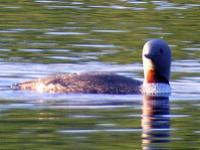
Science Review:
Articles:
More than 70 bird species regularly utilize Puget Sound during some or all stages of their life histories, but only a portion of these are actively being investigated.

Classification
Kingdom
Animalia
Phylum
Craniata
Class
Aves
Order
Gaviiformes
Family
Gaviidae
Genus
Gavia
NatureServe

Classification
Other Global Common Names
Colimbo Menor - plongeon catmarin
Informal Taxonomy
Animals, Vertebrates - Birds - Other Birds
Formal Taxonomy
Animalia - Craniata - Aves - Gaviiformes - Gaviidae - Gavia - This is a clearly distinct taxon at the species level.
Ecology and Life History
Short General Description
A bird (loon).
Migration
false - false - true - Arrives in nesting areas around Beaufort Sea usually in early June (Johnson and Herter 1989). Common migrant off U.S. west coast April-June. Returns to U.S. Atlantic coast mainly in October, off California shores by September-October (Terres 1980). Large numbers may pass through the Great Lakes region in October.
Non-migrant
false
Locally Migrant
false
Food Comments
Diet mainly fishes; also eats shrimps, snails, aquatic insects and some aquatic plants. When feeding young, often leaves nesting area to obtain fishes from larger lake or marine waters (Reimchen and Douglas 1984). Forages in shallow water.
Reproduction Comments
Nesting begins late May in south, late June or early July in far north; eggs are laid from early May to mid-July in British Columbia (Douglas and Reimchen 1988). Both sexes (mainly female) incubate 1-2 (usually 2) eggs 24-31 days. Young are tended by both parents, fly at about 8 weeks. First breeds probably at 2-3 years (Johnsgard 1987). Nest density in Alaska and Canada ranges up to 1.65 per sq km (Johnson and Herter 1989).
Ecology Comments
Somewhat gregarious when not breeding (Oberholser 1974). Gulls, jaegers, and/or arctic fox may cause significant loss of eggs and young in some areas (Johnsgard 1987). <br><br>Defends nesting territories of variable size. Sometimes an single pond is defended (e.g. 1.1 ha in Shetland Islands, Furness 1983), sometimes multiple ponds (Tuktoyaktuk Peninsula, NWT, Dickson 1993), sometimes several pairs share a larger lake (e.g. 5 pairs on a 76-hectare lake on Bathurst Island, Barr et al. 2000). Home range larger than breeding territory; individuals fly up to 14-20 kilometers away from nest site to forage (summarized by Barr et al. 2000). Merrie (1978) suggested that each breeding pair requires 2.5 square kilometers of foraging waters.
Length
64
Weight
1551
Conservation Status
NatureServe Global Status Rank
G5
Global Status Last Reviewed
2008-01-04
Global Status Last Changed
1996-11-20
Other Status
LC - Least concern
Distribution
Conservation Status Map
<img src="http://www.natureserve.org/explorer/servlet/GetMapGif?CA.AB=S1&CA.BC=S4&CA.LB=S3&CA.MB=S3&CA.NB=__&CA.NF=S1&CA.NT=S4&CA.NS=__&CA.NU=SNR&CA.ON=S3&CA.PE=__&CA.QC=S4&CA.SK=S1&CA.YT=S4&US.AL=__&US.AK=S4&US.AR=__&US.CA=__&US.CO=__&US.CT=__&US.DE=__&US.FL=__&US.GA=S4&US.ID=__&US.IL=__&US.ME=__&US.MD=__&US.MA=__&US.MI=__&US.MN=__&US.MS=__&US.NH=__&US.NJ=__&US.NY=__&US.NC=__&US.PA=__&US.RI=__&US.SC=__&US.TN=__&US.VT=__&US.VA=__&US.WA=__&US.WV=__&US.WI=__" alt="Conservation Status Map" style="width: 475px; height: auto;" />
Global Range
H - >2,500,000 square km (greater than 1,000,000 square miles) - H - Breeding in North America occurs on Arctic coasts and islands from Alaska to Ellesmere Island, south along the Pacific coast through the Aleutian Islands to Queen Charlotte and Vancouver islands; inland to central Yukon, southern Mackenzie, northeastern Alberta, northern Saskatchewan, around Hudson Bay, and along the Atlantic coast to southeastern Quebec. In Eurasia, the breeding range extends from Greenland, Iceland, and Arctic islands and coasts south to the British Isles, southern Scandinavia, northern Russia, Lake Baikal, Sakhalin, the Kuril Islands, Kamchatka, and the Commander Islands (AOU 1998). During the nonbreeding season, the range in North America extends from the Aleutians south along the coast to northwestern Mexico; and from southern Newfoundland to northeastern Florida and the Gulf Coast; in Eurasia south to Mediterranean, Black, and Caspian seas, and along the western Pacific coast to China and Taiwan (AOU 1998).
Global Range Code
H
Global Range Description
>2,500,000 square km (greater than 1,000,000 square miles)