

Species: Plethodon vehiculum
Western Redback Salamander
Species
Show on Lists
Encyclopedia of Puget Sound
Classification
Kingdom
Animalia
Phylum
Craniata
Class
Amphibia
Order
Caudata
Family
Plethodontidae
Genus
Plethodon
NatureServe

Classification
Other Global Common Names
Western Red-backed Salamander - salamandre à dos rayé
Informal Taxonomy
Animals, Vertebrates - Amphibians - Salamanders
Formal Taxonomy
Animalia - Craniata - Amphibia - Caudata - Plethodontidae - Plethodon - Analyses indicated that PLETHODON STORMI and P. ELONGATUS are clearly sister taxa, and P. DUNNI and P. VEHICULUM also are well-supported sister taxa. PLETHODON LARSELLI and P. VANDYKEI appear to be closely related, whereas P. NEOMEXICANUS did not group with any other lineage. All analyses yielded a paraphyletic PLETHODON but constraint analyses did not allow rejection of a monophyletic PLETHODON. Mahoney recommended continued recognition of ANEIDES as a valid genus and adoption of the metataxon designation for PLETHODON*, indicating this status with an asterisk. (A metataxon is a group of lineages for which neither monophyly nor paraphyly can be demonstrated.)
Ecology and Life History
Short General Description
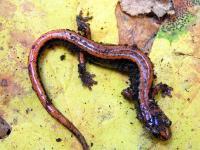
A lungless salamander that reaches a maximum snout-vent length of about 6 cm.
Migration
true - false - false
Non-migrant
true
Locally Migrant
false
Food Comments
Feeds on a wide variety of terrestrial invertebrates including mites, collembolans, spiders and isopods (Nussbaum et al. 1983).
Reproduction Comments
In Oregon, breeds mainly from November-early March; courtship occurs in autumn on Vancouver Island (Ovaska and Gregory 1989). Female lays a clutch of about 10 eggs in the spring, broods them during the summer. Hatchlings appear in autumn. Female oviposits at intervals of 2 years or more; male produces sperm every year.
Ecology Comments
In British Columbia, mean distance between the two farthest captures over several months was 2.7 m (range up to 8-9 m) for adult males, which moved greater distances than did adult females and juveniles (Ovaska 1988); captures during the active season ranged from 0.3-1.16 per sq m, highest in spring (Ovaska and Gregory 1989).
Length
12
Conservation Status
NatureServe Global Status Rank
G5
Global Status Last Reviewed
2002-03-27
Global Status Last Changed
2001-10-31
Distribution
Conservation Status Map
<img src="http://www.natureserve.org/explorer/servlet/GetMapGif?CA.BC=S4&US.OR=S5&US.WA=S5" alt="Conservation Status Map" style="width: 475px; height: auto;" />
Global Range
F - 20,000-200,000 square km (about 8000-80,000 square miles) - F - Southwestern British Columbia, including Vancouver Island, south through western Washington to southwestern Oregon (Petranka 1998). Sea level to about 4100 ft (1250 m) (Stebbins 1985).
Global Range Code
F
Global Range Description
20,000-200,000 square km (about 8000-80,000 square miles)