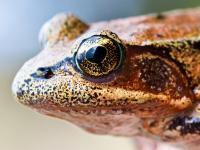
Species: Rana aurora

Northern Red-legged Frog
Species
    Rana aurora

    Dorsum brown, gray, olive, or reddish, with irregular dark spotting or blotching; usually has a dark mask above the whitish jaw stripe; adults usually red on lower abdomen and underside of legs; usually coarse blackish, red, and yellow mottling in groin; relatively long legs (heel reaches at least to nostril when extended leg is pulled forward; eyes face outward, well covered by lids when viewed from above; prominent dorsolateral folds; snout-vent length usually 4-13 cm; young may have yellow instead of red on underside of legs and in groin; adult males have enlarged forelimbs and thumb base and more extensive webbing (Stebbins 1985).

    Articles:

    Reports: Sauk-Suiattle amphibian surveys

    The Sauk-Suiattle Indian Tribe conducts annual surveys of amphibian egg masses in the Reservation Slough wetland near the Sauk River.
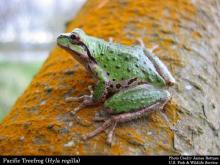
    Pacific Treefrog; photo by James Bettaso, U.S. Fish and Wildlife Service
    Red-legged frogs in the Puget Sound watershed

    The Northern Red-legged Frog is described here relative to its local behavior, habitat, threats and morphology.
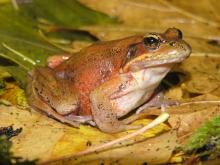
    Adult female Rana aurora during fall migration of 2005 in Puget Sound (Hayes, Marc 2005).
    Kingdom
    Animalia
    Phylum
    Craniata
    Class

    Amphibia

    Order

    Anura

    Family

    Ranidae

    Genus

    Rana

    Classification
    Informal Taxonomy
    Animals, Vertebrates - Amphibians - Frogs and Toads
    Formal Taxonomy
    Animalia - Craniata - Amphibia - Anura - Ranidae - Rana - form a clade within the R. boylii species group (Macey et al. 2001).

    Dorsum brown, gray, olive, or reddish, with irregular dark spotting or blotching; usually has a dark mask above the whitish jaw stripe; adults usually red on lower abdomen and underside of legs; usually coarse blackish, red, and yellow mottling in groin; relatively long legs (heel reaches at least to nostril when extended leg is pulled forward; eyes face outward, well covered by lids when viewed from above; prominent dorsolateral folds; snout-vent length usually 4-13 cm; young may have yellow instead of red on underside of legs and in groin; adult males have enlarged forelimbs and thumb base and more extensive webbing (Stebbins 1985).

    Migration
    true - false - false - In Oregon, Hayes et al. (2001) found that four individuals moved 1.1, 1.2, 1.3, and 2.4 km between capture points (these were the largest documented movements).
    Non-migrant
    true
    Locally Migrant
    false
    Food Comments
    Diet includes beetles, caterpillars, isopods, and various other small invertebrates (Nussbaum et al. 1983). In California, diet mainly invertebrates of shoreline or water surface; large adults also may eat small vertebartes. Larvae eat algae, organic debris, plant tissue, and other minute organisms.
    Reproduction Comments
    Breeding time varies geographically; breeds March-July in the north. Breeding period lasts about 1-2 weeks. Eggs hatch in 5-7 weeks in western Oregon. Larvae metamorphose in about 11-20 weeks, but sometimes may overwinter. Larvae in British Columbia metamorphosed in 11-14 weeks.
    Length
    14
    NatureServe Global Status Rank
    G4
    Global Status Last Reviewed
    2008-06-26
    Global Status Last Changed
    1996-11-01
    Conservation Status Map
    <img src="http://www.natureserve.org/explorer/servlet/GetMapGif?CA.BC=S3&US.AK=SE&US.CA=S2&US.OR=S3&US.WA=S4" alt="Conservation Status Map" style="width: 475px; height: auto;" />
    Global Range
    G - 200,000-2,500,000 square km (about 80,000-1,000,000 square miles) - G - also is introduced and established on Chichagof Island, Alaska; the source of the frogs was Oregon (Hodge 2004).
    Global Range Code
    G
    Global Range Description
    200,000-2,500,000 square km (about 80,000-1,000,000 square miles)
    ELEMENT_GLOBAL.2.100633