

Species: Strix occidentalis caurina
Northern Spotted Owl
Species
Show on Lists
Encyclopedia of Puget Sound
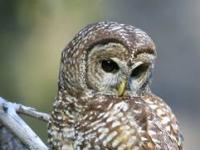
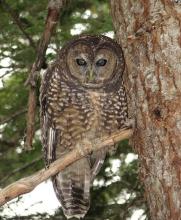
A large, dark-eyed, round-headed, dark brown owl with white spotting on the head, back, and underparts (spotted breast, barred belly).
Source: Encyclopedia of Life
Articles:
This article was originally published by the Washington Department of Fish and Wildlife as part of its annual report Threatened and Endangered Wildlife in Washington.
Classification
Kingdom
Animalia
Phylum
Craniata
Class
Aves
Order
Strigiformes
Family
Strigidae
Genus
Strix
NatureServe

Classification
Informal Taxonomy
<p>Animals, Vertebrates - Birds - Other Birds</p>
Formal Taxonomy
Animalia - Craniata - Aves - Strigiformes - Strigidae - Strix
Ecology and Life History
A large, dark-eyed, round-headed, dark brown owl with white spotting on the head, back, and underparts (spotted breast, barred belly).
Source: Encyclopedia of Life
Short General Description
Medium-sized, dark-eyed owl lacking ear tufts.
Migration
<p>true - true - false - ></p>
Non-migrant
true
Locally Migrant
true
Food Comments
Small mammals, particularly nocturnal arboreal or semi-arboreal species, dominate the diet; flying squirrels, woodrats, and lagomorphs are common prey items, with pocket gophers, red tree voles, and deer mice are regionally important; flying squirrels are comsumed more often at higher latitudes and higher elevations, woodrats more often at lower latitudes and lower elevations (Thomas et al. 1990). <br><br>Generally, flying squirrels are the most prominent prey for spotted owls in Douglas-fir and western hemlock forests in Washington and Oregon, while dusky-footed wood rats are a major part of the diet in the Oregon Klamath, California Klamath, and California Coastal provinces (see USFWS 2007 for specific sources of this information).<br><br>Olympic Peninsula, Washington: primary prey included flying squirrels, woodrats, and snoeshoe hares (Carey et al. 1992). Oregon: diet dominated by flying squirrels and red tree voles in Douglas-fir and western hemlock forest; woodrats in mixed coniferous forest; pocker gophers and voles (<i>Clethrionomys</i>) at higher elevations. California: mostly flying squirrels, woodrats, and gray squirrels.
Reproduction Comments
The spotted owl is relatively long-lived, has a long reproductive life span, invests significantly in parental care, and exhibits high adult survivorship relative to other North American owls (USFWS 2007).<br><br>USFWS (2007) summarized life history as follows. Courtship behavior usually begins in February or March, and females typically lay eggs in late March or April. The timing of nesting and fledging varies with latitude and elevation. Breeding females lay 1-4 four eggs per clutch, with the average clutch size being two eggs; however, most pairs do not nest every year, nor are nesting pairs successful every year. Renesting (in different nest) after nest failure is infrequent. Incubation, by the female (fed by male), lasts about 30 days. Young leave the nest at about 5 weeks, fly at about 6 weeks. After they leave the nest in late May or June, juveniles depend on their parents until they are able to fly and hunt on their own. Parental care continues after fledging into September. During the first few weeks after the young leave the nest, the adults often roost with them during the day. By late summer, the adults are rarely found roosting with their young and usually only visit the juveniles to feed them at night. Spotted owls are sexually mature at 1 year of age, but rarely breed until they are 2 to 5 years of age. See USFWS (2007) for specific sources of this information.
Ecology Comments
In southwestern Oregon, density ranged from 0.190 pairs/sq km in old unfragmented mixed-conifer forest to 0.046 pairs/sq km in old fragmented Douglas-fir forest (Carey et al. 1992). <br><br>Population density estimates range from 0.09/sq km in Washington to 0.36/sq km in Oregon (Johnsgard 1988); 0.24/sq km in northwestern California (about 0.6/sq km of suitable habitat) (Franklin et al. 1990). Density estimates for 12 study areas during 1985-1992 ranged up to 0.27 adults and subadults/sq km (Thomas et al. 1993).
Length
45
Conservation Status
NatureServe Global Status Rank
G3T3
Global Status Last Reviewed
2007-10-03
Global Status Last Changed
1996-11-27
Distribution
Conservation Status Map
<img src="http://www.natureserve.org/explorer/servlet/GetMapGif?CA.BC=S1&US.CA=S2&US.OR=S3&US.WA=S1" alt="Conservation Status Map" style="width: 475px; height: auto;" />
Global Range
G - 200,000-2,500,000 square km (about 80,000-1,000,000 square miles) - G - Range extends from southwestern British Columbia (Dunbar et al. 1991) southward through the Coast Ranges and Cascade Range (both west and east sides) of Washington and Oregon to northwestern California north of San Francisco (Marin County) and northwest of the Pit River in northeastern Shasta County (the Pit River boundary between subspecies <i>caurina </i>and <i>occidentalis </i>is based on biogeographic considerations, rather than on adequate taxonomic data from that area) (Thomas et al. 1990). The population on the Olympic Peninsula appears to be reproductively isolated (by nonforested lands of the Puget Trough) from owls in the Cascade Range. The Columbia River may constitute an isolating barrier between the Cascades populations in Washington and Oregon. Population size and density are relatively low at the northern and southern ends of the range.
Global Range Code
G
Global Range Description
200,000-2,500,000 square km (about 80,000-1,000,000 square miles)