


Evolving strategies for confronting potentially dangerous low-oxygen conditions in Puget Sound are being driven by recent legal rulings and administrative decisions.
In January, the Washington Department of Ecology decided to abandon its “nutrient general permit,” originally designed to control nitrogen releases from sewage-treatment plants throughout Puget Sound. Nitrogen has been shown to be a major contributor to decreasing oxygen levels in Puget Sound waters.
“Based on the feedback we received in 2025, as well as legal rulings on permit appeals, we are not reissuing the Puget Sound Nutrient General Permit,” states a notice from Ecology, which spent two years developing the permit imposed on most treatment plants on Puget Sound in 2022.
Without the general permit, Ecology now faces the necessity of adding nitrogen limits to the individual permits for some 58 treatment plants discharging into Puget Sound. How quickly those individual permits can be updated is a major issue. More than three-fourths of treatment plants have been operating under expired permits due to staffing shortages not related to the recent change. Ecology has increased its permit staff to address a statewide backlog, according to an official report to the Legislature.
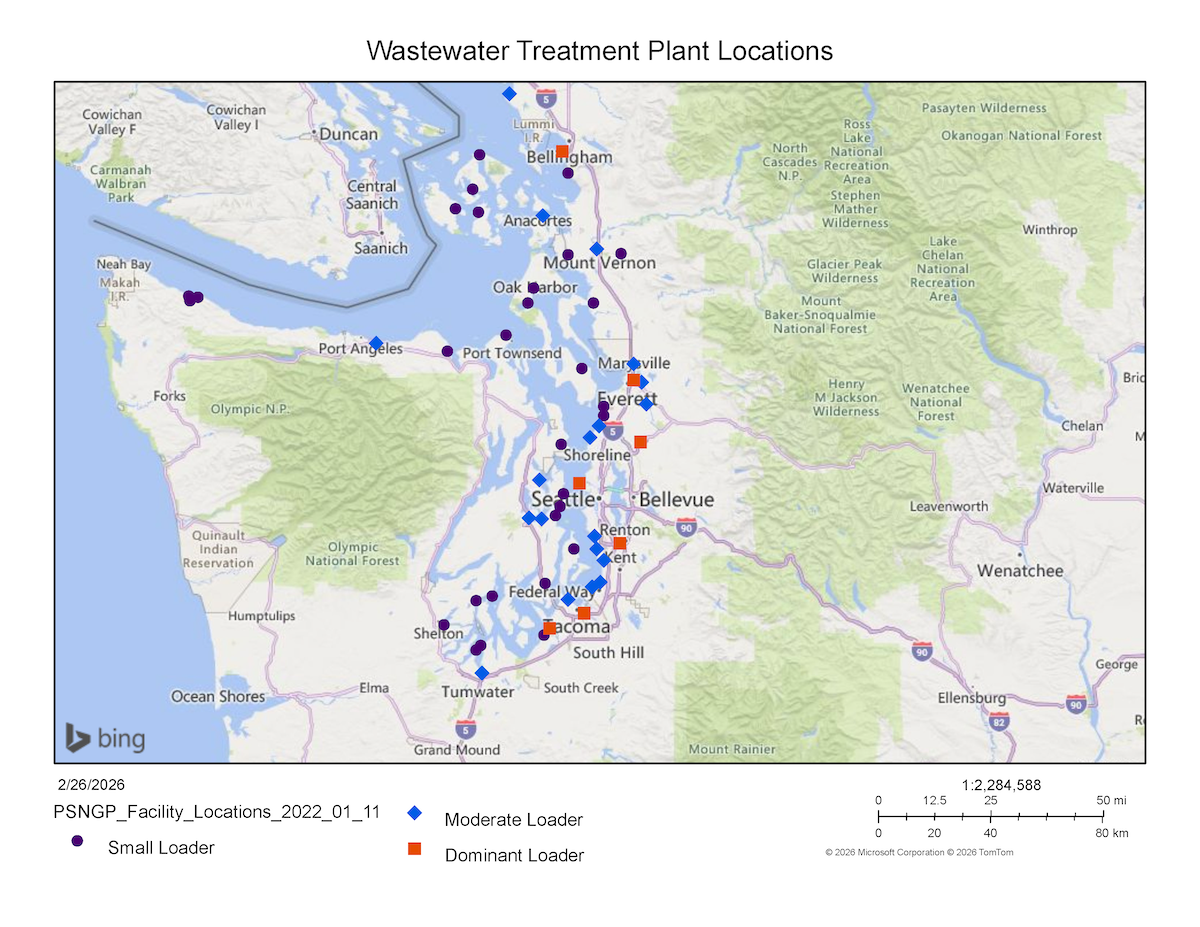
Perhaps influencing the decision to abandon the general permit was a ruling in August by the state’s Pollution Control Hearings Board, which reviews appeals of treatment plant permits—called National Pollution Discharge Elimination System, or NPDES, permits. The August ruling overturned a portion of the permit for Seattle’s West Point treatment plant, a permit issued by Ecology without restrictions on nitrogen.
The board said the plant, operated by King County, must include controls on nitrogen, because this “pollutant” had been determined to be a proximate cause of the low-oxygen problem in Puget Sound. State and federal laws require permits to address pollution that contributes to water-quality problems, according to the board’s August ruling.
The usefulness of a nutrient general permit for all treatment plants on Puget Sound was already diminished by a previous board ruling in February of last year, when the board said state law prevented Ecology from imposing the new general permit on utilities already operating with individual NPDES permits. Overlaying permits is not allowed without the individual utility’s consent, the board said, agreeing with several utilities that had challenged the general permit’s legality.
Ecology’s first response was to keep the general permit in play, revising it and making it optional for sewer utilities, as suggested in the hearing board’s order. Nitrogen restrictions in the general permit would then apply only to utilities that agreed to the voluntary program. (Another option would be for the Legislature to change state law.)
Regulations aimed at updating the general permit to an optional program were still under review when the pollution board found in August that the West Point plant’s permit had been issued without nitrogen limits. Instead, the permit referenced requirements that were invalidated and not yet revised in the general permit.
“It is undisputed that the West Point permit does not contain effluent limits for TIN (total inorganic nitrogen) — the compound responsible for nutrient pollution in Puget Sound,” states the board’s final order. “Ecology issued the West Point permit on the premise that nutrient pollution would be regulated through the PSNGP (Puget Sound Nutrient General Permit)…
“Because Ecology continued to rely on invalidated portions of the PSNGP to regulate nutrients, current discharges from West Point are not subject to any effluent limitations for nutrient pollution. This plainly contravenes state and federal laws that require NPDES permits to include effluent limits necessary to ensure permitted dischargers do not cause or contribute to violations of water quality standards,” the board concluded.
Ecology’s decision to abandon the general permit was influenced by 35 comments received last summer on the idea of moving ahead with the program with an opt-in provision. In January, Ecology announced its decision, explaining that adding nitrogen controls in all the individual permits “makes more sense at this time,” according to a statement from the agency.
Permit officials for Ecology are now moving forward with new nitrogen restrictions by prioritizing individual permits for renewal or possibly adding administrative orders to existing permits. The amount of nitrogen released in proximity to low-oxygen areas is one factor used to determine which ones should come first, according to an Ecology spokesperson. Other factors include when a permit was last renewed and what other forms of pollution are posing risks to humans or the environment.
Ecology has not yet described how nitrogen will be limited in the revised permits, and several treatment plant operators have expressed skepticism about the ultimate benefits of restrictions proposed by the agency. But environmental activists and tribal representatives remain strongly supportive of controls on nitrogen from human sources.
Sean Dixon, executive director of Puget Soundkeeper, the organization that challenged the West Point permit, said the overall effort should put into place permits with nitrogen limits as quickly as possible, so that real improvements in dissolved oxygen can take place.
“We need to protect the Sound from pollution,” Dixon said. “Permits are our way of permitting pollution that normally would not happen. We have to have limits, and they have to be enforced.”
Rate of response
As individual treatment plant permits come under review, one of the big questions is how quickly state regulators will attempt to bring all of Puget Sound back to acceptable conditions, as defined by state water-quality standards for dissolved oxygen.
Guidance is expected to come from the draft Puget Sound Nutrient Reduction Plan, a document that examines the overall problem of low oxygen in Puget Sound. The draft plan, which is still under review, describes computer modeling efforts that assess local and regional effects of nitrogen coming from each of the treatment plants, along with nearly 200 rivers and streams bringing nitrogen to the Sound from upland sources. The plan’s recommendations call for the Sound to meet water quality standards by 2050.
Although sewage-treatment plants get a lot of attention, they are not an original source of nitrogen. Rather, nitrogen arrives at the plants in wastewater and undergoes the same treatment process that kills bacteria and reduces a variety of contaminants in sewage.
That’s not soon enough for many environmental advocates and tribal representatives, who say 25 years is too long to wait.
“We are unaware of any other category of pollution that allows for such a long timeline,” according to the group Washington Conservation Action, commenting on the nutrient reduction plan. “Even the Model Toxics Control Act and Superfund sites have shorter action windows.
“We recognize that some activities that require significant capital investments will take years to plan, finance, design, permit and build…,” the statement continued. “However, such an extraordinarily long timeline simply secures the delays that some dischargers have been seeking. We urge Ecology to adopt a timeline of 2035 for meeting water quality standards.”
On the other side of the debate, treatment plant operators say they are facing enormous costs in upgrading their plants to reduce nitrogen, costs that must be passed on to sewer customers unless significant grant funding becomes available. The Legislature has approved initial funding to address the problem, but so far it covers only a tiny fraction of the likely expense.
It took nearly 15 years to construct the state-of-the-art Picnic Point treatment plant in Southwest Snohomish County, according to comments submitted by Alderwood Water and Sewer District. That project, which did not include property acquisition, took 10 years for planning alone—and the plant is small and relatively simple. “Most of these upgrades across the Sound are going to take decades, not years, to complete,” district officials said.
The Puget Sound Nutrient Reduction Plan is undergoing revisions following numerous comments on the draft document, according to Ecology officials. Although they have not said what changes they are considering, the outcome must reconcile both immediate permitting and long-range plans to upgrade treatment plants.
Meanwhile, Ecology has been working to reduce a backlog of expired permits that are normally renewed every five years. For years, permit fees used to hire staff failed to keep up with the number of employees needed to evaluate, formally review and update pollution fees statewide—including more than 300 municipal sewage systems, more than 2,000 industrial wastewater systems and more than 4,000 stormwater systems. In 2022, the Legislature removed a limit on the fees and encouraged Ecology to hire the needed staff, with requirements to report back every two years.
One goal was to reduce the backlog of permits for sewage treatment plants from a recent 80 percent of permits being out-of-date to 40 percent by 2025, down to 20 percent by 2027. Ecology’s latest report says the 2025 backlog goal was not met, in part because of a state hiring freeze and lag time in getting staff hired and fully trained in the permit system. Now, the agency says it is focused on reaching the original goal of no more than a 20 percent backlog by 2027.
Evaluating limits on nitrogen
Nitrogen is essential to all living things, but excess nitrogen in Puget Sound can trigger massive plankton blooms. Plankton eventually die and decay, a process that consumes available oxygen. At various times and locations—especially along the bottom of enclosed bays—the resulting oxygen deficiency can affect growth, reproduction and survival of marine creatures.
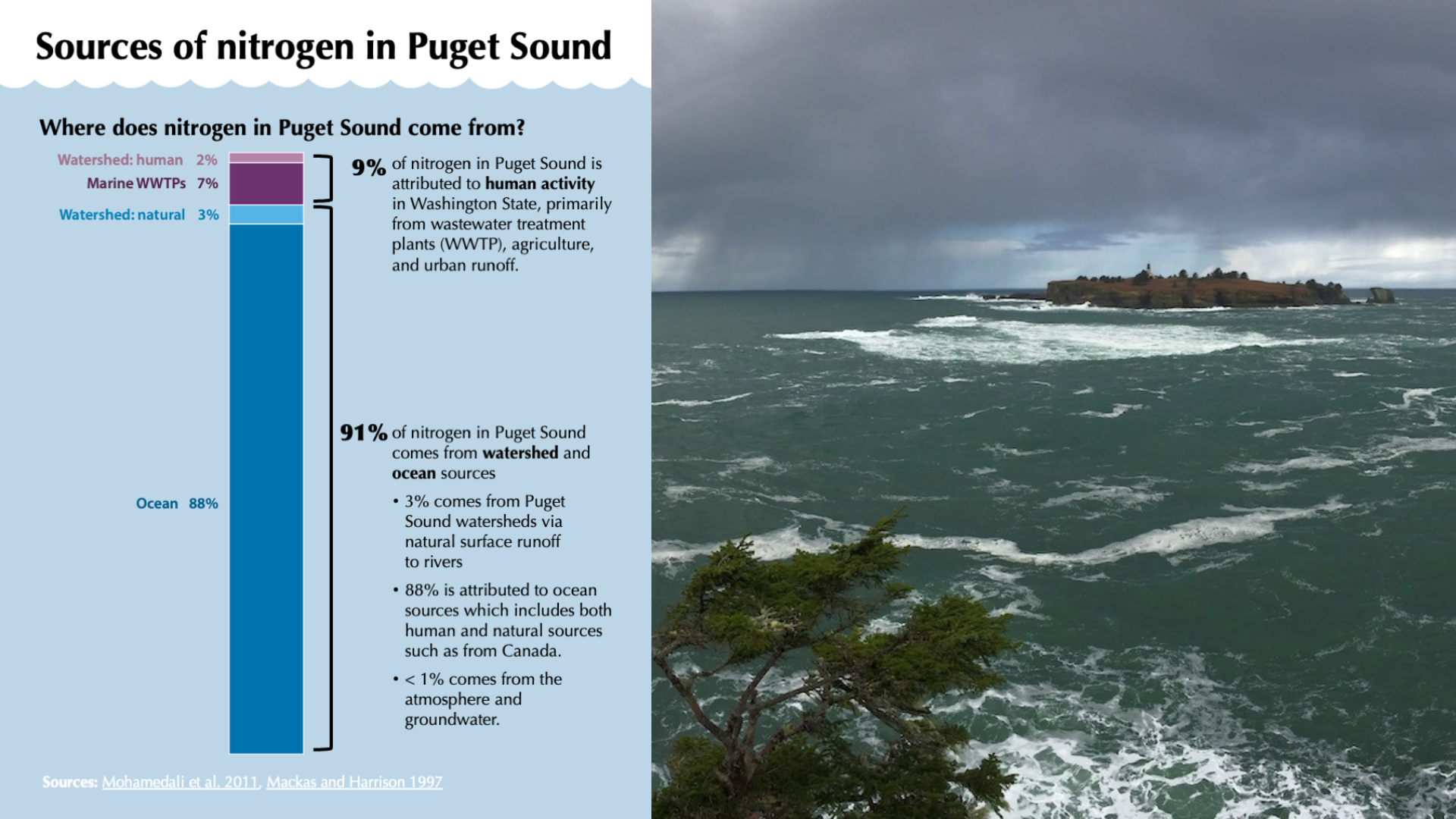
Although sewage-treatment plants get a lot of attention, they are not an original source of nitrogen. Rather, nitrogen arrives at the plants in wastewater and undergoes the same treatment process that kills bacteria and reduces a variety of contaminants in sewage. Most incoming nitrogen is from human waste, with 80 percent from urine. Food scraps, soaps and oils also contribute. Treatment plants that remove so-called "conventional pollutants" — such as solids and some organic matter — are not designed to remove nitrogen, so 70 to 90 percent passes through and into Puget Sound with treated effluent.
“Optimization” of conventional plants can significantly reduce nitrogen, according to studies, while advanced treatment, involving expensive nitrogen-removal systems, can eliminate up to 95 percent of the incoming nitrogen. After advanced treatment, most of the nitrogen ends up as a gas in the atmosphere, but some goes into biosolids, with a small amount released to the water.
Besides treatment plants, human sources of nitrogen include fertilizers, animal wastes and septic systems. These nitrogen compounds can wash off the land and into streams, eventually reaching Puget Sound.
Meanwhile, the largest source of nitrogen coming into Puget Sound by far—the ocean—is accounted for in the models, but it is largely considered background and beyond human control. Modeling studies have shown that, against this background, human sources of nitrogen are often the key to pushing portions of Puget Sound into unsafe levels of oxygen during certain times of the year.
In addressing the various sources of nitrogen, the Puget Sound Nutrient Reduction Plan divides Puget Sound into eight major “basins,” based on geography, circulation and other factors. Driven by the Salish Sea Model, the plan estimates how much nitrogen can be released into each basin without violating water quality standards. Planners then developed several scenarios based on these basin-wide “targets” and settled on one recommended option, largely because it “required a lower amount of nutrient reductions, relative to other scenarios, while achieving DO standards throughout the Sound…”
For each treatment plant within a basin, the plan has assigned a maximum nitrogen level, described as a “model input.” The document emphasizes that these “model inputs” cannot be directly incorporated into individual permits without further work.
"This work happens through the administrative process associated with developing and issuing permits, which includes public comment,” according to a focus sheet on the plan, which notes that a technical advisory committee will be formed to help develop actual nitrogen limits.
Despite that reservation, a comment about the plan from the EPA, written by watershed sections manager Jenny Wu, suggests that these “model inputs” for treatment plants should be considered a solid starting point. They should be labeled as “targets” or possibly “wasteload allocations” in order to “make clear that the plan is establishing targets for the individual point sources.”
“These loadings, after any adjustments or corrections based on public comment, should be translated into permit limits in the next permit cycle,” according to Wu’s letter, which was written before the Pollution Control Hearings Board’s ruling on the West Point plant. That decision, which implies the need for nitrogen limits at all treatment plants, could throw off the normal five-year permit cycle, as Ecology attempts to bring all permits into compliance.
The hearings board acknowledged in its ruling that required limits in permits need not be numerical constraints on the amount of nitrogen in effluent. Relevant laws allow treatment plant operators to follow “narrative effluent limits” in situations when “calculating a numeric effluent limit is infeasible.” Narrative limits often require treatment plants to be operated under “best management practices.”
Permits also must comply with Washington’s AKART provision, which stands for “all known, available and reasonable methods of treatment.” Courts have ruled that the most advanced treatment methods for removing nitrogen from effluent may not be “reasonable” because of cost, unless it can be shown that such treatment is necessary to meet water quality standards.
In a fact sheet (pdf) describing the revised nutrient general permit (now off the table), Ecology said the AKART provision has begun to evolve, as a result of increasing violations of dissolved oxygen standards throughout Puget Sound along with changes in technology.
“It is apparent that the agency must start to consider refining what constitutes AKART for this treatment category,” the document states. “The AKART provision needs evaluation on a case-by-case basis, given its direct ties to economic impact. What constitutes AKART at one facility may be different at the next.”
While the Salish Sea Model provides a basis for placing numeric limits on nitrogen discharges from the various treatment plants, AKART—with its considerations of technology and cost—could be an important factor in future permits. Since abandoning the general permit, Ecology has not yet declared a clear position on this evolving issue.
Low oxygen challenge series | |
|---|---|
| Scientists have spent years studying and debating the problem of low oxygen in Puget Sound. This four-part Salish Sea Currents magazine series looks back on how we have reached our present condition, including a consideration of possible solutions. |
Nutrient reduction plan or TMDL?
Under the federal Clean Water Act, “impaired” waters in violation of water-quality standards must be addressed with a cleanup plan, known as a TMDL, which stands for total maximum daily load.
The plan is called a TMDL because it includes an assessment of the maximum amount of a pollutant (load) that can be safely accommodated in a body of water. The plan also places limits (maximum loads) on individual sources of pollution, so that the total stays below the safe level. While the law requires a TMDL to address impaired waters, it does not say when such a cleanup plan must be done.
The Environmental Protection Agency and the courts have allowed reasonable delays in TMDL development when states undertake alternate cleanup efforts, such as an “advanced restoration plan.” The Puget Sound Nutrient Reduction Plan, which includes potential load allocations for various nitrogen sources, is considered an advanced restoration plan (ARP) by Ecology and the EPA. Ecology contends that the nutrient ARP will solve the low-oxygen problem quicker for Puget Sound than a formal TMDL.
“An ARP contains many of the same elements as a TMDL but provides more flexibility in how clean-up efforts are approached, with the goal of cleaning up water faster than a traditional TMDL…,” according to language in the plan. “This approach will not only allow us to move more directly to reducing nutrient pollution but also provide flexibility to those that need to make significant investments in pollution reduction.”
The plan states that its schedule of “measurable milestones” will make sure that Puget Sound meets water-quality standards by 2050. If Ecology falls behind schedule, the TMDL approach could be adopted at that future time, according to the plan.
Some organizations are calling for Ecology to conduct a TMDL for oxygen immediately, if not sooner. A lawsuit filed by Northwest Environmental Advocates says a TMDL should have been launched when portions of Puget Sound were first declared impaired for oxygen in the 1990s.
“In 1996, Ecology first listed 17 Puget Sound segments as impaired for dissolved oxygen,” according to documents filed by NWEA in federal district court. “That list has steadily increased, to 25 segments in 1998, 52 segments in 2004, 100 segments in 2008, and 141 segments in 2012. Today, there are currently 197 Puget Sound dissolved oxygen listings—an area over 63 square miles.”
The lawsuit asserts that the nutrient reduction plan, or ARP, has been used as a delaying tactic to avoid putting nitrogen limits into permits for sewage-treatment plants.
“The draft ARP, even if it were to become final as an ARP, is fatally flawed and has little chance of achieving anything but further delays,” according to NWEA’s final brief in the case, now moving toward a court hearing.
The lawsuit seeks a court order requiring the federal Environmental Protection Agency to take over development of a TMDL, saying Ecology’s failure to comply with a legal mandate for a TMDL justifies such action under the theory of “constructive submission.” The idea is that Ecology’s failure to act can be considered a submission of an inadequate TMDL, thus triggering a requirement that EPA take over the cleanup plan.
Taking Ecology’s side, EPA contends that Ecology has “a robust water-quality improvement program” that includes hundreds of TMDLs to address pollution problems, including TMDLs in portions of Puget Sound. Because of “limited resources,” the EPA states in its brief, many TMDLs remain uncompleted.
“Ecology is investing considerable effort and resources to address low DO conditions in Puget Sound and has not renounced its obligation to establish a TMDL,” says the EPA document, adding that the Clean Water Act allows states options for when and how to develop TMDLs. “No precedent supports finding a constructive submission based on alleged deficiencies in a functioning program absent a clear and unambiguous decision to abandon the TMDLs at issue.”
The nutrient reduction plan can be used to set limits on nitrogen at sewage-treatment plants and “will ultimately inform and expedite completion of the TMDL,” the EPA document says.
In a brief filed by Ecology, the agency says the Puget Sound Nutrient Reduction Plan should be considered a precursor to “numerous” future TMDLs to address the dissolved oxygen problem. With limited resources and other high-priority obligations under the Clean Water Act, Ecology argues that “an ARP, such as the PSNRP, is the more immediately beneficial, practicable, and defensible approach for bringing Puget Sound into compliance with applicable DO water quality standards.”
In comments on the nutrient reduction plan, Justin Parker, executive director of the Northwest Indian Fisheries Commission, said the nutrient reduction plan lays out a structure for implementation, but a TMDL would provide a “stronger backbone for accountability” and a “legally enforceable nutrient cap for Puget Sound.”
“These are not abstract water-quality problems,” said Parker, whose organization represents 20 Western Washington treaty tribes. “Nutrient pollution threatens not only water quality but the very foundation of salmon recovery and treaty-reserved rights.”
He suggests revisions to the nutrient reduction plan to reflect the full complexity of the Salish Sea food web while acknowledging historical and ongoing inequities.
“For tribal nations in the Puget Sound region, the health of the water is directly tied to the health of our people, our cultures and our economies,” Parker said. “Reducing nutrient pollution in Puget Sound is essential — not only for the health of the ecosystem, but for the continued exercise of tribal treaty rights, the vitality of our communities, and the survival of salmon and shellfish that define this region.”
This article was funded in part by King County in conjunction with a series of online workshops and research exploring Puget Sound water quality issues affecting wastewater management. Its content does not necessarily represent the views of King County or its employees.