Eyes Over Puget Sound

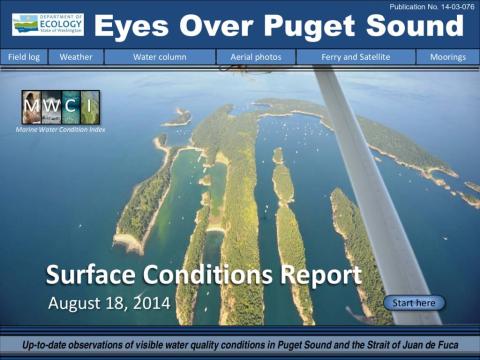
The Washington State Department of Ecology distributes a monthly report combining high resolution aerial photographs with satellite and ground-truthed monitoring data for Puget Sound surface conditions.

Visit the Eyes Over Puget Sound website

Overview

Once a month, Washington State Department of Ecology marine scientists take to the air to obtain high-resolution aerial photo observations and gather water data at the agency's monitoring stations and via state ferry transects. This provides a visual picture of the health of Puget Sound, which they call Eyes Over Puget Sound or EOPS.

The float plane prepares to take off. Photo by Jeff Rice for the Encyclopedia of Puget Sound.

Related Articles

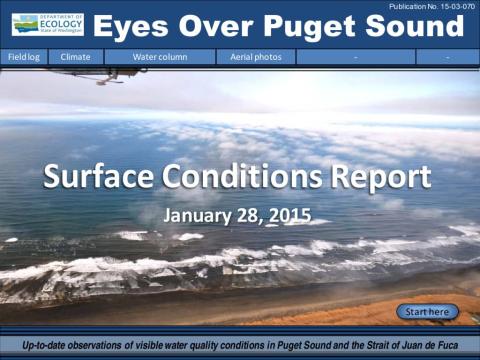
Warm air and water temperatures and offshore winds have persisted since fall. Numerous and sizable jelly fish patches are still present in southern inlets of Puget Sound. Coastal waters were colored in shades of gray to brown by sediment and humic substances. Phytoplankton blooms were restricted to the surf zone. We were treated to artful views of meandering sloughs and gullies on exposed mud flats during low tide in Willapa Bay, interspersed with the geometry of shellfish management. Brown pelicans: a story of recovery.
The year 2014 in pictures: In 2014, Puget Sound and Hood Canal behaved distinctly different in temperature and dissolved oxygen. In Puget Sound, generally warmer conditions, abundant and diverse algal blooms, and large pools of organic material persisted along with lower oxygen, high jellyfish abundances, and a lot of suspended sediment. On the other hand, Hood Canal was colder, more oxygenated, and algae blooms were rare. People and planes: past and present.
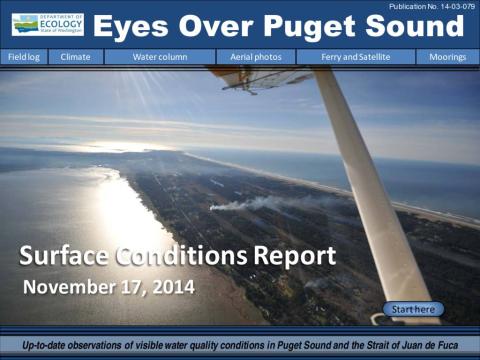
A recent cold spell hits Puget Sound lowlands, interrupting this year’s warmer air temperatures. The warm ocean coincides with new maximum water temperatures observed throughout Puget Sound in October! Hood Canal’s higher dissolved oxygen and cold water anomalies are disappearing. November brings cold water from Whidbey Basin into Puget Sound with moderate levels of chlorophyll fluorescence. Abundant smacks of jellyfish in finger inlets of South Sound observed from our flight. Red-brown blooms remain strong in smaller bays of South Sound. Visible suspended sediments in the coastal estuaries from rain, wind, and waves. Playing in the water? Visit our BEACH program.
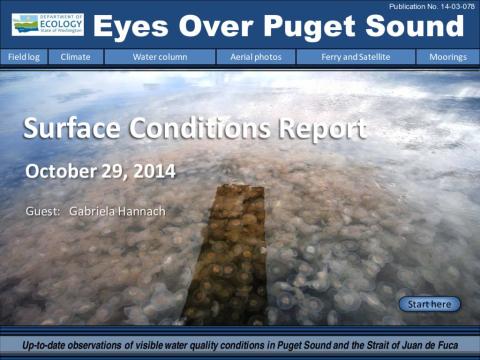
At the end of summer, water temperatures are still high, and salinities and dissolved oxygen are low in Puget Sound. Both sea surface temperature and upwelling off the coast are elevated (PDO and Upwelling indices) and the the Fraser River flow is low. This combination makes it an interesting fall. Very dense and large patches of jellyfish appear in finger inlets of South Sound. Red-brown blooms also remain strong in South Sound.
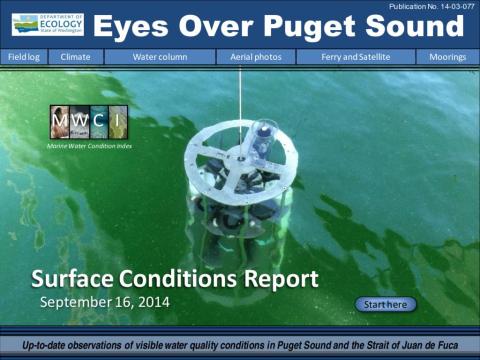
Sunshine and warmth continue into September. Upwelling is higher, yet low Fraser River flow reduces the likelihood of low-oxygen water moving into Puget Sound. Dissolved oxygen remains relatively high in Hood Canal and is lower elsewhere. Satellites show relatively warm water in the Strait of Georgia and Whidbey Basin and an extensive offshore bloom. Water temperatures also remain high in South Sound were red-brown plankton blooms and large smacks of jellyfish adorn the water surface. Explore what frequent blooms in smaller bays can tell us.
Sunshine and warm temperatures return after last week’s intense rain. The Puyallup and Nisqually Rivers are flowing high. Red-brown blooms and numerous patches of jellyfish remain strong in South Sound, Sinclair and Dyes Inlets, and Bellingham Bay, with brown-green blooms in Whidbey Basin. Macro-algae surface debris is very high in South and Central Sound. Hood Canal remains cooler but Puget Sound-wide temperatures are now warmer and less salty. Sea surface temperatures are above 15 °C, conditions favorable for some pathogens, and harmful algae blooms. Read about super colonies of by-the-wind sailors washing up on our shores.