Eyes Over Puget Sound

The Washington State Department of Ecology distributes a monthly report combining high resolution aerial photographs with satellite and ground-truthed monitoring data for Puget Sound surface conditions.

Visit the Eyes Over Puget Sound website

Overview

Once a month, Washington State Department of Ecology marine scientists take to the air to obtain high-resolution aerial photo observations and gather water data at the agency's monitoring stations and via state ferry transects. This provides a visual picture of the health of Puget Sound, which they call Eyes Over Puget Sound or EOPS.

The float plane prepares to take off. Photo by Jeff Rice for the Encyclopedia of Puget Sound.

Related Articles

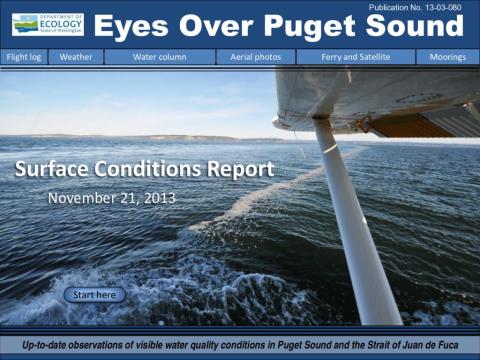
Air temperatures have fallen due to unusually weak northern winds bringing in cold air. A dry beginning to winter causes low river flows. This dry winter brings new Puget Sound conditions with colder saltier waters observed in the northern regions. Oxygen has stabilized again within expected ranges. Suspended sediments along wind and wave exposed beaches add artful brushstrokes to the Puget Sound waterscape. Jellyfish are still going strong in Eld Inlet. Oil seen leaking from a boat in Commencement Bay and Ecology’s Spills Program responds. Our intern, Clifton, brings renewed passion to monitoring!
The year 2013 in pictures: Low oxygen conditions persisted from January into August and broke a two-year anomaly of more favorable water quality conditions (lower temperature and salinity and higher dissolved oxygen). Dramatic Noctiluca blooms appeared one month earlier than normal (May), lasted for two months, and coincided with lower oxygen. Large jellyfish patches persisted over the winter but then were less visible for the rest of the year. Large drifting algal mats appeared in August.
After weeks of clouds and warmer air, blue skies and cold temperatures set in. Strong tidal fronts and sediment-rich brackish plumes leave Whidbey Basin and move into Admiralty Reach. A pod of Orcas follows the edge of the plume heading north! Red-brown blooms continue in Henderson, Eld, and northern Budd Inlets. Long organic debris lines are numerous in northern Budd Inlet, Hood Canal, and in Central Sound north of Edmonds (Triple Junction). Conditions in the water column in Puget Sound continue to normalize after seven months of lower oxygen. Water is very clear for this time of the year, particularly in the north.
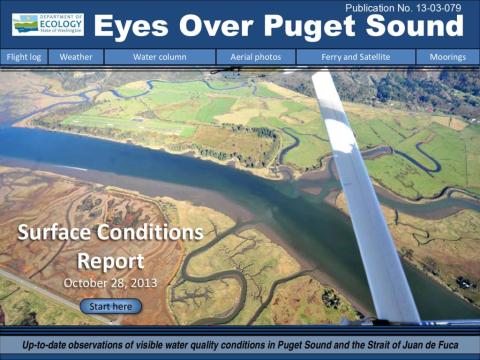
Puget Sound conditions are normalizing after seven months of lower oxygen. Calm, dry, cool, and foggy mornings abruptly changed on October 28 to sun and strong northerly winds. Red-brown blooms and abundant jellyfish in south Puget Sound inlets appeared as we flew to the coast. Blooms were still visible near ocean beaches and inner bays. Grays Harbor had abundant surface debris with green algae in North Bay. We spotted red-brown blooms in rivers and sloughs in Willapa Bay, as well as schooling fish near sandbanks. Many patches of suspended sediment appeared in shallow water unrelated to tidal currents and remain unexplained.
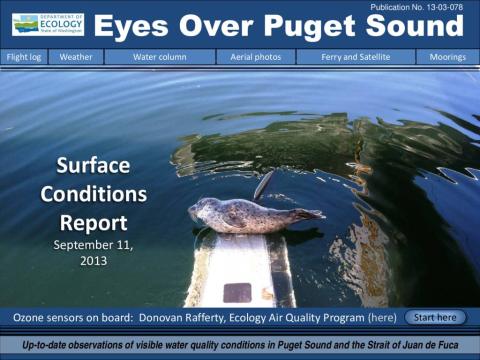
Sun and high air temperatures warrant en route ozone measurements for model validations. A furry visitor takes a rest on the float plane. See the spotlight on our pilot, Joe Leatherman. High river flows lead to striking fronts of turquoise-colored water carrying glacial flour in many northeastern regions. Satellite and aerial images show widespread phytoplankton blooms in Whidbey Basin, Hood Canal, South Puget Sound, and West Bay of Orcas Island. Numerous large debris patches are observed in Hood Canal, Central Sound, and South Sound Inlets. After two years of colder temperatures and higher oxygen, Puget Sound waters are returning to expected or lower dissolved oxygen levels.
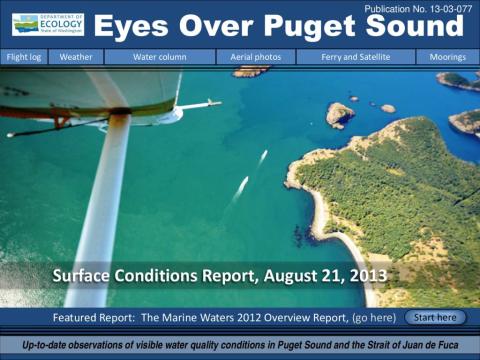
Warm air temperatures and increases in flows from glacier-fed rivers give rise to dramatic images in the San Juan Islands. Warm surface temperatures in South Sound foster abundant red-brown blooms in southern inlets. Similar blooms are happening in the inlets of the Kitsap Peninsula. Large drifting algal mats in Central Sound, Sinclair Inlet, Hood Canal and Padilla Bay will likely end up on nearby shorelines soon. Jellyfish abundance has dropped. This year, dissolved oxygen levels in Puget Sound waters quickly decrease to levels of the previous decade.