Eyes Over Puget Sound

The Washington State Department of Ecology distributes a monthly report combining high resolution aerial photographs with satellite and ground-truthed monitoring data for Puget Sound surface conditions.

Visit the Eyes Over Puget Sound website

Overview

Once a month, Washington State Department of Ecology marine scientists take to the air to obtain high-resolution aerial photo observations and gather water data at the agency's monitoring stations and via state ferry transects. This provides a visual picture of the health of Puget Sound, which they call Eyes Over Puget Sound or EOPS.

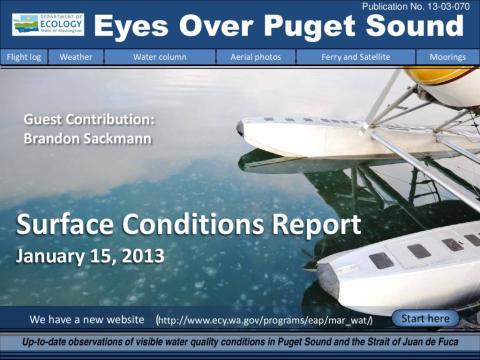
The float plane prepares to take off. Photo by Jeff Rice for the Encyclopedia of Puget Sound.

Related Articles

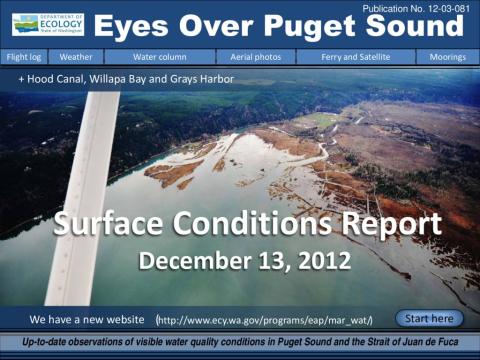
The weather has been relatively cloudy, warm and dry. We found less debris in the water but saw several large tidal eddies and suspended sediment plumes. Jellyfish continue to go strong this winter. We also observed early algae blooms in Hood Canal and Eld Inlet as well as multiple oil sheens in Seattle waterways. Listen to our marine flight technician discuss EOPS on the radio.
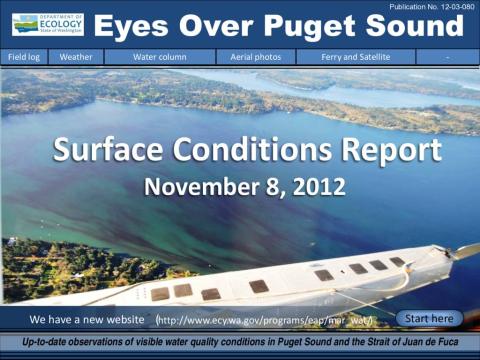
The pattern of colder and fresher Puget Sound water persists. Jellyfish aggregations continue to persist in Budd Inlet. Debris lines are numerous and long. There are multiple oil sheens in Seattle waterways. CDOM (colored dissolved organic matter) sensor and en route ferry thermosalinograph provide an important tracer for freshwater entering Puget Sound from Whidbey Basin.
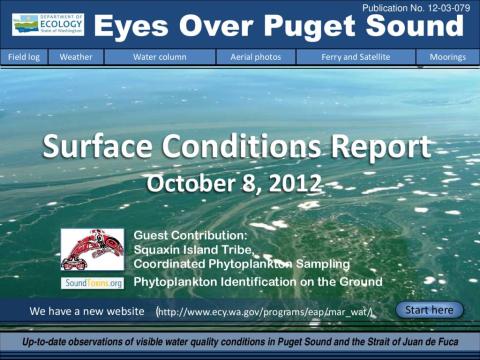
The weather has been warm, cloudy with weak winds from the south. Surface water temperatures range from 8.5-9.5°C. River flows are dropping below expected levels, yet the seasonal increase in freshwater can be clearly seen. Debris lines are numerous near river estuaries. Algal biomass is down but jellyfish aggregations continue to go strong in terminal inlets.
Temperatures range from 9-11°C. Red-brown blooms and jellyfish continue in terminal inlets. Low fluorescence throughout Central Sound and Admiralty Inlet. Since 2011 much colder and much fresher and oxygen levels are up.
Low to moderate fluorescence in northern Puget Sound. Red-brown blooms, and large jellyfish aggregations in the inlets of South and Central Sound. Dry weather and decreased thickness of the freshwater layer in Possession Sound.
River flows are below normal. Temperatures in Puget Sound are 12-14 °C. Extensive red-brown blooms in Inlets of South and Central Sound. Jellyfish are increasing in numbers. Low-moderate fluorescence in Central Sound. In Possession Sound dissolved oxygen decreased by 1.1 mg/L.