Species of concern

Species of concern are native species, sub-species or ecologically significant units that warrant special attention to ensure their conservation. The number of species of concern within the Salish Sea is used by the US Environmental Protection Agency and Environment Canada as a transboundary ecosystem indicator (called "Marine Species at Risk"). 

Source

Zier, Jacqlynn and Gaydos, Joseph K. (2016). The growing number of species of concern in the Salish Sea suggests ecosystem decay is outpacing recovery. Proceedings of the 2016 Salish Sea Ecosystem Conference, April 13-15, 2016
Vancouver, BC. 17 pgs.

Overview

The number of species of concern in the Salish Sea is growing at an average annual rate of 2.6%, according to a report published in the proceedings of the 2016 Salish Sea Ecosystem Conference in Vancouver, B.C.

The Tufted Puffin is among 125 species of concern found in the Salish Sea. Photo: Peter Hodum.

Related Articles

An intensive research program in the U.S. and Canada is studying why so few salmon in the Salish Sea are returning home to spawn. They are uncovering a complex web of problems involving predators, prey and other factors that put salmon at risk as they migrate to the ocean. We begin a four-part series on the Salish Sea Marine Survival Project, including new findings presented at the 2018 Salish Sea Ecosystem Conference last spring in Seattle. 

As wildlife managers work to recover Puget Sound’s diminished Chinook population, a proposed white paper is expected to review the impacts of some of the salmon's chief predators. The study would include a section on potential management of seals and sea lions, prompting open discussion of a long taboo subject: Could officials seek to revise the Marine Mammal Protection Act — or even conduct lethal or non-lethal removal of seals and sea lions in some cases? Such actions are hypothetical, but we look at some of the ongoing discussions around the issue as prompted by a new resolution from the Puget Sound Leadership Council. 

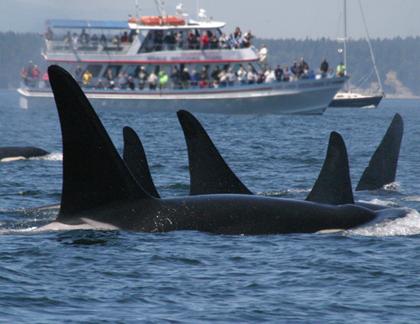
A December 2017 article in the journal PLOS One reports that incidents and violations among whale watching vessels have increased in the Central Salish Sea since 1998.

Increased consumption of Chinook salmon by seals and sea lions in the Salish Sea “could be masking the success of coastwide salmon recovery efforts,” according to a new study published in the journal Scientific Reports. Endangered resident orcas are said to be declining in part due to a lack of available Chinook, the orcas' preferred prey.

Formaldehyde is often used to control parasites on hatchery salmon and trout. The U.S. Environmental Protection Agency and the Washington State Department of Ecology conducted a joint study of formaldehyde concentrations in effluent from hatcheries in the Pacific Northwest. 

In recent decades, hundreds of millions of dollars have been spent to restore habitat for Puget Sound salmon. In this article, we look at how scientists are gauging their progress. Are environmental conditions improving or getting worse? The answer may depend on where you look and who you ask.