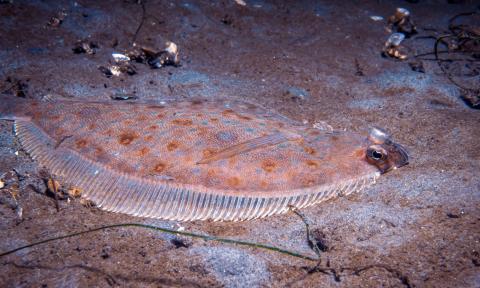
A new report from the Puget Sound Institute and the University of Washington School of Aquatic and Fishery Sciences examines a species-level approach to oxygen risks in Puget Sound. Case studies of Dungeness crabs, English sole, and Chinook salmon provide new details on when and where individual species may be most vulnerable. Funding for this article is provided in part by King County.
The Washington State Department of Ecology is responding to new legal rulings and public concerns with changes in planning and potentially future enforcement. We continue our occasional series on water quality and wastewater management in Puget Sound. Funding for the series is provided in part by King County.
Low dissolved oxygen levels put aquatic life in Puget Sound at risk – but not everywhere. A combination of careful monitoring efforts and powerful computer models are now enabling scientists to identify which areas of our regional waters are most prone to low oxygen levels, when, and why. This article is part of a series of reports funded by King County about the quest to define healthy oxygen levels in Puget Sound.
Diverse communities of microscopic organisms called phytoplankton make up the base of the aquatic food web. In that role, they are essential to the tiny animals that eat them, but phytoplankton are not dependent on others. Thanks to chlorophyl, these tiny organisms can generate their own energy from nutrients and sunlight. Despite their critical importance to a great diversity of sea life in Puget Sound, phytoplankton can also contribute to low-oxygen conditions, and some can be harmful in other ways.
Years after the appearance of the devastating marine heat wave known as "the blob," scientists are still working to understand how it has affected the Salish Sea. In some ways, they say, it is like the blob never left.
Chemicals, disease and other stressors can increase a salmon's chance of being eaten or reduce its ability to catch food. We wrap up our series on the Salish Sea Marine Survival Project with a look at some of the lesser-known, but still significant factors contributing to salmon declines in the Salish Sea.
As the region's population grows, scientists say we can expect to see increasing amounts of nitrogen and other elements flowing into Puget Sound. Known as “nutrients” these elements are naturally occurring and even necessary for life, but officials worry that nutrients from wastewater and other human sources are tipping the balance. That could mean big problems for fish and other marine life, gradually depleting the water of oxygen and altering the food web.
A regional sewage-treatment system in Thurston County has helped contain low-oxygen problems in Budd Inlet as the population continues to grow. The system cleans up some of the effluent for replenishing groundwater supplies.
High amounts of elements such as nitrogen can cause blooms of phytoplankton that sometimes trigger perturbations throughout the food web. This occurs most often in the spring and summer after the long, dark, cloudy days of winter begin to fade.